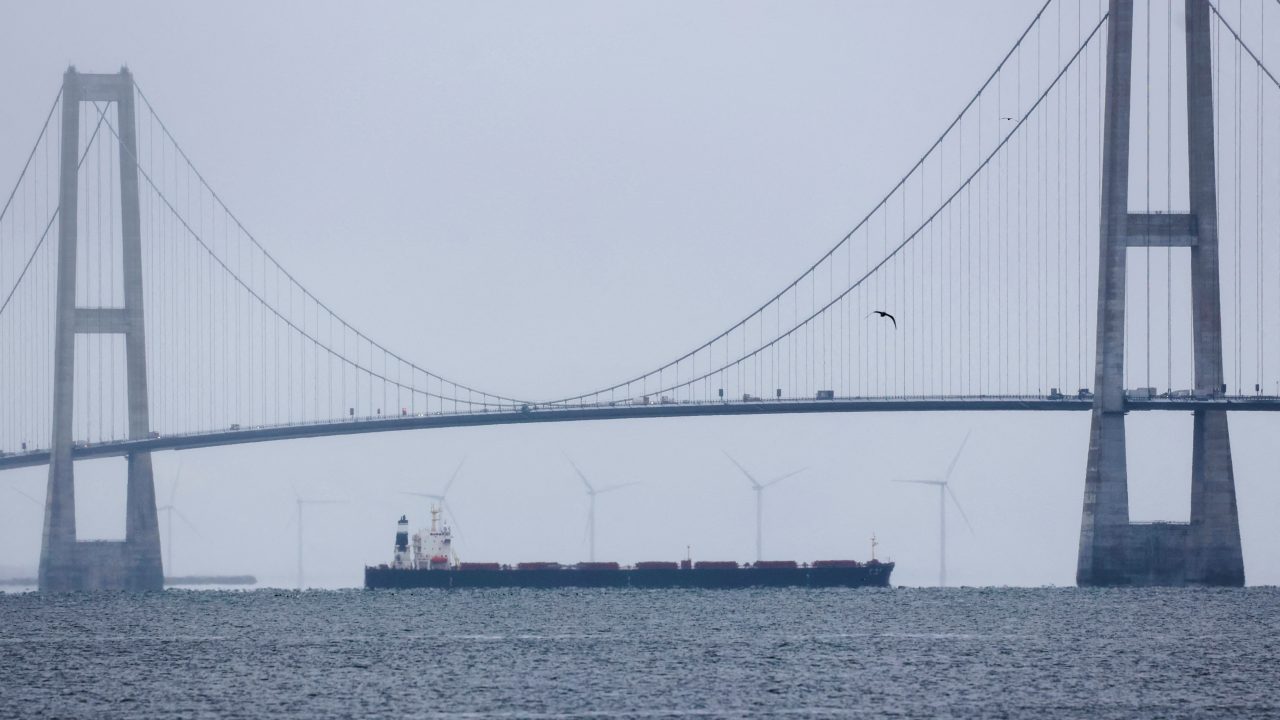
On Sunday an undersea communications cable linking Lithuania and Sweden through the Baltic Sea stopped working. Then early on Monday morning, the same thing happened to another cable that links Finland and Germany. These cables are two of many that allow the transmission of huge volumes of data and internet traffic. So what happened to them?
It is relatively common for the undersea fiber-optic cables that link different countries or landmasses to be damaged by shipping, especially by fishing boats. Some 150 to 200 are accidentally damaged every year. However, two cables being damaged in 24 hours has raised eyebrows.
Last year, in October, two other cables which link Estonia with Finland and Sweden were also damaged or severed, as well as a natural gas pipeline from Estonia to Finland. It was eventually established that a Chinese container ship had dragged its anchor across all three.
Baltic countries are now seeking to establish whether another Chinese ship was involved in this week’s incident.
Taiwan has had its own experiences with Chinese cable interference. Last year, the outlying Matsu islands had their internet slowed to a standstill after Chinese ships severed the two data cables that provide the islands with their main source of communications.
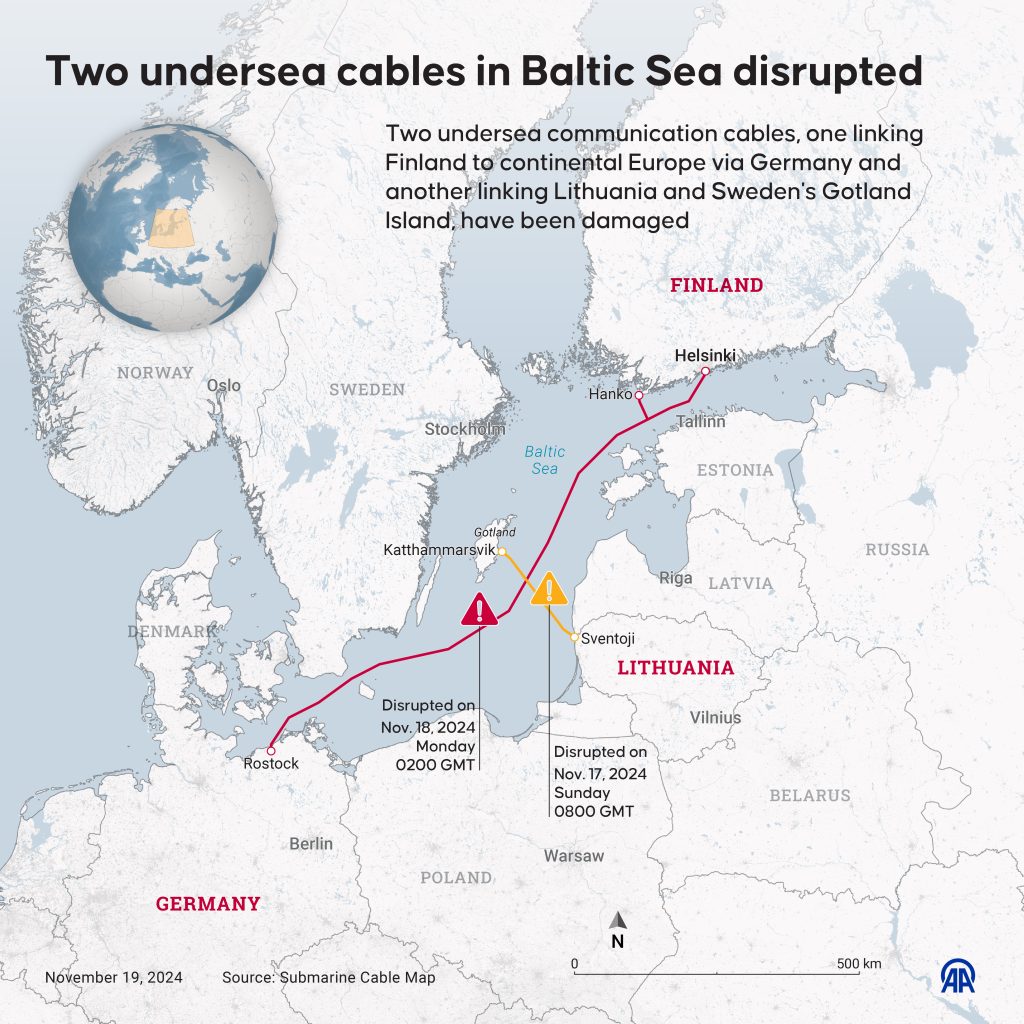
Obviously, the damage to the two cables this week is a developing story, but there are things that are already established. Both cables have either stopped working or been severed entirely. The two cables run almost perpendicular to each other. The suspected site of damage for the Germany-Finland cable is hundreds of kilometers away from the intersection point, and indeed any part of the Sweden-Lithuania cable. This is one reason to doubt that the damage is accidental.
According to reporting from the Financial Times, on Monday German defense minister Boris Pistorius said that: “No one believes that these cables were cut accidentally . . . Therefore we have to state, without knowing specifically who it came from, that it is a ‘hybrid’ action. And we also have to assume, without knowing it yet, that it is sabotage.”
Suspicion has fallen on the Chinese bulk carrier Yi Peng 3, which was in proximity to both cables at the times they were damaged. The ship is currently stationary in Danish waters, and the Danish military has confirmed that they are present in the area near to the ship. It is not clear whether Danish personnel have boarded the ship, or whether the ship is in some sense detained.
Swedish police have also said that they are interested in the Yi Peng 3. Both breaches happened in Sweden’s Exclusive Economic Zone, and Reuters reports that Sweden has started a preliminary investigation into possible sabotage.
There have been multiple reports that the Yi Peng 3 has a Russian captain, however the Guardian spoke to Russian maritime pilot Alexander Stechentsev, who had guided the ship out of Ust-Luga, a Russian port near Estonia. He said the crew were Chinese nationals.
European authorities may be keen to avoid a repeat of what happened after last year’s October cable damage incident. By the time that Finnish and Estonian authorities identified the Chinese ship Newnew Polar Bear as a “ship of interest,” it was long gone. China carried out its own investigation and found that the Newnew Polar Bear was indeed responsible. It submitted a report to the Finnish and Estonian governments.
According to the South China Morning Post, the report said the accident was the result of a strong storm. However, according to Finnish media, via Voice of America, Markku Mylly, the former director of the European Maritime Safety Agency, said there were no storms in the Gulf of Finland at the time. Voice of America further reported that the Finnish newspaper Iltalehti consulted data from the Finland Meteorological Institute and confirmed this.
Estonian defense minister Hanno Pevkur said in response to the report that “Personally, I find it very difficult to understand how a ship’s captain could fail to notice for such a long time that its anchor had been dragging along the seabed,” in an interview with Estonian media ERR.
Unlike in the two Baltic incidents, the two cables that Matsu relies on were not severed on the same day. Rather, two separate incidents took place six days apart in early February 2023. Taiwan’s National Communications Commission blamed the first incident on a Chinese fishing vessel and the second on a Chinese cargo ship. However, the Taiwanese government has never officially accused Beijing of carrying out a deliberate attack.
In reporting by the Taipei Times, National Communications Commission spokesman Wong Po-tsung (翁柏宗) pointed out that it is relatively common for cables linking different islands in the Matsu archipelago to be damaged, but “unusual” for the same thing to happen to a cable linking them all to the main island of Taiwan, which is some 200 kilometers away.
Without both cables, Matsu’s internet slowed to a crawl, which was a huge inconvenience for the residents of the islands, who found it difficult to communicate with the outside world. It also raised the specter that all of Taiwan, which is heavily reliant on 14 data cables, could suffer the same fate if China decided to conduct a concerted gray-zone attack on its communications infrastructure, although just how “gray” such an attack would be is obviously debatable, as Domino Theory has previously discussed.
Writing in the Diplomat after the first cable was repaired, the then Democratic Progressive Party’s (DPP) local chapter head Lii Wen (李問) said that because Taiwan does not have its own cable repair ship, it had to wait until one was available internationally. He also described how Taiwan had used a backup microwave communications system to provide limited internet to Matsu while waiting for repairs.
Domino Theory spoke to Joe Lee (李哲宇) who is the current DPP Matsu chapter head, and asked what Baltic countries can learn from Matsu’s experience. He said that Matsu is adding a third cable, which will be completed in 2026, and he confirmed that upgrades to the backup microwave system announced last year have been completed. Lee also says that there should be more penalties on those who damage cables, giving the example of arresting and fining the ships’ crews responsible.
It remains to be seen whether the Yi Peng 3 is indeed responsible for the latest cable breaches, and indeed what the European countries affected, and Denmark, will do if they establish that while the ship is still in Danish territory. It could be yet more troubled waters in the European-Chinese relationship.
One man who appears to have already made his mind up is the outgoing Lithuanian Foreign Minister Gabrielius Landsbergis, who wrote the following post on X:
“If I had a nickel for every time a Chinese ship was dragging its anchor on the bottom of the Baltic Sea in the vicinity of important cables I would have two nickels, which isn’t much, but it’s weird that it happened twice.”






Leave a Reply