
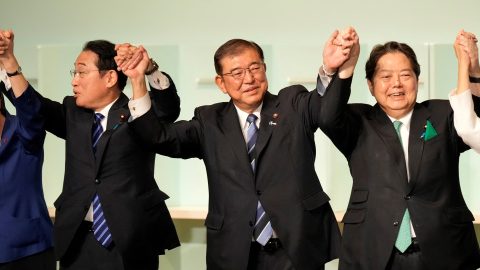
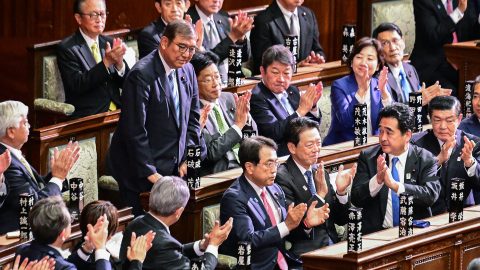
In Japan’s Liberal Democratic Party (LDP) leadership election on October 4, Sanae Takaichi, a conservative former economic security minister, won with strong support from party lawmakers and members. She is set to become Japan’s first female prime minister, succeeding Shigeru Ishiba, who resigned amid scandals and low approval ratings.
Takaichi is considered very friendly towards Taiwan. She visited Taipei in April, meeting with Taiwanese President Lai Ching-te (賴清德), as well as former President Tsai Ing-wen (蔡英文). In July, Takaichi was photographed meeting with Taiwanese Foreign Minister Lin Chia-lung (林佳龍), who was on an unpublicized visit to Japan.
Takaichi is a “loyal friend of Taiwan,” President Lai said on X, as he congratulated her on her victory. He added that he hoped Taiwan and Japan would deepen exchanges and cooperation, elevate Taiwan-Japan relations to a new stage and contribute to the security and stability of the Indo-Pacific region.
“Taiwan is an extremely important partner and a valued friend for Japan,” Takaichi herself said in an interview with the Hudson Institute during her election battle.
Takaichi is a protege of former Prime Minister Shinzo Abe. She entered politics in 1993 as an independent, joined the LDP in 1996 and has won 10 terms in the House of Representatives. She has served as economic security minister, state minister for trade and industry, and a record tenure as internal affairs and communications minister. Takaichi supports constitutional changes to strengthen the military and opposes same-sex marriage and maiden name retention for married women.
During Takaichi’s visit to Taiwan in April, she called for a “quasi-security alliance” between Japan, Taiwan and other democratic countries, framing the proposal in a world where U.S. security guarantees are no longer seen as cast iron. Both Japan and Taiwan “need to strengthen their respective self-defense capabilities,” she added.
Takaichi held a much-publicized video call with then President Tsai in 2021, at a time when travel between Japan and Taiwan was difficult because of the pandemic. Takaichi’s backdrop drew attention because she had hung the flags of both Japan and Taiwan behind her. Takaichi was in the middle of a previous, unsuccessful bid for the presidency of the LDP.
“Takaichi does not have adequate understanding of Taiwan’s situation, but she is on the pro-Taiwan side,” said Tsuyoshi Nojima, a former Asahi Shimbun Correspondent in Singapore and Taiwan who is currently a specially appointed professor at Japan’s Daito Bunda University. He pointed out that when Abe said “a Taiwan contingency is a Japan contingency” he had already stepped down as prime minister.
Takaichi comes from the conservative wing of the LDP. Her victory is seen partly as a response to the recent electoral success of the populist right-wing Sanseito party. She has long argued for Japan to spend more on defense and to change its constitution to rename Japan’s Self-Defense Forces as National Defense Forces, further normalizing them away from being a pacifist force.
Takaichi’s political hero is Margaret Thatcher, the conservative who was the U.K.’s first female prime minister. Now, she will follow in Thatcher’s footsteps. But perhaps her greatest influence was Shinzo Abe, who served as Japan’s prime minister throughout the 2010s before being assassinated in 2022.
Abe passed legislation removing the constitutional prohibition on Japanese forces fighting overseas and, with Trump in his first term, revived the Quad mechanism between Japan, the U.S., Australia and India. He was also a staunch supporter of Taiwan. After his death, Taiwanese government buildings flew flags at half-mast, and then Vice President Lai flew to Tokyo to pay respects, the highest-ranking Taiwanese visit to Japan in 50 years.
There is even a statue of Abe at a temple in Kaohsiung, and a Shinzo Abe Research Center at National Chengchi University in Taipei, inaugurated by President Lai, who praised it as a key platform for enhancing Taipei-Tokyo ties amid regional tensions.
While Takaichi’s connection to Abe will be music to Taipei’s ears, it may cause problems elsewhere, including Seoul and Beijing. Japanese conservatives who hold revisionist views about Japanese war crimes in World War II have long been a thorn in the side of positive relations with South Korea.
In particular, it would be a major issue if Takaichi visited the Yasukuni Shrine, where Japanese war dead, including war criminals, are honored. Takaichi visited the shrine this year, but declined to say whether she would do so as leader. No sitting Japanese prime minister has done so since Abe in his first year.
Takaichi expressed support for the Japan-U.S.-Korea partnership. “Japan’s maintenance of strong ties with South Korea promotes regional stability and enables Takaichi to pursue her diplomatic strategies effectively,” said Nojima. “Robust Japan-South Korea relations serve as an indispensable diplomatic pillar in Takaichi’s policy domain and it could ultimately bolster Japan’s influence across the region.”
Takaichi has generally been seen as a strong China hawk. She generally seems to cast China as a threat, but, when asked about the Taiwan issue, she said that she wants to “engage in solid and candid dialogue with Chinese leaders”. Under Abe, Japan-China relations were stable even if they were not good, according to Satoru Nagao, nonresident fellow at the Hudson Institute.
The coalition formed by the LDP and Komeito currently lacks a majority in both the House of Representatives and the House of Councilors. Takaichi must secure support for the prime minister’s nomination in the Diet and forge alliances with the opposition. U.S. president Donald Trump will visit Japan at the end of this month, meaning her foreign policy will also get an early test.
Japan’s approach to Taiwan did not change a lot in the three leadership transitions Tokyo experienced since 2019. From Taipei, there is the perception of a constant upward trend, especially in the security sphere. Nagao expects that Takaichi will promote Japan-Taiwan relations more actively. Japan did its first Taiwan strait transit in the modern era under Fumio Kishida, and several more have taken place under current prime minister Ishiba.
On Friday, it was revealed the Japanese and Taiwanese coast guards conducted a joint exercise off Okinawa in June. Japan News said the two vessels involved “simulated a maritime rescue operation,” and reported that “the two sides are planning to conduct regular joint drills” in the future.




Leave a Reply