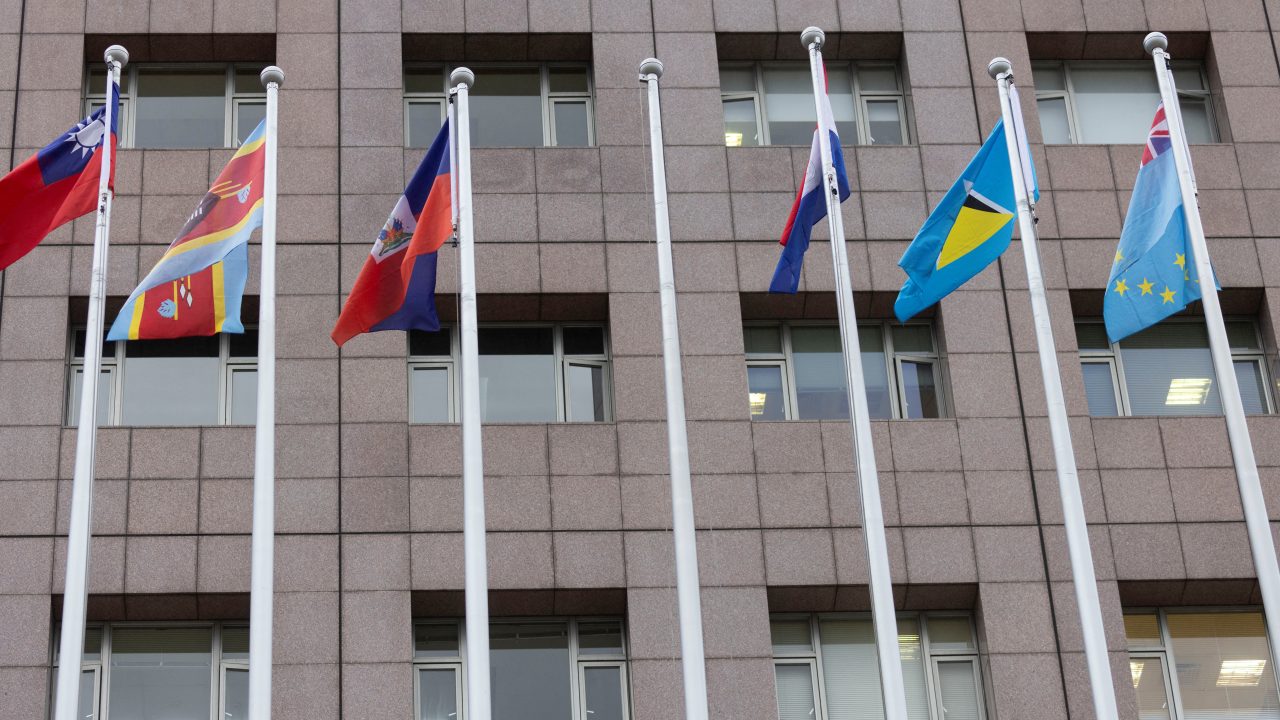
Remember Liz Truss, the famous China hawk and 44-day prime minister of the United Kingdom? Remember her publicly urging her country’s subsequent leader, Rishi Sunak, to declare China as an official threat and her rallying of the West to decouple from Beijing during a visit to Taiwan in May 2023?
Well, money talks. Not only was Truss paid over $100,000 by the Taiwanese government and a think tank in the country for her five-day Taipei trip, during which she made some of the above comments, but, a little over two months later, in private communications that have just surfaced through a freedom of information request, she was helping the other side, too.
Truss secretly requested the U.K.’s business and trade secretary, Kemi Badenoch, to expedite the sale of demining equipment to the Chinese military, a move that could increase its ability to invade Taiwan. The deal, which remains under review, will potentially deliver millions to Richmond Defence Systems, a company in her constituency, if it eventually goes through.
Justifying her position on the grounds that China would reverse engineer the technology anyway, logic that could be applied to approve the sale of literally anything to the People’s Liberation Army, Truss ignored the fact that learning to make something oneself takes time, the very commodity that Taiwan desperately needs to solidify its defenses. She also appears to have undermined U.S. policy of transferring mine-laying equipment to Taiwan.
But the U.S. brings up another topic itself. Remember COVID-19? You know, the disease that collapsed the global economy, led to nearly 15 million global deaths in 2020 and 2021 alone and continues to add to hospital workloads to this very day? Remember the pain, fear and panic of pandemic and lockdown? Remember the furious debate on just how much China knew about the virus as it began its killing spree in Wuhan and the praise it received from the World Health Organization for its handling of the crisis?
It now transpires via the Wall Street Journal that a Chinese scientist identified as Lili Ren (任麗麗) had almost completely sequenced the virus and uploaded it to the GenBank database run by the U.S. National Institutes of Health by December 28, 2019, a full fortnight before such information was made available to the global scientific community, long in advance of confirmation about its infectiousness and still when the WHO was in the dark about the outbreak. Because, for reasons unknown, Ren did not answer follow-up questions that are part of standard procedure, the sequence was then deleted on January 16, 2020.
This makes evidentially certain what has long been so emphatically beyond reasonable doubt that it is almost mundane to say aloud: China knew far more about COVID, such as that it was a coronavirus, far earlier than it claims. Its reticence to share both delayed the global response, including vaccine development, and inhibited scientific understanding of the pathogen’s origins.
But, then, Beijing is not the only one that has been concealing vital knowledge from the public: The NIH has had these details in hand for four years, and they have only come to light after the U.S.’s House Energy and Commerce Committee threatened it with a subpoena. Why exactly has it been letting everybody argue back and forth about the extent and starting point of China’s lies while holding back such a key piece of evidence? It cannot be that nobody had noticed the significance of Ren’s December 19 contribution all the way up to the present day.
What unites these two cases — Truss and the NIH — is a democratic deficit: On the one hand, both display an inexplicable ambivalence to helping the Chinese Communist Party sustain its power and even, with the former, expand its rule to Taiwan. On the other, they deprive respective electorates on each side of the Atlantic of crucial knowledge. Indeed, as per Politico, which reported Truss’s arms-to-China support, the main concern from the U.K.’s aforementioned business and trade secretary appears to be that the communication has reached the public realm.
The cases also indicate that countries and figures most strongly associated with assertiveness towards Beijing can sometimes be far more equivocal in act than they are in speech. While this has long been obvious in the field of economics, it is disturbing to see it extended to public health and the defense of democracy.
Furthermore, these are not the only spheres: As China’s intention clarifies to sprinkle Earth’s orbit with 26,000 satellites forming Starlink-like networks with probable military and surveillance uses, its collaboration with the European Space Agency has been spotlighted by the launch of the Einstein Probe satellite, whose unexpected rocket trajectory provoked a mistranslated missile warning in Taiwan earlier this month.
Interpreted by some as an attempt at intimidation ahead of the Taiwanese election and by others as a retort to accusations that the People’s Liberation Army has a corruption-induced soft center, the launch raises questions about Europe’s enthusiasm for collaboration on such projects if China is leveraging them for posturing, prestige and possibly much worse. While space exploration was once seen as a frontier for peace between rivals, it would be naive in the extreme to believe that Beijing sees the future that way, even if the Einstein Probe itself is aimed at astronomical observation.
So, when microstates like Nauru throw their Taiwanese allies under a Xi Jinping-driven bus in exchange for a rumored $100 million per year, it is difficult to single the country out for blame. Yes, it is abhorrent to empower tyranny. Yes, it is distasteful to take money from a country for years and then punish it for voting in its chosen leader in free and fair elections. And, yes, Nauru’s global image is deservedly tarnished as a result of its switch in recognition from Taipei to Beijing.
However, at least Nauru has been clear with where it stands, no matter the moral profligacy of its choice. Others who are much more widely proclaimed for their commitment to democracy and many times better furnished to uphold it are not as unyielding in their principles as they should be. Not only do they never defy China by honoring Taipei with full diplomatic ties themselves, but they’re also happy to sell it arms and prop up its public image.


Leave a Reply