
Kamala Harris’ pick for vice president, Minnesota Governor Tim Walz, chose to get married on the anniversary of the Tiananmen Square massacre because, in his own words, “there was no doubt I would remember that date.”
In 1989, Walz was among the first government-sanctioned Americans teaching in China. Shortly after arriving in Hong Kong, on the way to his assignment in Guangdong Province, the Tiananmen Square massacre happened. “It was an amazing thing to watch as the Goddess of Democracy rose … it was very powerful,” Walz said at a press conference in 2014. Walz has been to China over 30 times since then. Following his year in Guangdong, he and his wife honeymooned in China and set up an academic exchange program to take American students to China every summer. In Congress, Walz developed his China policy expertise as a more than decade-long member of the Congressional-Executive Commission on China (CECC), which monitors human rights and the rule of law in China.
Walz’s relationship to China has drawn ire from some — mainly Republicans — who are calling into question his personal history in China, as well as his perceived softness toward the country, due in part to a comment he made in 2016 that he does not think that “China necessarily needs to be an adversarial relationship.”
In fact, Walz has an impressively well-rounded perspective on China for a potential vice president, owing to his personal connection to the country and his long tenure serving on the CECC. Statements Walz made at CECC hearings clarify his preference for taking a holistic approach to the U.S.-China relationship that does not focus solely on economics to the detriment of environmental and moral considerations. He prefers pragmatism and balance, expressing alignment with “people that aren’t panda-huggers or dragon-slayers,” but rather, “folks that want to get this thing right in our relationship.”

It is too soon to tell the extent to which Walz would shape China policy in a Harris administration, because we don’t know what the scope of his foreign affairs portfolio would be, nor do we know with certainty how Harris would approach the U.S.-China relationship. Unlike Walz, Harris does not have abundant experience with China — her foreign policy training to date has largely occurred during her vice presidency. But it is worth looking into Walz’s congressional and gubernatorial record, as it may inform their joint perspective.
As a member of Congress and then governor of Minnesota, Walz has expressed willingness to cooperate with China where possible. In 2019, he voiced support for expanding military-to-military contacts and building a constructive economic relationship. Speaking with Nikkei Asia in 2023, Walz said the U.S. needs to collaborate with China on climate change and agricultural production.
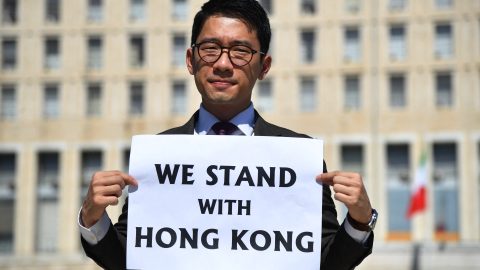
Despite his personal fondness for China and his belief in trans-Pacific cooperation, human rights is a major sticking point for Walz, and he would likely be persistent on this issue as vice president. While in Congress, Walz co-sponsored the Hong Kong Human Rights and Democracy Act of 2017 and two resolutions regarding the state-sanctioned organ harvesting of individuals from religious minority groups and the censorship of human rights abuses in China. Walz also met with the Dalai Lama, Hong Kong democracy activist Joshua Wong and Lobsang Sangay, the then-leader of Tibet’s government in exile. Although Walz has not said much about Taiwan on the record, his stance on Hong Kong indicates that he most likely feels strongly about protecting democracy here as well.
During his time on the CECC, Walz was eager to shed light on inconvenient truths and frankly discuss touchy subjects with Chinese officials. He also expressed a desire to leverage the U.S.’s trade relationship with China to improve its human rights record. Case in point, Walz took an official trip to China in 2015, during which he questioned Premier Li Keqiang (李克强) about a Potemkin village he was shown in Tibet and voiced his concerns about culturicide there. Reflecting on this conversation during a 2016 hearing, Walz said, “it was fascinating to me that the premier was gracious, he engaged in this conversation. I did not have any expectations there would be a change, but I think it did show if we continue to bring these issues up, if we continue to lead with our values, and tie those to our economic policies, not separate them from that, that there is potential here for us to get to a common ground.”
Beyond expressing the need for pragmatic U.S.-China engagement and advocating for human rights reform, Walz has spoken some — but not much — on the trickier economic and security dimensions of the U.S.-China relationship. During his tenure in Congress, he said the U.S. needs to stand firm on China’s behavior in the South China Sea and co-sponsored a bill to counter China’s unfair trade practices through tariffs. As governor, he has tried to reduce “American dependency on foreign producers like China” by investing in semiconductor manufacturing, according to a press release. In recent years, Walz has also seemed to favor cooperating with East Asian allies and partners over China, writing in a 2022 post on X that Minnesota was particularly eager to expand trade relations with Taiwan and telling Nikkei Asia in 2023 that “we welcome Japanese companies to invest billions of dollars in Minnesota, but we won’t accept Chinese companies.”
A spokesperson for China’s Ministry of Foreign Affairs said that China would not comment on Harris’ pick for vice president, as this is an internal matter for the U.S. However, China is likely not thrilled with the decision, due to Walz’s long history of criticizing the Chinese government.
Although Walz is certainly not soft on China, he is not a hawk either. He does not view engagement with China as a zero-sum game like the former U.S. deputy national security adviser Matt Pottinger or former U.S. congressman Mike Gallagher. Rather, he is willing to cooperate where possible, with caveats.
Another key difference between Walz and some more hawkish commentators is that Walz has been extremely careful to preface criticisms of the Chinese government with an acknowledgement that there is a difference between the Chinese government and Chinese citizens. As the rise in anti-Asian hate crimes during the COVID-19 pandemic showed, political rhetoric that fails to distinguish between the Chinese government and the broader Chinese community — such as “the China virus” — can perpetuate harmful stereotypes and xenophobia, contributing to a more hostile environment for Asian communities in the U.S. Walz’s remarks over his long tenure in the CECC make it apparent that he takes care in forming both his opinions and his sentences. In his own words, “I’m always trying to understand the people, and this dichotomy I have with a regime that doesn’t seem to honor those ideas [human rights principles], but a people who do on an individual and a community basis.”







Leave a Reply