
It’s 11 a.m., on a normal working day in Kyiv.
You’re sitting in the corridor of your office because an air raid alert has been announced due to a missile threat. Suddenly, you hear loud explosions outside.
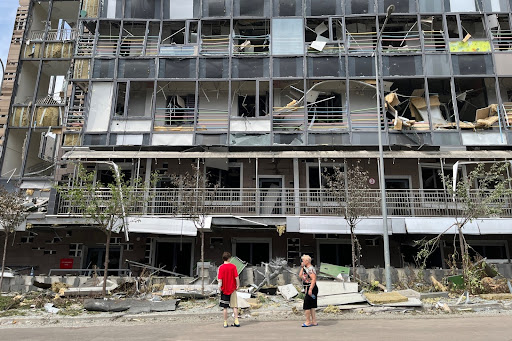
Half an hour later, you’re at the site of the attack, where a Russian missile hit the main children’s hospital in Kyiv.
A few days later, the U.N. officially said that the Okhmatdyt Children’s Hospital was “most likely” directly hit by a modern Russian Kh-101 cruise missile containing 400 kilograms of explosives. Two people were killed and 16 injured. Many more children, undergoing treatment, are displaced.
Critically, the missile included dozens of electronic chips from non-Russian manufacturers. Surprisingly, investigators found Taiwanese chips inside the remnants of the Kh-101 missile.
Back in June 2022, Taiwan imposed sanctions on Russia, including a ban on direct supplies of modern chips that could be used in weapons. However, the Russian Kh-101 used in the attack against Okhmatdyt was only manufactured a few weeks before the attack, according to Conflict Armament Research, a British investigative organization that tracks arms supply chains.
The attack — and its use of Western and Taiwanese components — show the failures of American, European and Taiwanese sanctions, which seek to starve Russia of its ability to manufacture death-dealing technology. After more than two years under sanctions, Russia is still able to supply its defense industry with chips that help it to launch precision strikes on Ukrainian cities, sourcing the parts via shell companies that are hard to track.
Since February 2022, numerous pro-Ukrainian rallies have taken place in Taiwanese cities, along with continuous humanitarian aid to Ukraine from Taiwan.
“Russia’s actions are an atrocity against innocent people in Ukraine as well as the ruining of the international law order. We will never accept this and will stand together with people in Ukraine to fight against the aggression,” former Taiwanese foreign minister Joseph Wu said in an interview with the Ukrainian TV channel Espreso in October 2022.
Despite this popular support, and a formal pledge to back Ukraine, Taiwanese manufacturers are still supplying components that end up arriving in Ukraine with deadly impact.
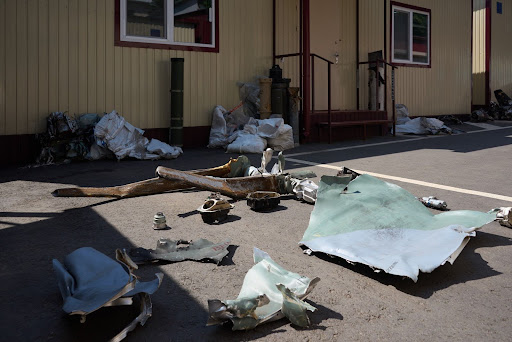
Since the start of the full-scale invasion, experts have identified at least 80 different components from Taiwanese companies, according to a database of Western components found in Russian weapons. The database was created by the defense intelligence agency of Ukraine, known as GUR. It lists electronics that have been found in Russian cruise missiles, drones, electronic warfare devices, communication devices and even MLRS missiles.
Without Taiwanese chips, it would be much more difficult for Russia to produce a wide range of weapons that it uses to kill Ukrainians.
The remains of the same missile, but from the site of another recent Russian attack on Kyiv, were brought to forensic examiners at the Ministry of Justice, whose experts determine what kind of weapon has been used by Russia.
The Counteroffensive visited the experts at the Kyiv Scientific Research Institute of Forensic Expertise, where experts explore components from different weapons used by Russia. Their work helps other parts of the government, which can use this information in their own investigations, including into war crimes and those who are complicit.
“These are the wing consoles,” said Andrii Kulchytskyi, head of the Military Research Laboratory, pointing to the remains of the rocket. “In the serial number that is left on the surviving piece of the missile, 263 is the model number of the Kh-101 missile, and the other numbers are the year of manufacture and the control number.”
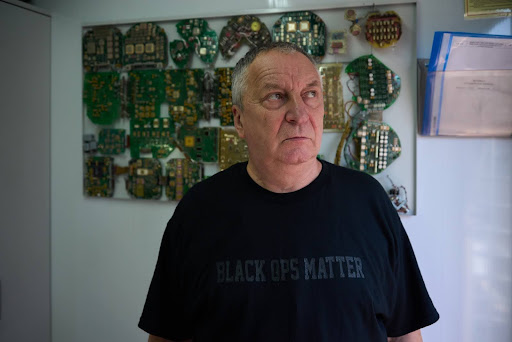
After the war, all this information will be used to determine who launched the missile, from where, and who ordered it to be used.
But it is even more difficult to determine what was inside the missile.
First of all, many of the electronics may have simply not survived the explosion. But on top of that, elements such as circuit boards and chips may be burned, or stickers or engravings with manufacturer codes may be peeled off, to make it harder for experts to determine their origins. Russia has been doing this more often recently, explained Serhii, a forensic expert at the laboratory who asked not to use his last name due to security concerns.
In this case, additional manipulations have to be made, such as scraping the paint off the surface, or using a microscope.
For complicated cases, the experts created their own catalog with photos of various components so that they can be identified by their external features, not just by inscriptions or emblems.
“See this servomotor? [Andrii shows The Counteroffensive a part from the Russian Shahed drone] There’s no marking here, but I know it’s a KVS [brand name], because we’ve seen such copies before,” Andrii explained.
The catalog also contains a section with Taiwanese companies, including Macronix, Winbond, Transcend, Tai-Saw and a dozen other manufacturers.
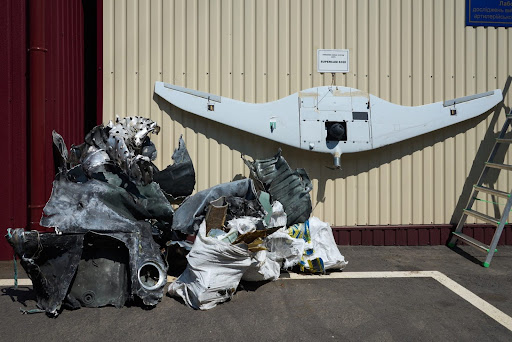
After the examination, all these components and information about them are handed over to investigators as evidence in criminal cases against Russia. The results of the examination are also used by the GUR to create an open database of Western components found in Russian weapons, so that Ukraine’s international partners and their sanctions enforcement agencies can be more attentive to their supply.
If you open the GUR’s database and sort the components by country of manufacture, you will see that along with microelectronics from authoritarian countries such as Iran, North Korea and China, there are many components from countries friendly to Ukraine, such as the United States, European democracies and Taiwan in particular.

“China and Hong Kong, Thailand, UAE, Kazakhstan, Uzbekistan, Kyrgyzstan, Taiwan, Indonesia, Maldives and Turkey — all of these countries have a very simple business registration procedure that Russia uses to create shell companies for the purchase of sanctioned components, and most of them did not impose sanctions against Russia,” explained Agiya Zagrebelska, who is deputy chief of staff at the National Agency on Corruption Prevention.
China is still the main transshipment hub for Russia’s access to Western microelectronics and provides 90% of the chip supply to Russia.
Recently, China has moved from supplying only dual-use technologies to supplying entirely military components, as U.S. Deputy Secretary of State Kurt Campbell stated. In return, China has gained access to the latest Russian submarine and missile technology, which Russia had been wary of sharing before.
When they are discovered, shell companies found to be selling restricted microelectronics to Russia are sanctioned, i.e., their property is frozen, relations with them are banned and supplies are prohibited, but this is not always practically possible or effective, according to Agiya.
Not all such companies are found in time, as the sanctions infrastructure is overloaded, so that the authorities of the sanctions coalition countries, which are supposed to monitor compliance with sanctions, simply cannot cope with the rapid growth in their number.
The simple rules of business registration in the countries that Russia uses to obtain sanctioned microelectronics often allow a new company to be registered even by the same individuals after sanctions are imposed on a company. This is due to the fact that usually only the legal entity is sanctioned, not the owners.
“[This] was the case with [Chinese] SMT-ILogic, which supplied parts for Orlan UAVs [a type of drone]. After this company was sanctioned in China, the same Russians set up another company with a quite similar name and continued to supply the same components for Orlans,” Agiya said.
The case of Taiwan is somewhat unique compared to other countries through which Russia obtains modern microelectronics for its weapons, due to Taipei’s proximity and trade with China.
As stated earlier, Taiwan imposed sanctions against Russia in the first year of the full-scale invasion, including on the supply of chips to Russia. And the country has not changed its position on sanctions: In fact, Taiwan has recently expanded sanctions against Russia and banned the export of nitrocellulose, a key raw material for gunpowder production, and established stricter controls over its exports to risky jurisdictions.
The Counteroffensive reached out to the International Trade Administration, which is the department in charged in Taiwan, and found out that the Ukrainian government contacted them about similar issues last Summer.
Taiwanese journalists at The Reporter disclosed that milling machines from Taiwanese companies went through Turkey and were imported to Russia in January. To prevent Russians from getting Taiwanese chips via high-risk third parties (countries like Turkey and the United Arab Emirates), the Taiwanese government required the sellers to provide an application form and an affidavit letter, to ensure these products are not sent to Russia or Belarus.
The Taiwanese government has updated the sanctioned list six times since Russia invaded Ukraine. However, the ministry seems to have their hands bound on banning sales to China.
“We have raised the fines up to 1 million NT Dollars, which is more than 31 thousand USD. We have hosted 11 forums to promote the updated information about the sanctions,” the Taiwan International Trade Administration told The Counteroffensive. “We also gave out suggestions about [how to be] aware of abnormal trading actions from Chinese companies.”


Leave a Reply