
At the end of November, the Taiwan-friendly government of Lithuania expelled three Chinese representatives. China condemned the action and has threatened to retaliate. So why have they not yet done so? Because in the next few days a new Lithuanian government will be sworn in. The incoming prime minister, Gintautas Paluckas, said he was not informed about the expulsion or its circumstances.
Before the election in October, Paluckas and his party argued that ties with China should be improved. But doing so would likely come at a cost for Taiwan, which had made great diplomatic inroads in Vilnius under the outgoing administration.
Lithuania made big waves in Taiwan and globally when it was announced in 2021 that Taiwan would open a representative office in Vilnius. Despite Chinese protestations, the opening went ahead, and shortly after Beijing recalled its ambassador and kicked out the Lithuanian representative. Lithuania later opened its own office in Taipei.
In particular, Beijing protested the naming of the representative office as Taiwan not Taipei, which it views as being more of a recognition of Taiwanese sovereignty. This is despite the fact that the Lithuanian foreign minister explicitly stated that ties with Taiwan were conducted within Lithuania’s “One China” policy.
Since then, there have been numerous economic exchanges and talks, and some investment, but not all Lithuanians feel that the benefits of the association with Taiwan have been worth the cost that China has imposed, slashing imports and restricting visas.
Although China has never said so explicitly, it is hard to see how Lithuania could repair the ties broken by Beijing without the symbolic step of renaming the Taiwan office to Taipei, if not closing it all together. The former would be a humiliation for Taipei, the latter a diplomatic disaster.
After the opposition won the election, Taiwanese Foreign Minister Lin Chia-lung (林佳龍) visited Lithuania on a tour that was ostensibly about trade and in particular UAVs. He did not meet publicly with members of the incoming administration. However, it would be strange if there were not any private interactions.
In particular, Domino Theory speculates that if the new Lithuanian government was already set on altering the name of the representative office, it would have made sense for Taiwan to preemptively change it and save at least some face. That this did not happen could be a signal it will not. To be clear, this is analysis not evidenced reporting.
Incoming prime minister Paluckas caused concern among in Taiwan when he said that: “Let’s not speculate, we don’t know what the Chinese will ask for. We don’t know the real situation” Such a statement not only suggests a deep willingness to do what it takes, it also could indicate naivety or at least a lack of understanding that China is not going to ask for less because you approach the negotiation from such a position of “goodwill.” However, there is no need for Taiwan to despair. In the same interview, Paluckas went in a different direction and said that “without humiliating ourselves, falling to our knees and begging for anything. We are a sovereign country, we have no dependency on China and nobody is trying to create one.”
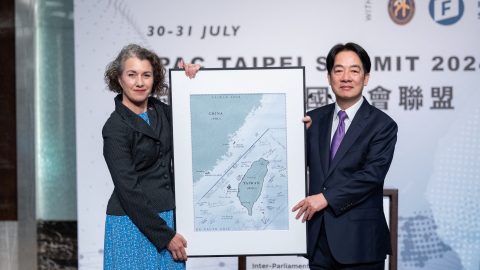
There are reasons for optimism. Paluckas will head a coalition government, and several of his ministers from other parties are friendly to Taiwan. The incoming defense minister, Dovile Sakaliene, visited Taipei in 2021, where she said Taiwan was an important friend to Lithuania and that Vilnius would continue the friendship. She came back in July to attend the IPAC Inter-Parliamentary Alliance on China summit, where she additionally met with National Security Council Secretary-General Joseph Wu (吳釗燮).
The incoming foreign minister, Kestutis Budrys, has made several statements since his appointment that will no doubt make Beijing pause. He told the Baltic News Service that the “ball was not in Lithuania’s court” since it was China who recalled their ambassador in 2021. In a recent interview with Nikkei Asia, Budrys said that Lithuania is prepared to assist Taiwan if China invades.
The new government then is at best divided on this issue. Domino Theory spoke with Simona Merkinaite from the Eastern Europe Studies Centre, who pointed out that the outgoing foreign minister Gabrielius Landsbergis had also called for improving ties with China. This is despite him being then and now one of the most hawkish figures on China in Europe. So the gap between the old and new administrations is even closer than a preliminary analysis would indicate. In Merkinaite’s own words, there is “probably more continuation rather than radical change.”
There are other headwinds against a policy shift, too. Marius Laurinavicius at the Vilnius Institute for Policy Analysis pointed out in a recent South China Morning Post article that “China has no leverage on us anymore — for us, China is nothing now.” Lithuania already had relatively little economic exposure to China, and that reduced even further after the degradation of ties.
The election of Donald Trump in the U.S. complicates things further. On the one hand, the Trump administration looks likely to be very hawkish on China, which will bleed into the politics of other democracies, especially if the new administration asks allies to join it in economic restrictions against Beijing, as Biden already did. On the other hand, Trump seems very skeptical of Europe and NATO. If the U.S. even partially withdraws from Europe, it will force the EU and other European countries to seriously consider improving ties with China for geostrategic hedging reasons. In this regard, it’s hard to predict which way things will fall until Trump enters office.
In short then, while it is unknowable what the future holds for Lithuania and Taiwan, there is no need to be despondent. Especially if the new U.S. administration cares to exert pressure to keep things as they are, Taiwan can be optimistic. The China-Taiwan-Lithuania triangle might be better seen as a tetrahedron with the U.S. on the fourth vertex.


Leave a Reply