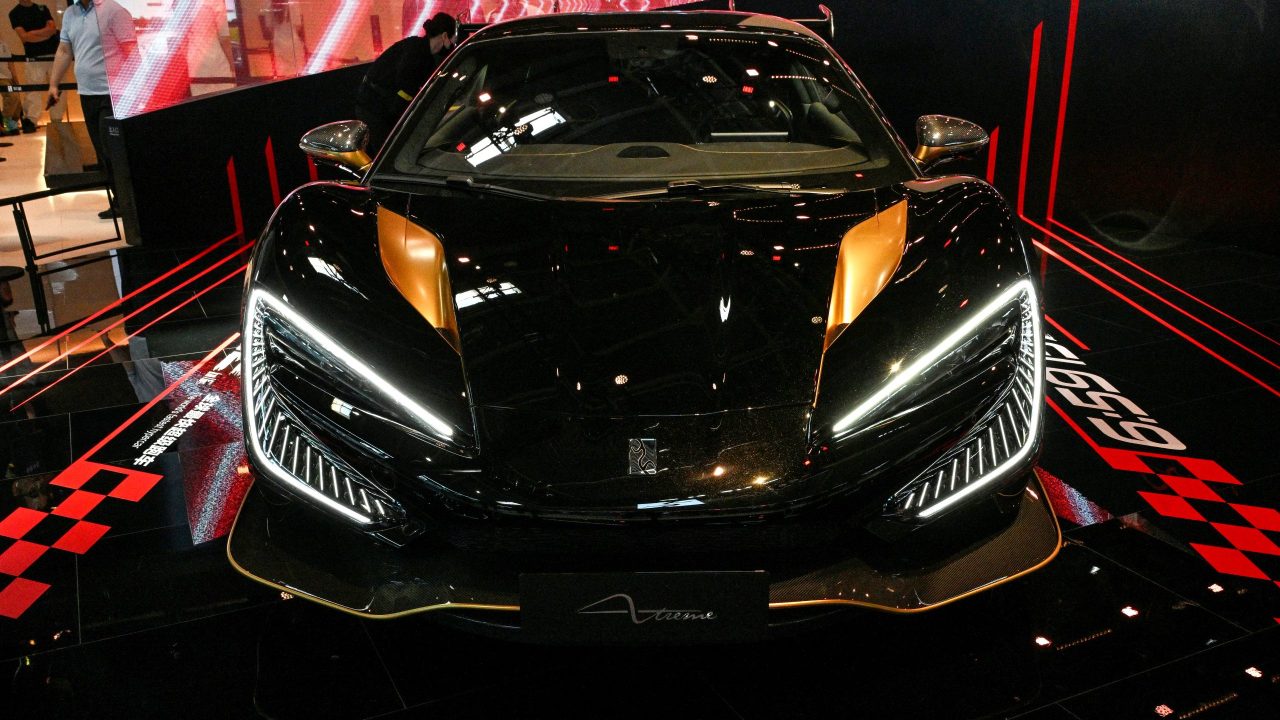
Television viewers in Washington are familiar with the aesthetics of the political attack ad, with its menacing voice-over and unflattering tint. But in a 30-second spot aired during a WNBA broadcast earlier this week, Mystics fans were introduced to a new kind of villain: the Chinese electric vehicle.
“China’s driverless vehicles will map our neighborhoods, our military bases and our critical infrastructure,” the ad declares. “The Chinese Communist Party will have it all.”
The ad, created by a political advocacy group run by former members of the Trump administration, reflects a policy concern that has animated this era of rising Chinese technology: That data collected on American users and stored in China can be exploited by the Chinese government.
It also speaks to a growing debate about Chinese electric vehicles, which have emerged in the last decade — seemingly out of nowhere — to dominate the global market. In the first half of 2026, Chinese automaker BYD sold more electric vehicles than any company in the world, surpassing Tesla by nearly 30,000 units.
China’s dominance is most pronounced in the developing world, where its carmakers are accounting for roughly 80% of new car sales. But it has also sent shockwaves across Europe, where auto manufacturing remains a rare industrial strength. Despite the 38% tariff that the EU imposed on Chinese electric vehicles in July 2024, their market share has continued to grow, reaching a total of 14.2% of all EVs sold in Western Europe in the first five months of 2026.
So far, the United States has not allowed Chinese electric vehicles to be sold at all. The Biden administration put a 100% tariff on their import, which Trump has left in place. That rule, together with an executive order restricting the sale of cars containing Chinese-made software, has acted as an effective ban. Today, the U.S. is the only major car market in the world — excluding Taiwan — where Chinese electric vehicles are not sold.
“Japan, Korea, Europe — they all allow Chinese cars in their market,” said Scott Kennedy, senior adviser and trustee chair in Chinese Business and Economics at the Center for Strategic and International Studies. “Even Israel, which has the world’s tightest cybersecurity protection regime, has Chinese cars in their market.”
The question facing U.S. policymakers is how long this state of affairs can last. Canada recently agreed to an initial import quota of 49,000 Chinese EVs. In Mexico, they command 70% of the total electric vehicle and plug-in hybrid market. Because of a rule allowing Mexicans to temporarily drive their cars across the American border, BYD cars have become a common sight in southern California.
Google-owned Waymo has introduced a new fleet of robotaxis manufactured by Zeekr, the luxury EV brand of Chinese auto giant Geely. On Thursday, Waymo announced that the new fleet is fully operational in three U.S. cities, meaning that residents of Los Angeles, San Francisco and Phoenix will now be able to hail a car that they themselves cannot purchase.
Waymo’s access to Zeekr vehicles would be preserved under a special provision in the Motor Vehicle Modernization Act, which would otherwise act as an indefinite ban on Chinese EVs. The bill passed out of House committee with bipartisan support in May. But the Waymo carve-out has drawn the ire of the Protecting America Initiative, which purchased the recent ad spot. “Tell Congress: Keep China’s driverless vehicles out of America,” the ad concludes.
One lawmaker who has gotten the message is Ohio Senator Bernie Moreno, who sponsored the Senate’s version of the bill. “We will not commit industrial suicide, and we will not allow ‘automotive fentanyl’ to enter the United States of America,” he said recently.
China’s electric vehicle sector has benefited from massive industrial subsidies — some estimates place the total value at more than $230 billion. Sustained government backing gave firms like BYD and Geely an unfair advantage over their foreign counterparts, according to many trade experts. Tesla, for example, has also received billions of dollars in government support, but remains much more constrained by shareholders’ demand for profit.
“Chinese companies, especially ones that are state-owned enterprises or heavily state influenced, they don’t care about profitability,” said Stephen Ezell, vice president for global innovation policy at the Information Technology and Innovation Foundation, in a recent podcast appearance. “They care about market share. They care about dominating sectors.”
China’s support for EV startups, which relied heavily on local government financing, led to a proliferation of automakers — as many as 500 at one point. Only a fraction have survived, but China has still been left with a severe overcapacity of electric vehicles, leaving firms little other option than to sell their inventory abroad.
To some analysts, this massive state support is a sort of original sin, which Chinese automakers cannot just shrug off, even if they have become legitimately profitable now. “The fact that they can produce the car 30% lower — yes, part of that is innovation to be sure, but part of it is the subsidies that have had this flywheel effect,” Ezell said.
Kennedy, the CSIS expert, says there is room for a more targeted approach. “The U.S. would be better served by choosing policy tools that set standards for acceptable behavior, as opposed to singling out and banning cars from a country outright,” he said.
Chinese vehicles are not just attractive to foreign consumers because government subsidies have made them less expensive than the competition. BYD and its peers have become innovators, too, in everything from battery chemistry to cabin entertainment systems. Kennedy says exposure to Chinese competition would be healthy for U.S. automakers who, apart from Tesla, have lagged in the global EV race.
“There’s not a great record of using extremely high protectionist walls to incentivize American companies to improve their capabilities and become innovation leaders,” he said.
Electric vehicles are not the first example of Chinese tech threatening to take over the American market. The short-form video platform TikTok faced cybersecurity concerns for years before the U.S. government forced the company to divest from its American business last year. It is unclear whether the U.S. government would be able to come to a similar arrangement with companies like BYD, who currently store all of the data they collect on Chinese servers.
Joseph Webster, a senior fellow at the Atlantic Center, is not optimistic about the possibility. “Unfortunately, under the 2015 National Security Law of the People’s Republic of China, all Chinese companies are required to answer the demands of the state, including Chinese intelligence services,” Webster wrote in an email. “Accordingly, it will be impossible to differentiate between connected vehicle risks on a firm-by-firm basis.”
There is one American who has already been driving a Chinese EV: Ford CEO Jim Farley. In 2024, Farley revealed on a podcast that he had shipped an SU7 sedan, made by Chinese smartphone maker Xiaomi, from Shanghai to Detroit to serve as his daily driver. Then he didn’t want to give it up.
The outright ban on Chinese electric vehicles has provided a shield for traditional American carmakers for now. But Farley doesn’t expect it to last forever. Within the next five to 10 years, he predicts, the Chinese EVs will be here.





Leave a Reply