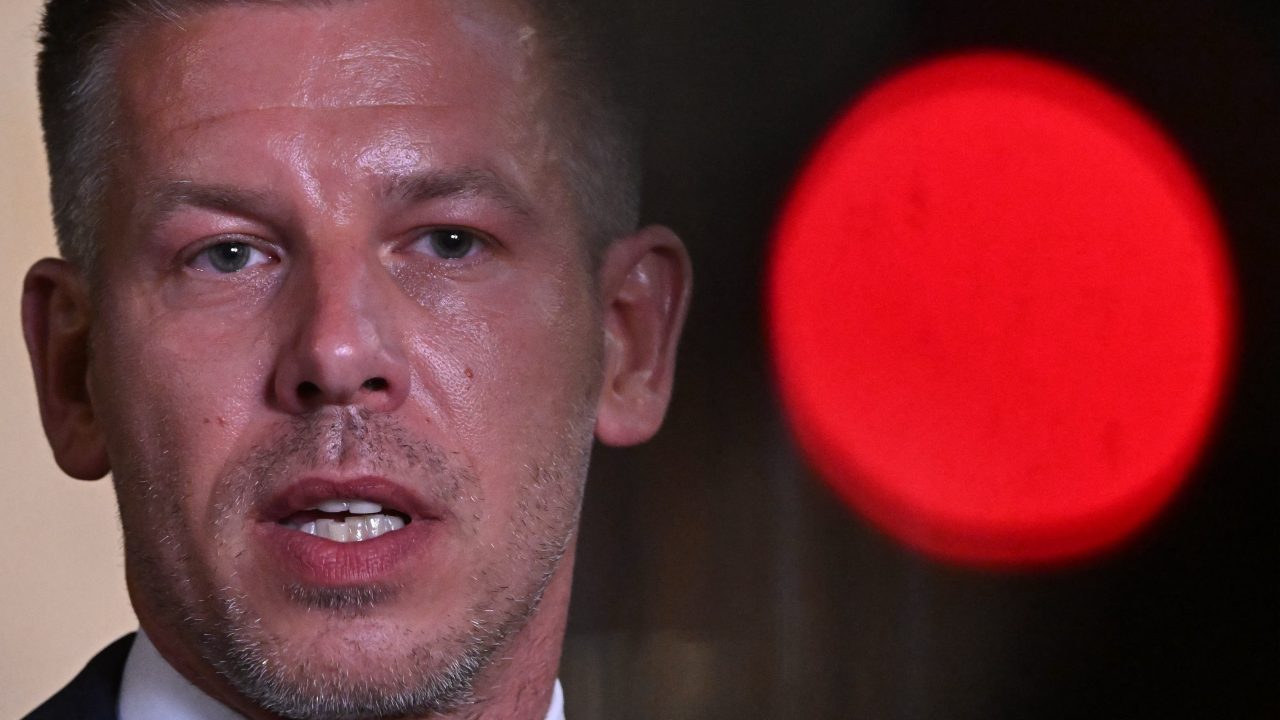
Former foreign minister of Hungary Peter Szijjarto resigned as a member of parliament yesterday, announcing that he was taking a job with the Chinese car manufacturer BYD.
In response, Hungarian Prime Minister Peter Magyar said “signing with the Chinese global giant BYD is synonymous with entering the service of the Chinese Communist Party.”
Szijjarto was responsible for a foreign policy that took Hungary much closer to China and Russia, attracting criticism from other European capitals but significant investment from Beijing. During his time in office, BYD agreed to build an electric bus factory in Komarom, an electric vehicle factory in Szeged, and decided to set up their European headquarters in Budapest.
In return, the Chinese manufacturer received state aid from the Hungarian government: $2.75 million for the Komarom factory and an undisclosed amount for the Szeged plant. The European Commission is also investigating whether BYD received unfair subsidies from the Chinese government.
Magyar said that Szijjarto had lobbied for “hundreds of billions of forints in Hungarian state support” to BYD. One hundred billion forints is approximately $320 million at today’s exchange rate.
Szijjarto “has not represented the interests of Hungarians, but those of foreigners until now,” Magyar said. “The only difference compared to before will be that from now on, it won’t be the Hungarian people paying Peter Szijjarto for the same work, but his actual employer.”
Magyar has “rightly pointed out” that in the case of leading Chinese companies, the boundary between the state, the Chinese Communist party and private enterprises is “extremely blurry,” said Marcin Jerzewski, the head of the Taiwan Office of the European Values Center for Security Policy.
Szijjarto’s move raised “not only moral but serious legal concerns,” according to Magyar. However, the legal director of Transparency International Hungary, Miklos Ligeti, told Hungarian media 24.hu that there was no restriction on the former foreign minister taking such a job, as there would be with certain other ministerial positions.
Szijjarto left government after his party, Fidesz, lost their majority in the April general election. Fidesz’s leader, Viktor Orban, had been prime minister of Hungary since 2010 and was heavily criticized for reforms that Magyar and other critics said heavily damaged Hungarian democracy.
In his announcement, Szijjarto said he had received “an extremely honorable offer to fill an international position from one of the world’s leading companies.”
The construction of BYD’s factory in Szeged has been criticized by rights groups. Two workers from the majority-Chinese construction workforce have died in accidents this year, and China Labor Watch has accused the construction site of forced labor practices, allegations that BYD has denied. Production at the plant has been delayed and is now expected to start at the end of 2026.
In a speech at the beginning of this year, Magyar said “Hungarians do not want a country where Asian companies, circumventing environmental regulations and benefiting from massive subsidies, produce batteries primarily with non-Hungarian labor.”
“It is not expected that Hungary will perform a policy U-turn on China, given China’s investment presence in Hungary,” said Matej Simalcik, the executive director of the Central European Institute of Asian Studies. However, he expects Magyar’s policy to become more aligned with the European Union mainstream view. Hungary will no longer play “the role of China’s proxy to the extent it was under the Orban’s regime,” he said.
Following Szijjarto’s announcement, the Chinese embassy to Hungary made a Facebook post criticizing Taiwan’s representative to Budapest, Elliot Wang (王翼龍). Hungarian media Atlatszo published an interview with Wang yesterday where he said that Taiwanese interest in Hungary had noticeably increased since the election, pointing out Taiwan had previously invested heavily into the country.
“We hope that this year’s 70th anniversary of the 1956 revolution will provide a good opportunity to revive relations,” Wang said, adding that Taiwan had sent aid to Hungarian refugees after the revolution was crushed by Soviet tanks.
“It is no coincidence that Mr. Wang Yilong has chosen this particular moment to advance his erroneous narrative, with the sole aim of disrupting China-Hungary relations,” the Chinese embassy wrote in its response. (In Taiwan, Wang’s given name is usually written as Yi-Lung in English)
Szijjarto’s hiring was also covered by industry publications, including CnEVPost. Phate Zhang (张帆) wrote: “Szijjarto’s value may lie less in automotive manufacturing experience than in his extensive government relationships.”
It will be interesting to see how extensive those relationships are now that Szijjarto has left office. The then-foreign minister admitted in March he had been in regular contact with his Russian counterpart during private European Council summits on foreign affairs. Polish Prime Minister Donald Tusk described his conduct as “repulsive.”





Leave a Reply