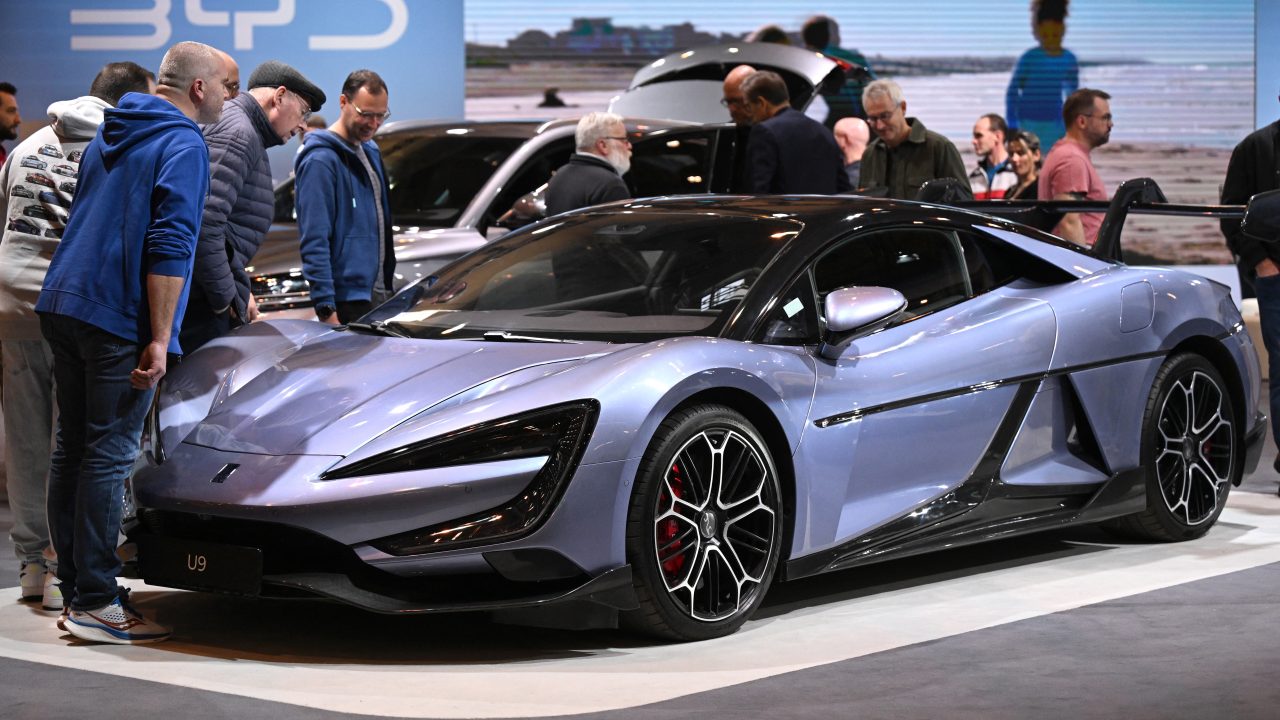
In 2016, when Wolfgang Egger left Volkswagen to join BYD, an up-and-coming electric vehicle maker in Shenzhen, Germany still far outpaced China in high-end manufacturing. China was the world’s factory, but its factory owners drove BMWs.
Ten years later, on the eve of German Chancellor Friedrich Merz’s trip to Beijing, things look much different. Germany’s triumvirate of BMW, Mercedes Benz and Audi still lead the global luxury car market, but sales in China have taken a sharp downturn recently, a trend that neatly coincides with the rise of BYD and other Chinese competition.
BMW remained the world’s leading luxury brand in 2025, according to an analysis by the automobile market research firm Inovev. But sales in China were down 14.2 percent compared with 2024. Mercedes Benz, the number two global brand, fared even worse, seeing a 19.2% decline in China sales over the same period.
Merz will be joined by a delegation of 30 chief executives from leading German firms, including CEOs from BMW and Mercedes Benz, as well as Oliver Blume, who leads Volkswagen group.
Blume has referred to China as Volkswagen’s “second home market.” Almost all of the cars that the company sells in China are domestically produced, in cooperation with local firms. But even Audi, Volkswagen’s luxury brand, has felt the heat of Chinese competition.
In 2025, Audi sold 617,514 cars in China, making it the leading luxury brand there. But that number represented a 2.7% decline from the year before.
“The German side must present a detailed account of where China is distorting competition,” said Hildegard Muller, president of the Germany’s automotive industry association VDA, in an interview with Die Welt’s Sunday edition last week. “The aim of the talks must generally be to further open up markets on both sides — not mutual isolation.”
Germany’s industrial proficiency had long let it avoid the kind of extreme trade imbalances with China that have bedeviled the more service-heavy economies of Great Britain and the United States.
But with the ascent of electric vehicle-focused brands like BYD, Xiaomi and Hongqi, Merz is now confronting a reality already familiar to his Western peers: There is no longer much that Germany can offer that China is unable to make itself.
Egger was once asked by a Chinese interviewer whether he thought BYD could become the BMW of China. He didn’t exactly answer the question. “We want to integrate design and technology, and transform BYD into a car brand that combines dynamism and luxury,” he said.
Defectors like Egger are one reason China has been so successful in automotive manufacturing over the last decade. But poaching European design talent isn’t unique to China. It’s standard practice for car companies hoping for a luxury facelift. See: Hyundai and Kia.
What is unique is the sheer scale of government subsidies that firms like BYD have received from the Chinese government.
In 2016, the year it hired Egger, BYD received more than $1 billion in subsidies from the Chinese government, a number that exceeded its total net profit. According to an estimate from the Rhodium Group, between 2015 and 2020, BYD received roughly $4.3 billion from the Chinese government overall.
Merz is expected to press Xi on China’s aggressive state support for its auto industry, but he may be too late.
By the time BYD passed Tesla as the world’s top electric carmaker last year, the Chinese government had already phased out its most aggressive subsidy programs. This part of the industrial monster, it seemed, was ready to fight on its own.






Leave a Reply