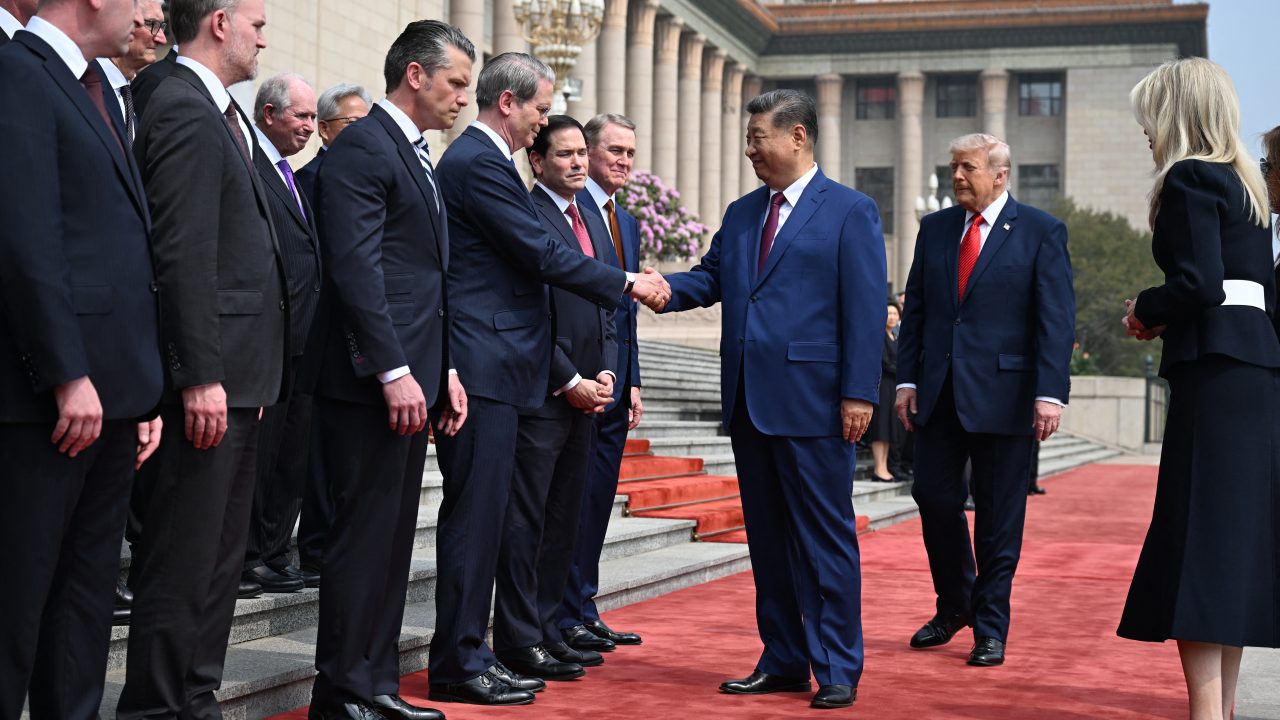
China announced on Tuesday that President Donald Trump and China’s leader, Xi Jinping (習近平), will hold a dialogue on artificial intelligence, confirming Treasury Secretary Scott Bessent’s comment to CNBC on the sidelines of the Trump-Xi summit in Beijing last week.
“The two AI superpowers are going to start talking,” Bessent said. “We’re going to set up a protocol in terms of how do we go forward with best practices for AI to make sure nonstate actors don’t get a hold of these models.”
Without providing details on how the dialogue will unfold, Chinese Foreign Ministry spokesperson Guo Jiakun (郭嘉昆) said its purpose will be to make sure that AI “will better contribute to the progress of human civilization and common welfare of the international community.”
The Wall Street Journal first broke the news that Washington and Beijing were considering discussions on AI on May 6, prompting U.S.-China tech policy experts to debate how this dialogue will affect U.S. chip export controls. The debate highlights a fragmented expert consensus, split between some who argue that an AI safety dialogue would require sustained or tightened export controls, and others that they require loosening controls.
Chris McGuire, who worked on chip controls for the Biden administration, thinks that China sees the U.S. desire to have talks as a chance to extract concessions that will allow it to close the AI gap. A targeted AI safety dialogue with China should be paired with tighter export controls that “expand the U.S. lead in AI as much as possible,” said McGuire, now a senior fellow at the Council for Foreign Relations. This would give the U.S. flexibility to develop the AI regulations it thinks are best, which it can then push China to adopt, McGuire told Politico earlier this month.
AI company Anthropic also supports tightened export controls to support U.S. leadership in AI safety. In a policy memo released last week, Anthropic argued that if Chinese models catch up to American ones, then both Chinese and U.S. AI firms will feel more pressure to release products quicker, taking less time to ensure that their products are safe. This pressure would also be felt by both Washington and Beijing, which could become reluctant to enact AI safety regulations “for fear of falling behind.”
Bessent agrees that the U.S. needs to remain ahead of China to meaningfully engage on AI safety. “I do not think we would be having the same discussions if they were this far ahead of us,” he told CNBC last Thursday.
But the Treasury secretary didn’t specify what role export controls play in sustaining the U.S.’s lead. The Trump administration in January approved the limited export of Nvidia’s H200 chips, one of Nvidia’s most powerful AI processors, to China. But the U.S. has not agreed to loosen controls on more advanced chip architectures like the B30A.
Other experts think that tighter export controls could risk AI safety dialogue by antagonizing China. Anthropic’s policy memo doesn’t explain why deeper safety engagement could survive the diplomatic consequences of “sharper competitive denial,” Paul Triolo, a partner at the DGA Group, wrote in a Substack post. “A strategy that publicly frames Chinese AI progress as dependent on illicit extraction, loopholes, and authoritarian ambition will make technical safety dialogue harder, not easier.”
Sebastian Mallaby, a journalist and senior fellow for international economics at the Council on Foreign Relations, thinks that Washington should consider loosening export controls in exchange for an AI safety pact with China. They are “an act of aggression,” Mallaby said in an interview with The Wire China. Export controls did not prevent China from creating powerful AI, Mallaby said, “So we shouldn’t view this as something we could never compromise on.”
How these dynamics play out depends on the type of bargain the Trump administration decides is necessary for safety cooperation. For now all we know is that, as Beijing said, a “dialogue will be carried out.”



Leave a Reply