
The Xi-Biden talks at the Asia-Pacific Economic Cooperation (APEC) leaders’ week in San Francisco have been picked apart from every angle. But notably when U.S. President Joe Biden reached for an example of the world being at “an inflection point,” his first thought was about artificial intelligence. “Just think of AI,” he said.
For the semiconductor industry, this focus on AI presents a bind. Its key growth area is simultaneously the area that is likely to draw it further into the line of fire from the ongoing geopolitical contest between the U.S. and China, because economically and militarily it’s already an unmissably large phenomenon. It means the future may well be full of autonomous robots, but also looks like it will be full of sanctions.
The plus side of this equation for chipmakers is clear. In their year-on-year predictions for the worldwide growth of semiconductor revenue, the International Data Corporation (IDC) places growth in demand for chips involved in AI as a significant driver behind a 15-year outlook scenario that has the semiconductor industry doubling in size in less than a decade, with total market revenue reaching one trillion U.S. dollars in 2032.
Within those figures, both consumer and military AI applications are set for major growth over the next five to ten years. On the consumer side, “Everything from a laptop to a smartphone will all now be infused with the ability to run large language models [LLMs],” said Mario Morales, group vice president of enabling technologies, semiconductor, and storage research at IDC, speaking at a Nikkei Asia forum this week. On the military side, defense ministries around the world “are all focused on the application of increasing autonomy or semi-autonomous operation to almost all types of defense and intelligence systems,” Chris Miller, author of “Chip War: The Fight for the World’s Most Critical Technology,” told the same forum, adding that there was “great uncertainty about how it will develop.”
The difficulty for the industry is that both these AI-infused economic and military impacts potentially draw the attention of policymakers. For its part, the U.S. government has repeatedly emphasized military applications within its statements justifying sanctions, and while it has been noted that currently most military technology does not require cutting-edge chips, the increasing integration of AI may change this. On the other hand, thinkers such as the economic historian Adam Tooze say that sanctions on chips have very clearly been an economic project from the beginning, and AI only intensifies that interest.
The broad implication remains the same either way. Despite suggestions of lowered tensions elsewhere, AI looks set to be at the forefront of a “technology cold war,” with new fronts within the chip industry ready to open up as a result.
One example of this has just happened. The U.S. Bureau of Industry and Security updated its 2022 sanctions at the end of this October, “filling in critical gaps in U.S. policy” in order to “hinder China’s access to AI chips more effectively,” according to the Center for Strategic and International Studies. But despite underscoring the focus on AI, these remain “fairly narrow,” according to Chris Miller.
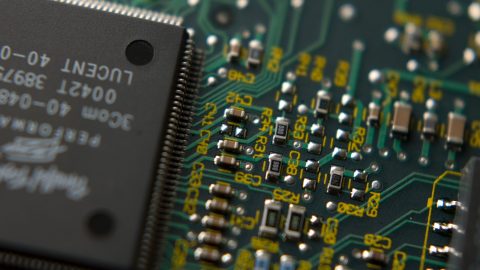
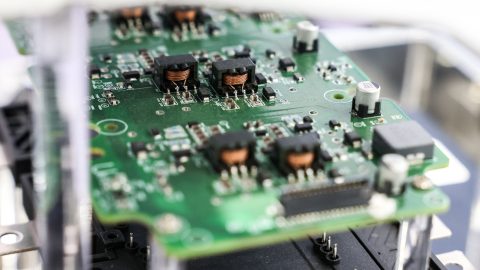
Another potentially more dramatic example came from Bloomberg this week. It suggested semiconductor packaging — a case that surrounds circuit material and has electrical contacts mounted on it which connect it to a printed circuit board — might provide a further avenue for the U.S. to restrict China’s semiconductor progress overall, with particular urgency added by the need for high-powered semiconductors in AI applications.
The idea here is that part of the way China can produce performance gains in its technology without access to the most advanced chips is through investing in more effective packaging. It can combine less advanced chips to increase processing speed, as well as enable “seamless integration of varied chip types.” The idea arises because China already has a strong foothold in this sector. Bloomberg points out that “China has 38% of the world’s assembly, testing and packaging market, the most of any nation.”
For now, the U.S. government says that sanctions around packaging would disrupt supply chains without reducing its national security risks — named as allowing China to improve its weaponry in the original 2022 U.S. sanctions. However, the Biden administration told Bloomberg it will be “continuously analyzing” the situation, so it’s worth considering the effects sanctions on packaging could have.
“In the short term, if the U.S. provides a grace period, Chinese packaging vendors will be the same as Chinese [foundries] and will actively order equipment … In the long term, it will still slow down the speed of Chinese packaging vendors’ investment in advanced packaging,” said IDC analyst Galen Zeng (曾冠瑋) via email.
In different circumstances, one might expect Taiwan to be the main beneficiary of this hypothetical decline, given it already holds a large stake in the market and its useful proximity to the Chinese market, but Zeng said “international companies may have concerns about continuing to place orders in Taiwan. Therefore, in terms of market share, this might not necessarily be beneficial for Taiwanese vendors.” They may in fact find it “necessary to accelerate overseas investments in packaging plants.”
In other words, packaging sanctions would likely offer an extension of trends that are already developing. And that, in semiconductor terms at least, is what AI’s impact looks like doing overall: extending and intensifying a contest that’s already begun but looks nowhere near ending.
Image: Brian Snyder/Reuters

Leave a Reply