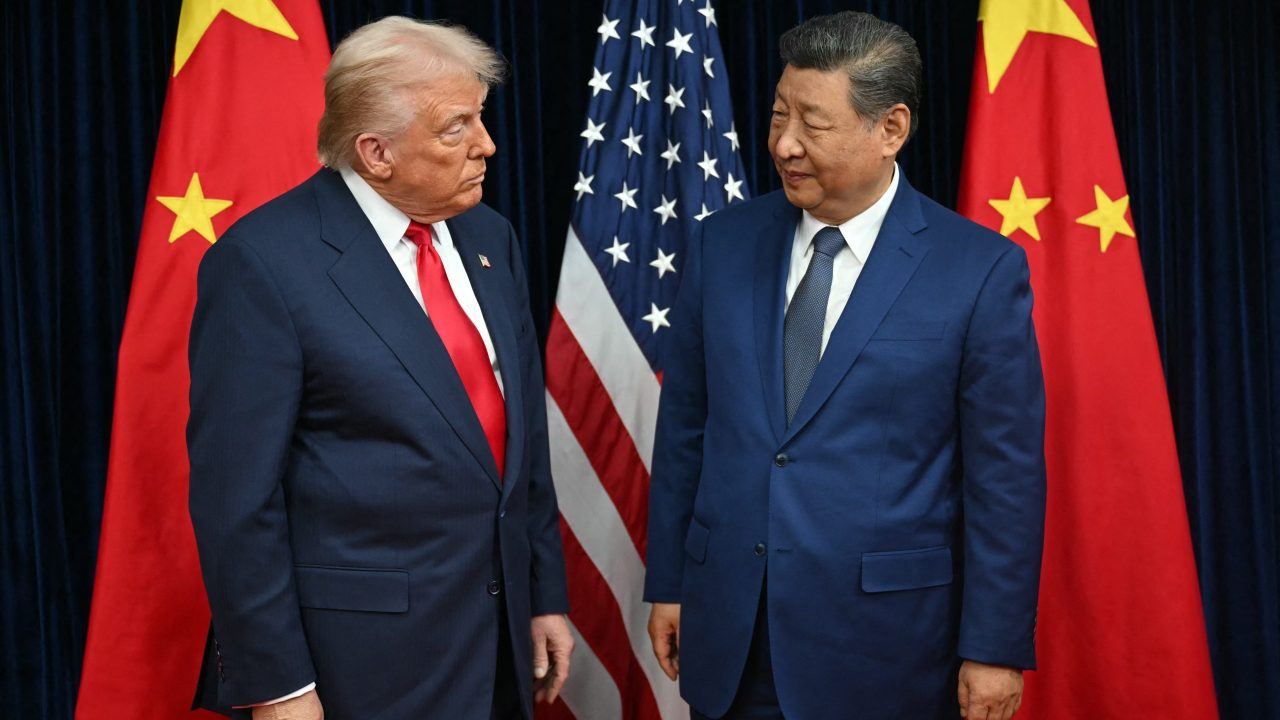
Anticipation is high this week as President Donald Trump prepares to travel to Beijing to meet with China’s leader, Xi Jinping (習近平), for the first time in his second term. Expectations for the outcomes of the summit, however, are low. That’s what Domino Theory found after asking leading U.S.-China experts on what they expect to see in Beijing later this week.
The U.S. and China have been enjoying a period of relative calm since agreeing to a trade truce during Trump and Xi’s meeting in South Korea last October. Yet the summit still comes at a fraught time for both countries, with the United States’ weapons stocks depleted from a war in Iran that has roiled global energy markets, while rapid advances in AI thrust new uncertainty into the world of cybersecurity.
With global chaos as its backdrop, analysts expect Trump and Xi to use the summit as a chance to build further stability on issues like tech and trade. “Neither side is looking to structurally improve the relationship,” said Amanda Hsiao, China director at the Eurasia Group. “The goal is to keep the truce going so that each side has the time and space to reduce their vulnerabilities and dependencies on the other.”
Despite years of decoupling efforts, the United States and China remain deeply reliant on the other in areas essential to their growing geopolitical competition. Chinese tech firms are desperate to get their hands on Nvidia’s AI chips, which continue to be subject to U.S. export controls. The U.S. is trying to avoid a repeat of last October, when China clamped down exports of rare earths, which make up critical components of the American automotive and weapons industries.
“I think Trump and Xi have come to the realization that we’re in a relationship of mutually assured destruction,” said Stephen Hartnett, a communications professor at the University of Colorado Denver who studies the history of U.S.-China relations. “No matter what their propaganda says, they need us. And no matter what Trumpian propaganda says, we need them.”
Jasmine Lee (李可心), an editor and contributor at U.S. Taiwan Watch, also expects Trump to prioritize stability in the relationship, while claiming victory no matter the outcome of the summit. Trump will always say it’s going to be a win, she said. That’s “100% going to happen.”
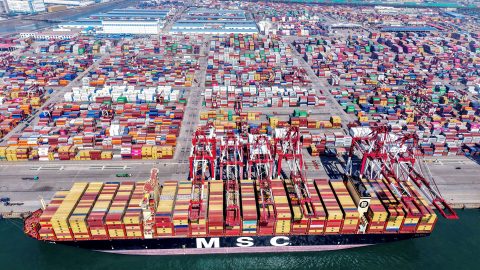
During past meetings with Xi, Trump has pushed for China to increase purchases of American goods, including agricultural products like beef and soybeans. The U.S. side has also pushed for China to buy more planes from aerospace giant Boeing, a rare area where the U.S. still maintains a significant technological lead over China.
“Trump is a MAGA president, and MAGA has been behind him in terms of recalibrating the trade relationships with many countries, including China,” said Stephen Nagy, a professor of politics and international studies at the International Christian University in Tokyo. “I think they expect him to come back with some kind of trade agreement that’s not only symbolic, but that has real significance for middle class Americans.”
Trump will be accompanied on his trip to China by a group of 16 U.S. business leaders including Tesla CEO Elon Musk and Apple CEO Tim Cook. While the U.S. side hopes to keep the focus on trade issues, Xi is likely to bring up Taiwan, whose legislature passed a new $25 billion special defense budget last week.
Xi has warned Trump in the past about American arms support for Taiwan, which is required under U.S. law. Congress already approved the first $11 billion worth of weapons covered under Taiwan’s new budget back in December, but the remaining $14 has been stalled in the executive branch, reportedly out of a desire to appease Beijing.
Trump said on Monday that he would talk to Xi about U.S. arms sales to Taiwan, a decision that appears to violate longstanding American policy prohibiting negotiation with China on the issue. “President Xi would like us not to, and I’ll have that discussion,” Trump said. “That’s one of the many things I’ll be talking about.”
Prior to meeting with Xi in South Korea last October, Trump told reporters aboard Air Force One that “Taiwan is Taiwan,” a remark that many interpreted as a positive sign for the United States’ commitment to the island nation. But it has not quieted concerns that Trump, who tends to show little regard for carefully calibrated diplomatic language, could yield to some version of China’s demands.
“Any shift away from the current position in the Shanghai Communique, in which the United States only acknowledges the Chinese position and [does] not agree with the Chinese position, would not be good for Taiwan,” Nagy said, referring to a 1972 document issued by the Nixon administration that helped form the basis of U.S. policy toward Taiwan.
“I think the best case for Taiwan is that President Trump says something affirmative about maintaining US policy, suggesting that he personally believes that it is important to uphold deterrence and is not going to negotiate on Taiwan’s status or arms sales with Beijing,” Zack Cooper, a senior fellow at the American Enterprise Institute, wrote in an email to Domino Theory. “I think that is unlikely, but that would be the best case outcome.”
A more realistic hope for Taiwan, according to Cooper, would be for the two leaders not to mention Taiwan at all. But that, he said, was also unlikely.
“Taiwan would breathe a sigh of relief if Beijing fails to extract meaningful concessions from the summit, such as Trump publicly declaring that he ‘opposes’ Taiwan independence or agreeing to scale back U.S. arms sales to Taiwan,” said William Yang (楊皓暐), a senior analyst at the International Crisis Group.
Haolan Wang (王浩嵐), a research associate at the Asia Society Policy Institute’s Center for China Analysis, said that the mere fact of an American president visiting China is a positive sign for the relationship. “Having that prestige of an American president on Greater China soil after eight long years is quite a diplomatic victory in itself.”


Leave a Reply