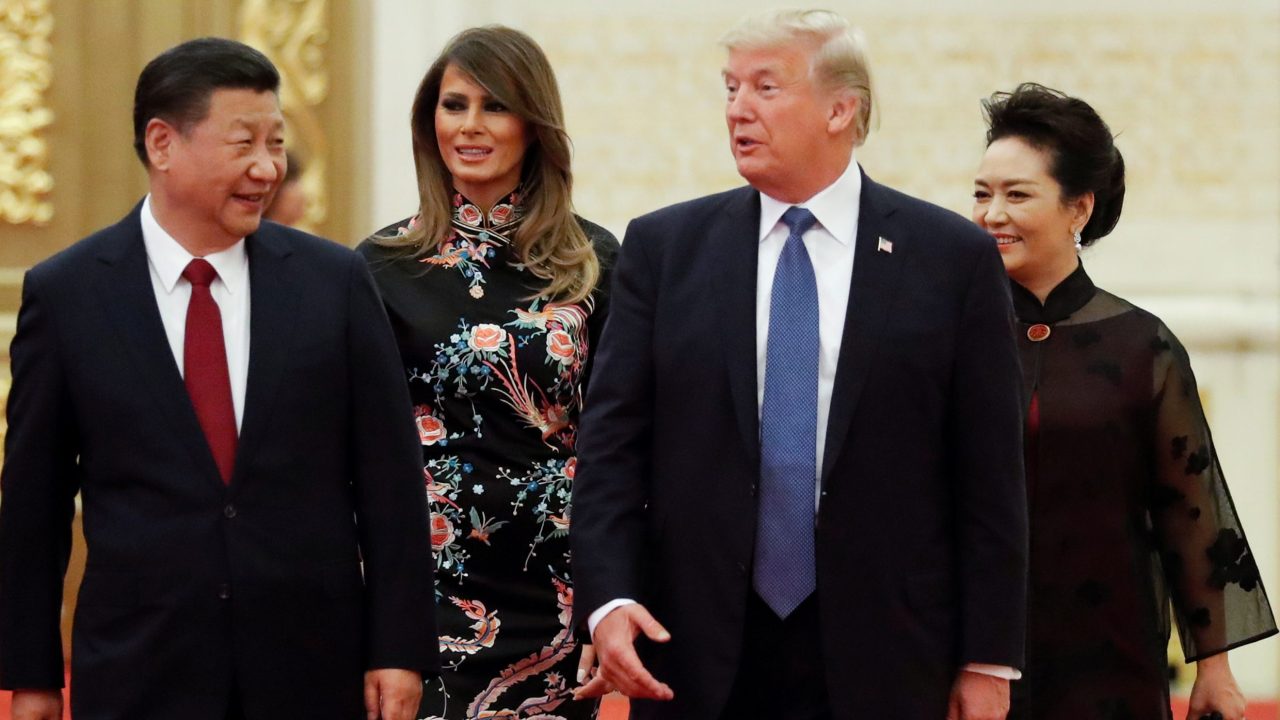
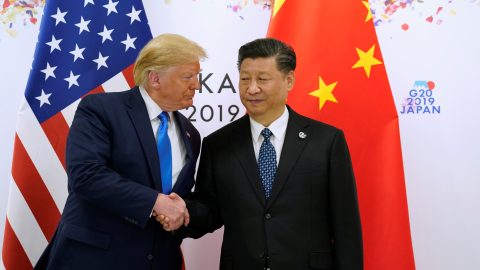
In 2019, at the G20 in Osaka, Donald Trump and Xi Jinping (習近平) met for 80 minutes. Over six years later, they are expected to meet again at APEC in South Korea.
Osaka was Trump’s last face-to-face meeting with Xi, taking place amid a trade war that Trump was desperate to turn into a big deal. In broad strokes, the situation is not so different in 2025.
“I think when Xi and I meet, every point will be agreed to,” Trump told reporters in February 2019, speaking about ongoing talks over what would become the Phase One trade deal. Trump later hinted at a summit at Mar-a-Lago in April, but Xi didn’t like the optics of being summoned.
Negotiations proceeded that spring with China’s lead negotiator, Vice Premier Liu He (劉鶴). Liu met with his counterparts at least six times. And on most, if not all of those occasions, Trump spoke with Liu himself — much more often than Xi spoke with the U.S. Trade Representative Robert Lighthizer and Treasury Secretary Steven Mnuchin.
In April, a 150-page document was drafted that would commit China to purchasing billions of dollars worth of American goods and substantial trade reform. But the deal was shot down at the last minute by China, reportedly by Xi himself because he believed it made him look weak.
Xi and Trump eventually met in June in Osaka, where they pledged to restart trade talks. When the Phase One trade deal was eventually signed in January 2020, Xi wasn’t there, presumably to save himself the embarrassment if the deal backfired. Liu put his signature next to Trump’s instead.
The oft-told legacy of Phase One is that China didn’t live up to its purchase commitments. Trump says this is because Joe Biden’s administration didn’t enforce it. Regardless, the deal was not the “historic” and “momentous” success that Trump initially touted.
Five years later, the sting of the Phase One trade deal might be why Trump raised tariffs to 145% in April, effectively placing an embargo on the import of Chinese goods. Trump wanted to bypass the protracted, staff-level negotiations of his first term and get Xi to the table, eager to strike a deal. The problem for Trump was that China was willing to go toe to toe.
On April 4, China restricted the export of seven rare earths that it has a monopoly on. These mined elements that are essential to producing cars, semiconductor chips and military technology. Even though China has restricted the export of critical materials before, this was the first time China wielded its rare earth leverage in full force against the U.S.
A former Trump administration official told Politico that following China’s restriction of rare earths, pressure from the auto and defense industries forced Trump to reach out to China. In short, China created pain, and Trump blinked.
The U.S. and China have conducted four high-level staff negotiations since then to establish a trade truce and work toward a deal on key issues including tariffs, fentanyl and TikTok. On the U.S. side are Treasury Secretary Scott Bessant, Commerce Secretary Howard Lutnick and U.S. Trade Representative Jamieson Greer. China’s lead negotiator is He Lifeng (何立峰), a long-time political ally of Xi whose “number one priority is implementing Xi’s directives.” He’s predecessor, Liu He, was more technocratic and reform-oriented, which could explain why he initially agreed to the 150-page draft trade deal that Xi later nixed.
Unlike in 2019, when Chinese deputy ministers arrived in Washington flanked by 30-person delegations of negotiators, the meetings that have occurred so far this time around seem to be mostly limited to the senior level, with some exceptions. Although Bessant hinted in August at “the makings of a deal” with China, the lack of mid-level engagement so far — which is required to hammer out the technical details of a trade deal — suggests that pushing forward a comprehensive trade agreement like Phase One will not be the focus of the Trump-Xi meeting at APEC. Perhaps Xi will make a loose commitment to purchase more American agricultural products like he did in Osaka in 2019. China has reduced these purchases this year, much to Trump’s chagrin.
Beyond staff-level negotiations, Trump and Xi have talked on the phone twice (officially) since April. In June, their phone call restarted negotiations that had stalled in part because China was dragging its feet on approving rare earth exports. After the call, Trump celebrated on Truth Social: “FULL MAGNETS, AND ANY NECESSARY RARE EARTHS, WILL BE SUPPLIED, UP FRONT, BY CHINA.” But after staff-level negotiations in London later that month, it became clear that China had not yet agreed to export specific military-use rare earths to the U.S., according to a Reuters report.
Trump and Xi talked again on the phone in September. Trump was characteristically enthusiastic about the call, particularly about Xi’s approval of a deal on TikTok, the framework for which had been negotiated by He, Bessant and others in Madrid earlier in the month. Coy as ever, the Chinese readout of the call did not confirm Xi’s approval.
With the trade war in a stalemate and talks on issues like TikTok and fentanyl ongoing, it is an open question as to how Trump and Xi will make use of their meeting at APEC. Suzanne Nossel wrote in Foreign Policy that for Trump, a summit doesn’t need to culminate some long diplomatic process but might rather be “a necessary stage in [his] own experiential foreign-policy education.”
Yet Trump might feel like he has something to prove. When North Korean leader Kim Jong Un and Russian leader Vladimir Putin flanked Xi during China’s National Day parade in September, Trump posted a message to Xi: “Please give my warmest regards to Vladimir Putin, and Kim Jong Un, as you conspire against The United States of America.” In Foreign Affairs, Jeffrey Prescott and Julian Gewirtz highlighted the inadvertent message this sent: “the American president, so often the prime mover of global politics, had become a spectator on the sidelines of a changing world.”
Moreover, Trump’s leverage when it comes to reshaping global trade has been called into question. His massive tariff retreat in April led to the virality of the term “Trump always chickens out” or “TACO.” With regard to the U.S.-China trade relationship, even people in Trump’s camp have mocked him for having a bad hand: Rare earths are the ace up China’s sleeve that Trump didn’t seem to plan for.
It is also no secret that Trump is desirous of a Nobel Peace Prize. In his inaugural address, Trump said that his “proudest legacy will be that of a peacemaker and unifier.”
Indeed, experts have been pondering whether Trump might use this opportunity at APEC to strike a grand bargain with Xi that resets U.S.-China relations. This could mean a change to the U.S.’s policy on Taiwan, as Beijing has reportedly been asking Washington to say that it “opposes” Taiwanese independence. Perhaps the cross-strait conflict is one that Trump believes (or could be convinced) he can solve before it really starts.
The reality is that we don’t know for sure what will happen when Trump and Xi meet at the end of the month. Will APEC follow the Phase One trade deal arc and be more about optics than substance? Or will Trump’s desire for some kind of Nobel Prize-worthy grand bargain lead him to bargain away Taiwan’s sovereignty?



Leave a Reply