
In the past day, tariffs on China have jumped from 54% to 125%. U.S. President Donald Trump’s 2.0 China policy is shaping up to be a supercharged version of Trump 1.0. But if Trump’s first administration was the success he claims it was, why is he upping the ante so intensely now?
The likely answer is that China proved to be a tough nut to crack during his first administration, and Trump remains somewhat befuddled about how to get Chinese President Xi Jinping (習近平) to do what he wants. Specifically, Trump’s escalatory tariffs might be informed by his experience with protracted negotiations over the Phase One trade deal six years ago. The question that remains is, what will these tariffs get him?
The Phase One trade deal that the U.S. signed with China in January 2020 was touted as a “historic” and “momentous” success by the first Trump administration. It was the result of the nearly two-year-long trade war, which Trump initiated with the imposition of 25% tariffs on $34 billion worth of imports from China in June 2018. Trump’s aim was to equalize the trade relationship between the U.S. and China. Specifically, Trump wanted to 1) make trade with China fairer by fixing structural issues like intellectual property theft, forced technology transfer and currency manipulation; and 2) rebalance trade by compelling China to purchase more American goods.
The journey to the Phase One trade deal was a long and arduous one, beginning in earnest in December 2018. It was primarily negotiated by the U.S. Trade Representative Robert Lighthizer and Treasury Secretary Steven Mnuchin on the American side, and Vice Premier Liu He (劉鶴) on the Chinese side.
One notable characteristic of these talks was the asymmetry in staff versus leader engagement at the negotiating table. Liu met in person with his U.S. counterparts at least six times to negotiate the deal. Liu spoke with Trump personally on most, if not all, of these occasions. In contrast, there appears to be only one primary instance of engagement between the American negotiators and Xi, which occurred in February 2019 at the Great Hall of the People in Beijing.
Nevertheless, Xi’s impact on the negotiations was acutely felt. Trump indicated in early February 2019 that he believed a personal meeting with Xi would be required to secure the deal. “I think when Xi and I meet, every point will be agreed to,” Trump told reporters. Later that month, Trump said that he expected to meet with Xi in person in April, potentially at Mar-a-Lago. But Xi didn’t like the optics being summoned by Trump to the U.S., and the face-to-face meeting didn’t happen.
Still, major progress on a trade deal was made with Xi’s surrogate, Liu. Trump indicated on April 4, 2019 that an “epic” trade deal could be expected in the next four weeks. Indeed, a 150-page draft that committed China to purchasing billions worth of U.S. goods and included substantial reforms to China’s trade practices was completed that month.
But on May 3, a last-minute intervention by China stalled the deal. Red lines were reportedly drawn through the U.S.’s core interests, including Washington’s request that Beijing implement an enforcement mechanism that would allow the U.S. to monitor China’s adherence to fair trade practices. According to Liu and the People’s Daily, Beijing ultimately objected because the U.S. was asking China to make changes to PRC laws, which is an infringement on China’s sovereignty. Some experts claim that it was Xi himself who intervened in the late stages, shooting down the deal because he believed it made him look weak.
Lamenting that China was trying to renegotiate in the twilight of the deal-making process, Trump slapped 25% tariffs on $200 billion worth of Chinese goods on a Sunday, less than two days after China returned the marked-up draft.
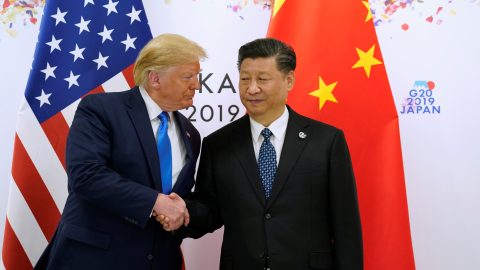
Trump and Xi eventually met face-to-face in Osaka, Japan on the sidelines of the G20 conference in June 2019. Here, they decided to resume talks about resolving the trade war but unsurprisingly didn’t come to any sort of resolution. The Phase One trade deal was ultimately signed several months later in January 2020, but without the enforceable structural changes to China’s trade practices that the Trump administration was hoping for. Driving home Xi’s overarching influence over the negotiations, the deal was signed by Trump and Liu, not by Xi. This ostensibly would save Xi the embarrassment if the deal were to reflect poorly on China.
The Phase One deal became even more of a flop for the Trump administration as time went on. While the deal gave Trump a big number to tout (China agreed to purchase an additional $200 billion worth of U.S. goods), it bore little fruit. Although the PRC claims otherwise, China fulfilled only 58% of its commitment. The Trump administration contends that the deal failed because the Biden administration didn’t enforce it. Whoever is to blame, this experience surely impacted how Trump is currently dealing with China.
Trump came into his second administration likely believing that he’s not going to get what he wants from China through protracted, staff-level negotiations. Instead, he chose to quickly accelerate extremely high, comprehensive tariffs (i.e., no exemptions for particular goods or companies). These tariffs were initially set at 10% on February 4, then raised to 20% a month later. On April 2, an additional 34% tariff was levied against China as part of Trump’s slew of reciprocal tariffs announced that day. After China retaliated with a 34% counter tariff, Trump raised the tariff rate an additional 50% on April 8. Then, when China added an additional 50% tariff yesterday, Trump raised tariffs again to a staggering 125%.
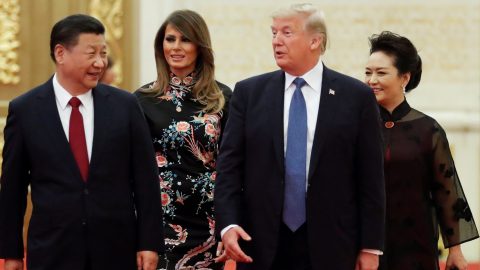
Throughout this tariff battle, Trump has repeatedly expressed a willingness to meet with Xi to resolve it. After hiking tariffs on China to 125%, Trump said, “President Xi — I like him, I respect him, sure I’d meet with him.” While Trump has already met with dozens of nations about reducing the reciprocal tariffs, he has not yet negotiated with China. Speaking to reporters yesterday, Trump said, “China wants to make a deal. They just don’t know how quite to go about it … They’re proud people. And President Xi’s a proud man.”
Will accelerating the situation with Xi lead to a better or worse outcome for Trump? This remains an open question. Trump has raised the tariffs to an utterly unsustainable level. Even if China is able to rally the spirit of strategic patience and place blame on the U.S. for domestic economic turmoil, any adverse impact to the daily lives of the Chinese population will rattle Xi.
However, Trump might be making things more difficult for himself by trying to force China’s hand and throw Xi off his negotiating rhythm. Xi evidently prefers to negotiate via his high-ranking staff across a longer timeline. The Phase One deal also highlighted that Xi might not want to be so closely associated with the negotiations. Now, if Xi comes to the table first, it will look submissive. China’s Commerce Ministry declared yesterday that China “has the firm will and abundant means to take necessary countermeasures and fight to the end.”
Trump might blink first. Perhaps, unlike Xi, Trump doesn’t consider hasty and contradictory movements to be submissive. As of yesterday, Trump has reversed all of the reciprocal tariffs he announced on April 2 (except for China) with a three-month reprieve. Retraction is also a cornerstone of his deal-making style, as described in the “Art of the Deal” — make an extreme demand first and negotiate something milder later.
When Trump and Xi do eventually hash it out, Trump’s unlikely to get everything he wants. Beyond tariffs, other major points of tension like the resolution of the TikTok dilemma and sale of the two Chinese-owned ports in Panama to BlackRock remain unresolved between the U.S. and China. Trump will probably try to get what he can get and then claim that’s all he wanted anyways.



Leave a Reply