
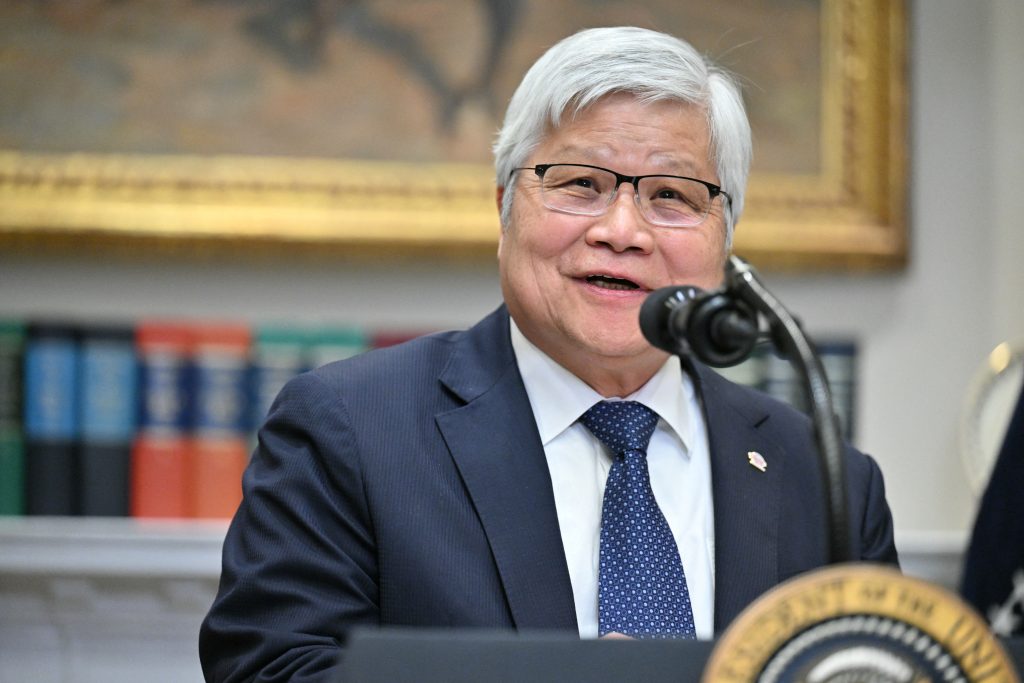
After arriving back in Taiwan from his visit to the White House, C.C. Wei (魏哲家), the chief executive of Taiwan Semiconductor Manufacturing Company, had to answer to the Taiwanese public.
“Life has been a little stressful lately” C.C. Wei joked, evoking chuckles from the crowd of reporters gathered in the Presidential Office to ask him about what TSMC’s $100 billion investment in the U.S. means for Taiwan’s heretofore dominance in semiconductor manufacturing.
Standing alongside Taiwanese President Lai Ching-te (賴清德), Wei gave plenty of assurances that this investment won’t affect Taiwan’s chip primacy. But the truth is that we don’t know the future, and many are understandably hesitant to make concrete predictions about how this will play out. The experts interviewed for this article largely agree that Taiwan will continue to be the center of cutting-edge chip manufacturing, at least for now. As for the rumored joint venture between TSMC and Intel, as Kristy Hsu (徐遵慈), director of the Taiwan ASEAN Studies Center at the Chung-hua Institution for Economic Research, put it, U.S. President Donald Trump “can only force [TSMC and Intel] to get married, he can’t force [them] to have a beautiful baby.”
Taiwan Will Continue to be the Center of Advanced Chip Manufacturing, At Least For Now
During his announcement of TSMC’s investment at the White House, Trump accurately observed how difficult it is to produce semiconductor technology. “It’s not a product that you can really copy,” he said. And yet, Trump claims that this investment will boost U.S. production of semiconductors to 40% of the global market share (the U.S. currently produces only about 12% of the world’s chips). Experts suspect this investment might not be the masterstroke Trump thinks it is.
Chun-Yi Lee (李駿怡), a professor of Taiwan studies and global development at the University of Nottingham’s School of Politics and International Relations, thinks this is an instance of political will twisting market logic. She believes Trump ultimately wants knowledge transfer from Taiwan to the U.S. But knowing how to make advanced chips does not automatically translate into the ability to mass produce them. American chip manufacturers like Texas Instruments and Intel failed to compete with TSMC not because they didn’t know how to make chips, Lee said, but because the cost of mass production in the U.S. was too high. Intel, for instance, has been contracting TSMC to manufacture some of its products since 1989.
Anywhere in the world, scaling semiconductor production is challenging. This is especially true at the cutting edge, where there are diminishing returns. The smaller and more advanced the chip, the more expensive it is to produce and the more difficult it is to maintain high yield rates, or the proportion of chips made from a wafer. Higher manufacturing costs in the U.S. exacerbate these difficulties.
The Semiconductor Industry Association estimated that a new fab in the U.S. costs 30% more to build and operate in the U.S. than in Taiwan. Other experts assess the cost of semiconductor production in the U.S. to be 150% to 250% more expensive due to the cost of labor and the difficulty of replicating Taiwan’s access to human and logistical capital. American chip fabricators also lack the closely integrated ecosystem of satellite companies that support chip production at incredible economies of scale in Taiwan.
Wong Chan-Yuan (王振源), a professor at the Institute of Technology Management at National Tsing Hua University, thinks that even if TSMC’s U.S. fabs are able to reliably produce cutting-edge technology, the most advanced chip manufacturing will remain in Taiwan for now precisely because the scaling is so difficult. Mass production first requires a lot of experimentation and prototyping to optimize yields, Wong noted, so it’s most economical for TSMC to commercialize chips in Taiwan before it replicates those manufacturing processes elsewhere.
Dan Nystedt, Vice President of TriOrient Investments in Taipei, said the simultaneous transfer technology from Taiwan to the U.S. isn’t feasible at the moment because it takes time to teach process engineers about how to put new chips into mass production. This process is facilitated in Taiwan by the high-speed rail, which can shuttle passengers down the length of Taiwan in mere hours. But flying engineers out to the U.S. would cause significant delays. “Down the road, it might be more possible to do a simultaneous or a more quick transfer, but it’s just not that easy to do,” said Nystedt, adding that a major hurdle “is the customers, because … they want their ships as fast as they can get them.”
John Lee, the Director of East West Futures Consulting, wrote in an email to Domino Theory that “However profitable the Arizona fabs are, the firm’s centre of gravity for both R&D and production will remain on Taiwan … So while an increasing proportion of the U.S. economy’s demand (including for the defense industrial base) is likely to be met from homeshored production, there is no prospect I can see of the U.S. becoming the main global location for chip fabrication.”
A Proposed Joint Venture Between Intel and TSMC
Reporting speculates that even after TSMC’s $100 billion promise, Trump has not taken tariffs off the table. This means that Trump might want to use tariffs or some other tool of economic coercion (like export controls) to extract more from TSMC in the future. But what else could he be looking for?
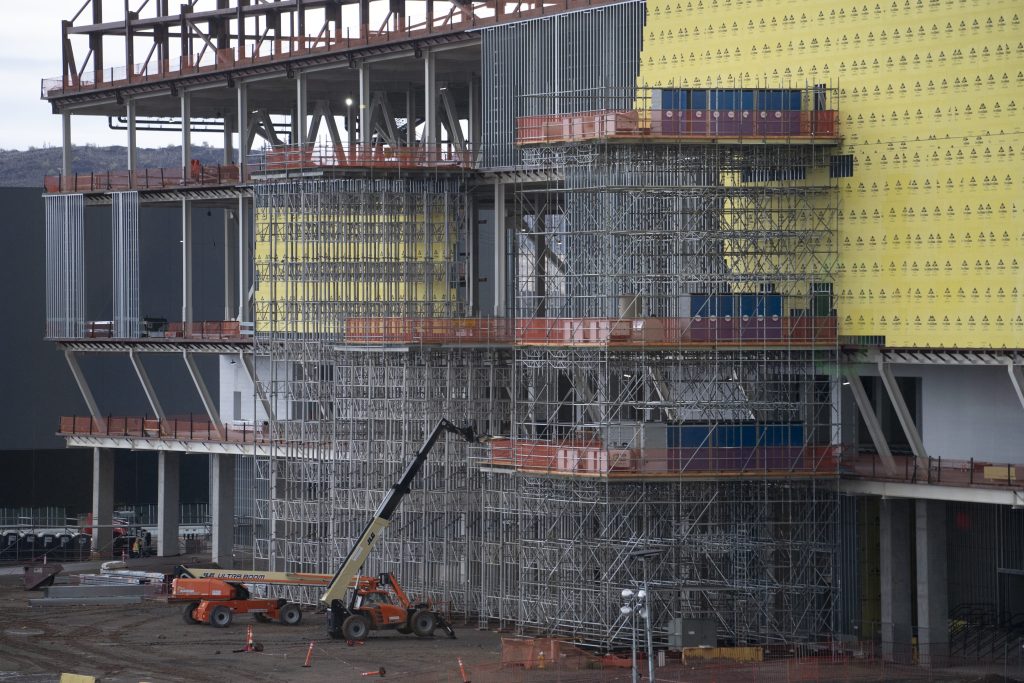
Before the announcement of TSMC’s new investment, many observers were predicting an announcement about some sort of joint venture between TSMC and Intel instead. In February, The New York Times reported that TSMC pitched a joint venture with Intel whereby TSMC would assume operational control over Intel’s foundry business and gain a majority stake in this business alongside a consortium of other companies. More recent reporting by Reuters indicates that talks are ongoing and TSMC has pitched this consortium idea to Broadcom, Nvidia and AMD.
The revival of Intel is important to the Trump administration, and reporting suggests that the administration is interested in this deal going through. As far as it lags behind, Intel is still Trump’s best bet for the revitalization of American chip manufacturing. “Intel is a perfect candidate to receive the recipe. But whether they can make a cuisine is a really big question mark,” said Chun-Yi Lee, the professor of Taiwan studies at the University of Nottingham.
Nystedt thinks that what Intel really needs is not necessarily the process technology (i.e., the recipe), but more capital and more time. Intel put a lot of cash into foundry expansion under the leadership of their previous CEO, Pat Gelsinger. “You can look at their financials, and you can see that they’re burning through cash. If you run out of cash, you’re a dead business, even if you’re profitable.” Intel needs a cash injection, and this is especially true if Trump figures out how to cancel CHIPS Act funding. Intel also needs time to develop relationships with customers (i.e., chip designers) who trust that Intel won’t create massive problems for their companies by messing up their orders.
It remains unclear what will come of TSMC’s pitch to Intel. The recent appointment of Intel’s new CEO, Lip-Bu Tan, has created further speculation that Intel may no longer be interested in cleaving its foundry business.
From the U.S. perspective, a joint venture wouldn’t fix the vulnerability created by the U.S.’s almost total reliance on TSMC, according to Nystedt. “I don’t see how [TSMC taking over Intel’s fabs] makes sense if you’re trying to build a robust ecosystem for the industry that has multiple manufacturers. I mean, TSMC would become bigger, that’s it,” Nystedt said.
What would make more sense, said Nystedt, would be for TSMC — possibly in coordination with chip design firms like Nvidia — to invest some amount of money into Intel’s foundry business. For TSMC, showing that it doesn’t want to destroy its competition would be helpful in countering potential future antitrust investigations. An investment like this would also be good for Intel, which needs capital, and the U.S. government, which seeks to bolster American semiconductor manufacturing.
What Taiwan Should Do
Much of this has yet to play out. Without knowing the outcome of TSMC’s venture into the U.S., something that is apparent at this moment is a sense of anxiety among the Taiwanese public about the transfer of TSMC’s core technology to the U.S. and the weakening of the “silicon shield,” or the idea that the strength of Taiwan’s semiconductor industry lends it physical security from Chinese invasion.
Government officials have assured the public that the most advanced chip technology will remain in Taiwan, but there is no legal mandate guiding their decision. While there is a law that blocks the “illegal leakage” of chips under 14 nanometers, a TSMC investment project in the U.S. that is approved by the Ministry of Economic Affairs wouldn’t count as a leakage, Hsu told Domino Theory. “In this regard, there are loopholes in our current policy,” said Hsu. But passing more comprehensive legislation would be challenging now that Trump is president due to the fear that it could be interpreted by D.C. as subverting Trump’s wishes.
With all of this in mind, Chun-Yi Lee thinks that Taiwan needs to diversify its offerings in the global technology value chain and do so quickly. “This is so crucial for Taiwan, we can’t just rely on the chips any longer.”



Leave a Reply