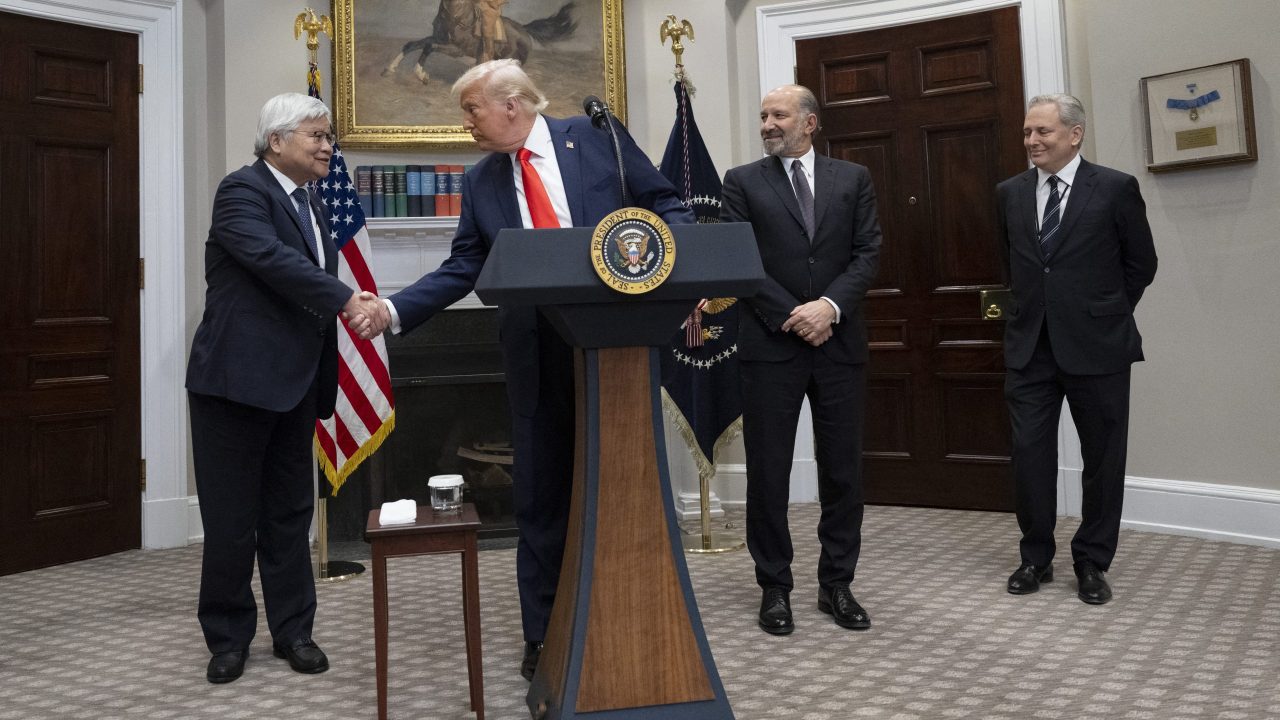
Donald Trump on Monday confirmed that his threat to impose tariffs on Taiwanese semiconductor chips was just that — a threat. TSMC CEO C.C. Wei (魏哲家) joined Trump in the White House to announce an additional $100 billion investment into five new semiconductor manufacturing facilities in the U.S., including three new fabs and two packaging facilities, as well as an R&D research center.
“This is a tremendous move by the most powerful company in the world,” Trump said. And he’s right. Combined with the $65 billion TSMC is already spending to build the first three fabs in Arizona, this amounts to the largest foreign direct investment in American history.
However, the announcement prompts a raised eyebrow, as well as several questions. First, Trump stated that this capital will be invested over “the next short period of time” but semiconductor fabs take several years to build. TSMC’s first fab in Arizona, which was announced during Trump’s first administration in 2020, is only starting mass production of advanced chips this year. Since Trump has less than four more years as president, what’s the recourse if TSMC delays investment or ultimately doesn’t fulfill its promise? It remains unclear how efficient these fabs will be, so it’s possible that TSMC decides to scale down its investment in the U.S. if the next administration proves friendlier.
Ping Wang (王平), a professor of economics at Washington University in St. Louis, believes that the most significant investment TSMC will have to make into its Arizona fabs is human capital — high skilled workers who are willing to work long hours and who are loyal enough to the company to not leak information — and organizational capital, or the logistics of harnessing human capital. Wang predicts that developing human and organizational capital in the U.S. will be more expensive than in Taiwan by 150% to 250%.
Second, we shouldn’t be fooled by Trump’s implication that his tariff threats alone spurred this investment. Kristy Hsu (徐遵慈), director of the Taiwan ASEAN Studies Center at the Chung-hua Institution for Economic Research, told Domino Theory that if the tariffs had been implemented, the burden on Taiwanese chip companies would have been comparatively low — U.S. consumers would have ultimately paid the price. A significant piece of leverage that the U.S. government does have over TSMC is its ability to restrict the flow of American intellectual property and chip-making tools that TSMC relies on (Taiwan imports upwards of $5 billion worth of semiconductor manufacturing equipment from American toolmakers each year). The result is that TSMC has very little room to say no.
However, the fact that this new investment includes two packaging facilities could make it easier for the U.S. to impose chip tariffs in the future. Chips need to be packaged after they are fabricated and this is typically done in a separate facility. One critical shortfall of TSMC’s original greenfield investment in Arizona is that those chips ostensibly would have to be shipped to Taiwan for packaging because Taiwan dominates the industry in advanced chip packaging, while the U.S. occupies less than 5% of the market. With TSMC’s help, the U.S. could eventually impose tariffs on foreign chips without subjecting American chips to tariffs upon reentry.
Third, Trump stated that “the most powerful chips in the world will be made here in America” but the Taiwanese government technically has the regulatory authority to block this investment if it believes the technology that is being exported is too advanced. It is a matter of practice (not law) that chip manufacturing in Taiwan remains two generations ahead of chipmaking done by Taiwanese companies abroad, Kristy Hsu noted. Responses by Taiwanese officials to the announcement so far have been positive, yet it remains unclear how advanced the chips the new fabs will produce will be.
It would be sensible for these new fabs to include a focus on mature chip technology. Trump mentioned during the press briefing that this investment is “very exciting for the automobile companies,” which rely on mature chips for 95% of their semiconductor needs. The U.S. is lacking in this technology and needs to head off China’s burgeoning ability to dump mature chips into the U.S. market.
The final question concerns what this investment means for Taiwan’s security. Trump’s rhetoric toward TSMC and Taiwan was more subdued and friendly than it has been in recent memory — he didn’t accuse Taiwan of stealing the U.S.’s semiconductor industry but rather flattered C.C. Wei and TSMC, marvelling that the company is able to put information into an area as small as “the point of a pin.”
Some believe that Taiwan’s chip industry acts as a silicon shield, protecting it from Chinese invasion. The idea is that Taiwan’s chip industry is too important to the U.S. to lose. The worry created by TSMC’s expansion into the U.S. is that the U.S. will in turn be less willing to defend Taiwan. Trump stoked this fear during the press briefing when he said that TSMC’s presence in Taiwan “will at least give us a position where … in this very very important business we would have a very big part of it in the United States. So it would have a big impact if something should happen with Taiwan.”
The question for those concerned about Taiwan’s security is whether Trump is right that this investment could sufficiently reduce the impact of a Chinese invasion of Taiwan on the U.S. economy. But even if Trump is wrong, does it make much difference if he and other U.S. leaders believe it to be true?


Leave a Reply