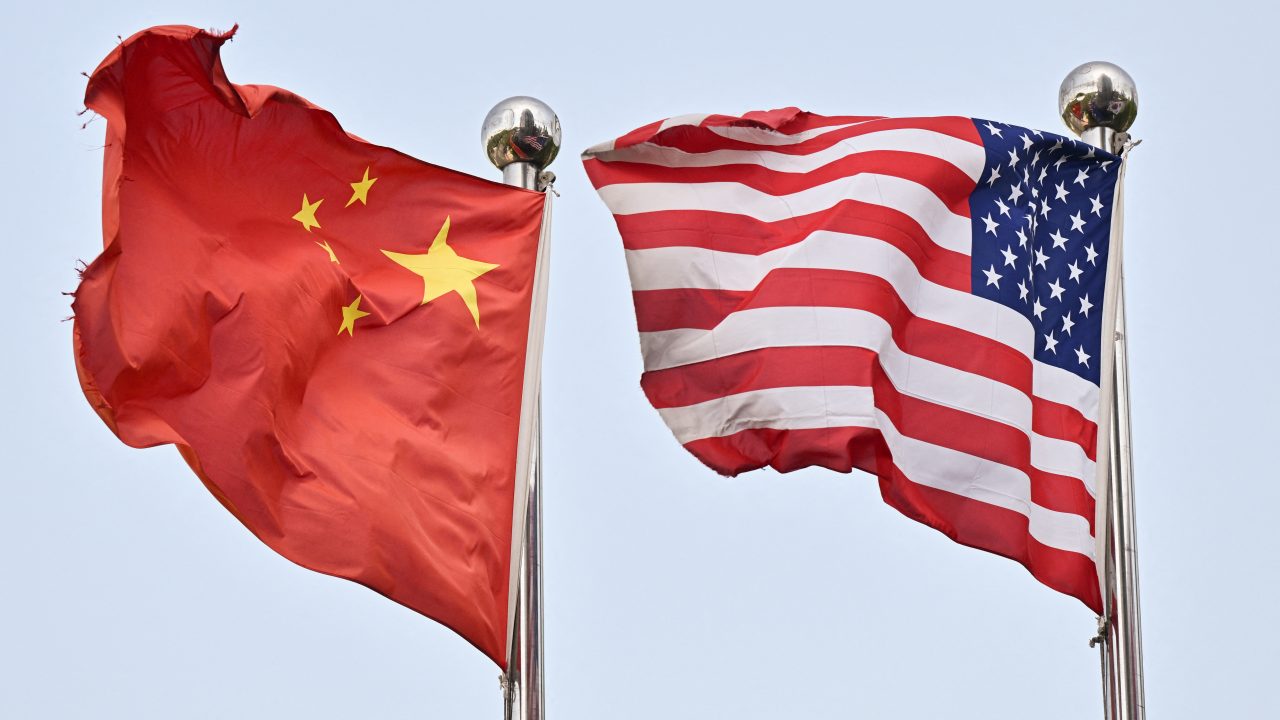
Last week, the U.S. House Select Committee on the Chinese Communist Party sent a letter to the United States Heartland China Association, accusing the non-profit of partnering with organizations tied to the Chinese government.
“I write to request verifiable assurances that the United States Heartland China Association is not operating as an unregistered agent of the Chinese Communist Party or the People’s Republic of China (PRC) government and enabling a foreign adversary to covertly influence our local state officials in support of its political objectives,” the letter states.
The letter is the latest in a string of actions taken by John Moolenaar, the Republican chairman of the committee, intended to raise awareness of Chinese United Front operations within the United States.
The United Front Work Department is a division of the Communist Party aimed at expanding China’s influence abroad. Under Chinese President Xi Jinping’s (習近平) leadership, the organization has sought to influence public discussions related to issues sensitive to Beijing, such as the status of Taiwan, and the party’s suppression of ethnic minorities in Tibet and Xinjiang.
The United Front Work Department operates in partnership with various overseas Chinese community organisations. Some of these — such as Chinese Students and Scholars Associations, which purport to serve as non-political support networks for students studying abroad — are ostensibly non-political. Others defend the Communist Party more openly.
United Front work is “a unique blend of engagement, influence activities, and intelligence operations” used by the Chinese Communist Party to “shape its political environment, including to influence other countries’ policy toward the PRC and to gain access to advanced foreign technology,” according to the China Select Committee.
“Heartland China should immediately terminate its relationship with all CCP United Front actors and cease serving as a pawn in the subnational influence operations of our foremost foreign adversary,” Moolenaar wrote in his letter, using the acronym for the Chinese Communist Party.
The United States Heartland China Association describes itself as a “bipartisan organization committed to promoting a stable and productive U.S.-China relationship that serves the interests of our communities.”
The organization serves a wide swath of states across Middle America, stretching from Kentucky to Colorado and Minnesota to Texas. Its goals include expanding U.S. agricultural exports to China and educating young people in the region about China and its culture.
“Not all bridges are built of concrete and steel,” Heartland China’s website reads. “Equally important bridges are built on friendship, cultural communion and commercial cooperation.”
The letter, which was addressed to Heartland China’s Chairman and President Bob Holden, accuses the organization of having “a long history of dealings with other associations in the United States whose leaders have extensive ties with the CCP’s United Front system targeting Americans.”
Moolenaar’s letter claims that Heartland China has partnered with the U.S. Chinese People’s Association for Friendship with Foreign Countries, or CPAFFC, to bring local-level U.S. officials on trips to China “with the clear aim of influencing their views.”
CPAFFC is a nonprofit that was founded in 1974 to “develop and strengthen friendship and understanding between the peoples of the United States and China,” according to its website. In October 2020, the U.S. government officially designated it as a foreign mission. “The goal of this action is to shine a light on this organization and make clear that their messages come from Beijing,” Secretary of State Mike Pompeo said at the time.
A June 2024 report by the Jamestown Foundation concluded that: “CPAFFC supports people-to-people diplomacy, public diplomacy, and city-to-city diplomacy to advance the Party’s global agenda beyond the reach—and notice—of national governments overseas.”
CPAFFC did not immediately respond to a request for comment.
Moolenaar also highlights Heartland China’s ties to the China-United States Exchange Foundation, or CUSEF, which he referred to in a 2020 letter to Columbia University as “an instrument of the CCP’s approach to political warfare, including influence operations intended to shape American’s views” toward the Chinese government.
In 2018, the University of Texas at Austin declined to accept a grant from CUSEF to support its newly established China Public Policy Center. At the time, CUSEF was vice-chaired by Tung Chee-hwa (董建華), the former chief executive of Hong Kong and vice chairman of Beijing’s top advisory body.
“With this decision, UT has exemplified the mindset America’s academic institutions must adopt to counter the PRC’s influence operations,” Texas Sen. Ted Cruz wrote in a tweet at the time.

Heartland China’s board of directors boasts high-profile members. Holden, the board’s chairman, was governor of Missouri from 2001 to 2005. The vice chair is Susan A. Thornton, a Senior Fellow at Yale Law School who served in Asia for the U.S. State Department for almost three decades.
“The staff of U.S. Heartland China Association have told the committee that they are working with attorneys to dispel the Committee’s misunderstanding of the organization’s work,” Thornton wrote in an email to Domino Theory, referring to the China Select Committee that Moolenaar chairs.
Heartland China’s executive director Min Fan (范敏) echoed Thornton’s statement in an email to Domino Theory. “We acknowledge receipt of that letter and look forward to clarifying the committee’s misunderstanding of our important work on behalf of US Heartland stakeholders, farmers, businesses and students,” she said. “We are working with our attorney to respond to the Committee’s requests.”
In February 2024, Mayor Sue Finkam of Carmel, Indiana, declined to renew the city’s membership with Heartland China following a Washington Post report describing China’s courtship of her predecessor. “As stated previously, the Chinese Communist Party will have no influence over the City of Carmel,” Finkam said at the time.
The most recent news item on Heartland China’s website was an article by Kenneth M. Quinn, a former U.S. Ambassador to Cambodia who now serves as a strategic advisor for Heartland China, describing a speech he recently delivered in Muscatine, Iowa, to commemorate the Lunar New Year.
In it, he wrote that the “days leading up to the start of the Year of the Horse … were particularly auspicious in that they represent the anniversary of then Vice President Xi Jinping’s February 15, 2012 visit” to Muscatine. Quinn’s recollections are displayed next to a snapshot of a recent headline from the CCP-run newspaper China Daily that reads: “Iowa friends salute warm ties with Xi.”





Leave a Reply