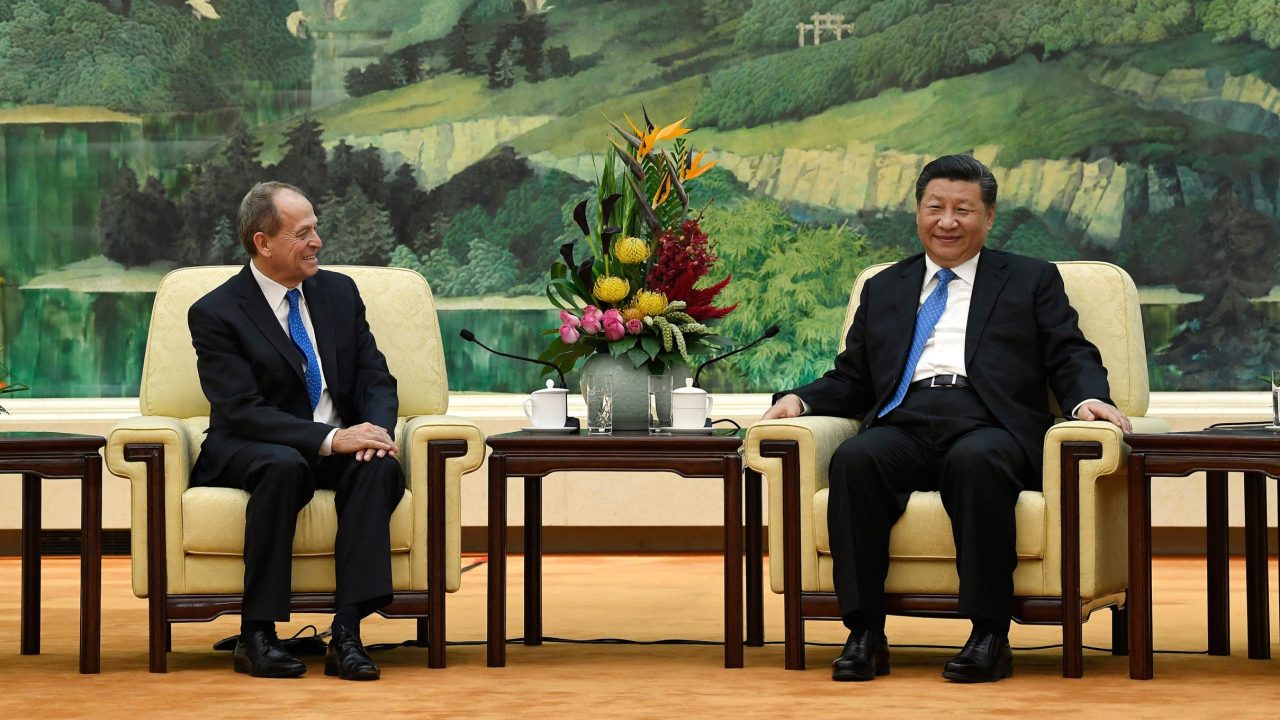
The 48 Group Club, a British organization that promotes business and cultural ties with China, was called out by the Interparliamentary Alliance on China, or IPAC, earlier this month for its “troubling ties” to the Chinese Communist Party.
In a letter to Jack Perry, the current chairman of the 48 Group Club, IPAC described the group’s connection to alleged Chinese Communist Party agent and spy Yang Tengbo (楊騰波) as particularly concerning. Yang was an honorary board member of the 48 Group Club until the British government deemed him a threat to national security and banned him from the U.K. in 2023. Yang also reportedly had close ties to united front work, a set of activities that aims to build relationships, shape perceptions and align influential voices with the Chinese Communist Party’s interests.
“The CCP sees the 48 Group as a tool for its ability to shape British narratives and for elite capture,” IPAC wrote, using the acronym for the Chinese Communist Party.
The letter requests that the 48 Group Club reveal due diligence assessments it conducted when expanding partnerships with individuals associated with the Chinese Communist Party, including Yang, and any agreements or contracts it has with Chinese members of the group, such as former Chinese Vice President Li Yuanchao (李源潮) and former Chinese Vice Minister of Foreign Affairs Fu Ying (傅瑩). Signatories include U.S. Representative John Moolenaar, U.S. Senator Merkley and U.K. ministers of parliament Iain Duncan Smith and Sarah Champion.
The 48 Group Club has said that it is “not a ‘pro-CCP’ body” or “in any sense a vehicle for Beijing,” but its leaders regularly parrot party talking points. Chinese leader Xi Jinping (習近平) even awarded Stephen Perry, the Honorary President of the 48 Group Club and Jack Perry’s father, a China Reform Friendship Medal in 2018. “China is already enormously influential in the world, but I think there’s much, much more to come,” Perry said at the awards ceremony.
The 48 Group Club has enjoyed access to political and economic elite in the U.K., too, where the 48 Group Club’s ideology lies closer to the “political fringe,” according to Mareike Ohlberg, a China expert at the German Marshall Fund who spoke to Domino Theory last fall. While the group may not be particularly rich or influential, “they still run an effective format that a lot of people use. And that’s ultimately why they’re relevant,” Ohlberg said.
IPAC’s letter cited Domino Theory’s previous reporting about the 48 Group Club’s ties to the Labour Party and the current U.K. government. Former Labour leaders Tony Blair, Jack Straw and Peter Mandelson were listed as fellows as recently as August 2025. While each have been photographed at events connected to the 48 Group Club, mainly in the 2000s and early 2010s, all have denied membership except Mandelson, who was pictured with Stephen Perry and Xi in 2018. Prime Minister Keir Starmer’s National Security Advisor, Jonathan Powell, was also listed as a fellow. “I’ve never heard of them,” Straw, the former home secretary, said in 2020, only to have The Times publish a picture a few days later of him receiving a fellowship award from the 48 Group Club in 2007. “I’d completely forgotten about that,” Straw said after seeing the picture.
It appears that the 48 Group Club had been casually awarding fellowships, not requiring much, if any, obligation in return. This would explain why several people have expressed confusion about being listed on the website. Sometime between August and October 2025, the 48 Group Club took down their list of fellows entirely, according to web archives.
But this doesn’t mean that the group isn’t both directly and indirectly connected to people with influence in the Starmer government. For one, 48 Group Club events, including its annual New Year’s celebration, gather British heavyweights in the private sector like HSBC, Barclays, KPMG and Circle Health. Labour courted U.K. business and finance in the years leading up to its victory in the 2024 British elections, building close relationships with people who would become key figures in the government like Chancellor Rachel Reeves. HSBC donated over GBP 75,000 (roughly $100,000) to Starmer’s campaign, and HSBC executives now visit Reeves in Whitehall. The bank also accompanied Starmer on his trip to Beijing earlier this year.
Greg Jackson, the CEO of Octopus Energy, is another British executive who traveled with Starmer to Beijing this year and who has strong ties to the 48 Group Club. Octopus Energy is the largest energy provider in the U.K. and has been involved in almost every publicized 48 Group Club event that’s taken place in the country over the past year, with Jackson giving a keynote address at one and receiving an award at another. Jackson formerly led the pressure group LabourList and currently serves as an advisor for Starmer on the Cabinet Office board. Octopus Energy has been urging the U.K. to “embrace Chinese technology in its energy market,” according to The Financial Times.
Another individual connected to both the 48 Group Club and the Labour government is David Sayer, a former vice chair of KPMG who currently serves as a non-executive director for the governance body that oversees the Department for Business and Trade, a ministerial department focused on economic growth. Sayer has been actively involved with the 48 Group Club in the past decade, giving a speech at the 48 Group Club’s 2021 New Year’s dinner. He also attended the awards ceremony when Stephen Perry won the Chinese friendship medal in 2018. Sayer previously sat on the board of the China-Britain Business Council, a more mainstream organization that regularly convenes the highest levels of British political and economic elite, including Labour government leaders.
The China-Britain Business Council and the 48 Group Club not only regularly collaborate but also have a shared origin: The original 48 Group of Companies, established by Jack Perry’s grandfather, also called Jack Perry, merged with the Sino-British Trade Council in 1991 to form the body that later became the China-Britain Business Council. The 48 Group Club was established as an outgrowth of that legacy.
There also exists an interesting overlap in the language used by the Starmer government and those associated with the China-Britain Business Council and the 48 Group Club to describe what ideal China policy looks like. Keith Bennett, the vice chair of the 48 Group Club who also leads an explicitly marxist organization called Friends of Socialist China, wrote a China Daily op-ed in 2022 that argued that the U.K. needs a “grown-up” China policy that tightens ties and doesn’t attempt to contain China’s rise. Sherard-Cowper Coles, a former HSBC executive and former chair of the China-Britain Business Council, said in 2021 that those who “grow up” and pursue an “adult” approach to China could benefit from engagement. Starmer’s government started using the phrase “grown-up” to describe its China approach in 2024. When visiting Beijing in January, Starmer told the business delegation that it was time for a “mature” relationship with China, the Australian Broadcasting Corporation reported. He told Xi that the U.K. wants a “sophisticated” relationship with China.
Starmer’s “grown-up” China policy has emphasized “pragmatic” engagement that pursues closer economic ties. Some believe this approach has led the government to compromise on national security, including allowing the prosecution service to drop charges against two men accused of spying for China and approving the controversial new 20,000 square-meter Chinese embassy in central London.
The 48 Group Club’s influence on these decisions may not be decisive, but united front work rarely is.







Leave a Reply