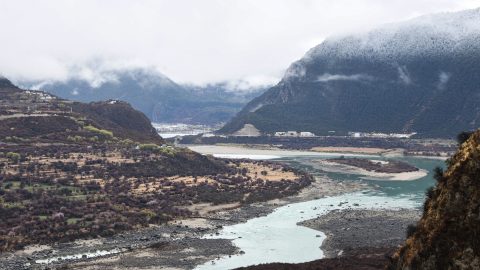
When the Chinese government greenlit the world’s largest dam in Tibet at the start of this year, activists and academics sounded the alarm. The dam is set to impact the water supply downstream. It will devastate traditional Tibetan holy sites. And it joins the large lithium mining operations in the area in potentially exacerbating the melting of Himalayan ice caps — which store vast amounts of carbon dioxide — and risking poisoning water supplies.
The consequences of hydropower and lithium mining projects in Tibet serve as a warning. There is no magic green swap on offer, whereby fossil fuels can simply be replaced by green energy. Green energy itself comes with powerful environmental — and specifically climactic — impacts. Even if the benefits outweigh the losses, a simple fact should be confronted: an insatiable thirst for energy to feed production increases has no consequence-free fix.
Cut to: Zambia, over 8,000 kilometers away, where a very similar story is playing out.
The ‘Dead’ River
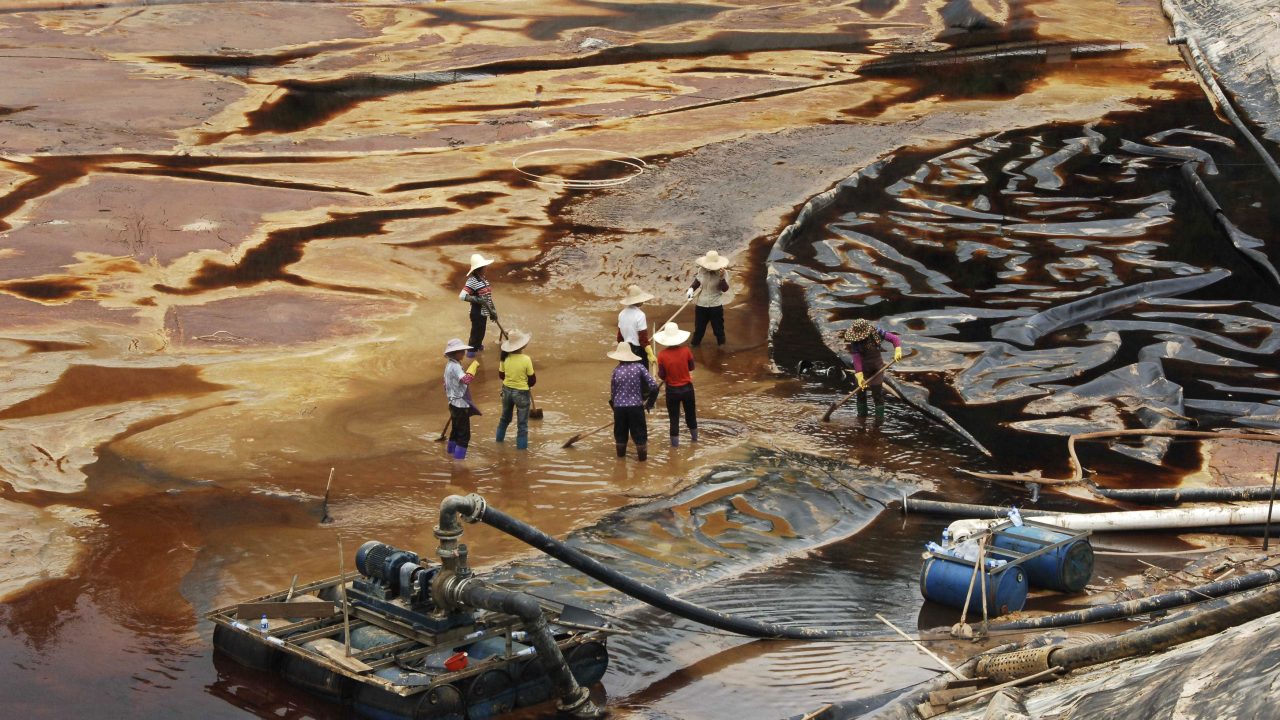
On February 18, a dam failed and a Chinese-owned copper mine spilled 50 million liters of acidic effluent into the Kafue River, damaging the lives of millions of people as pollution was detected at least 100 kilometers downstream.
Water supply was cut off in nearby towns. Fish populations have been devastated. Groundwater has likely been contaminated. Crops have been destroyed. And huge amounts of livestock have been killed, crashing the livelihoods of farmers.
“Prior to the 18th of February this was a vibrant and alive river,” Sean Cornelius, a local resident, told the Associated Press. “Now everything is dead, it’s like a totally dead river. Unbelievable. Overnight, this river died.”
“People unknowingly drank contaminated water and ate affected maize. Now many are suffering from headaches, coughs, diarrhea, muscle cramps and even sores on their legs,” Nsama Musonda Kearns, executive director of the Care for Nature Zambia NGO, told Climate Home News.
The Pattern
The company responsible for the February 18 spill is Sino-Metals Leach Zambia, which is majority owned by the state-run China Nonferrous Metals Industry Group (中國有色礦業集團公司). But it is not alone.
This year, four copper mining companies — one British and three Chinese — have been accused of releasing toxic mining waste into the Kafue River.
Chinese imports of Zambian copper were worth up to $4.05 billion in 2023, according to the United Nations COMTRADE database on international trade, and Chinese companies own many of the copper mines in the country.
Those companies’ records of environmental and worker safety have long been treated with skepticism. There have been clashes with miners over unfair pay and conditions and in 2018 there were riots against Chinese businesses. Zambia’s Ministry of Green Economy and Environment raised concerns about the Sino Metal dam that broke as far back as 2023.
Acquiring copper, which is used as a conductor in a wide range of renewable energy systems, including wind turbines, solar panels and electric vehicles, is regularly having a disastrous effect on Zambian people and their environment. And it forms part of a larger pattern.
“We’re moving into a political domain in which people understand you need to grab resources — food resources, mineral resources — and you need to create a hinterland and you need to control those hinterlands …” Martin Mills, director of the Scottish Centre for Himalayan Research at the University of Aberdeen explained a recent Institute for Security and Development Policy online event.
China and its companies are by no means alone in doing this. But it is certainly a useful description of their operations in Zambia.
NGO Response
Zambia’s government, which has committed to a green transition, has announced an independent investigation into the spills. But there has also been a civil society response. Environmental justice organizations called for further regulation of the industry and urged the Zambian government to prosecute the Chinese companies for environmental crimes.
There has been a “pattern of gross corporate negligence and inadequacies in environmental compliance, oversight and enforcement,” a shared statement from almost a dozen local environmental groups said, while calling for urgent reforms of the mining sector.
What is not being called for is an end to the mining, though. And there is a clear reason for this. Eighty-five percent of Zambia’s exports come from copper. Its economy, and ordinary people’s livelihoods, rely on it. And there is a view that whoever is doing it, it is a dirty business. This means the focus is on enhanced regulation, rather than outright bans.
“Chinese companies have a reputation locally and globally of having weak safety and environmental compliance, and this reputation is known before we give such companies the opportunity to mine or operate in Zambia,” Timothy Kamuzu Phiri, director and co-founder of Mizu Eco-Care, a Zambian environmental organisation that was one of the signatories to the statement mentioned above, told Domino Theory.
“So regardless of who the investor is or what their country of origin is, our environmental laws and policies should be strong enough to hold any investor accountable and ensure there is compliance to our safety and environmental standards — especially if they have a reputation of poor compliance to safety and environmental regulation standards.”
Kamuzu Phiri said the key question that should be asked now is why the government agencies responsible for environmental regulation and safety are failing to implement their mandate with such devastating consequences to the environment, wildlife and local communities’ livelihoods.
‘Clean’ Mining
There may be a few answers to that question — limits of state capacity and unhelpful incentive structures have come up in other examples. But whichever way one looks at it, all of them make the deliberate ignorance elsewhere about what green mining requires look ugly.
The British Museum’s mineral department’s section on potential “green” mining projects in the U.K., for instance, cheerfully says the U.K. must wait until it can be done safely. It makes no mention of the fact that countries like Zambia have not been given that option. And nor do the slick adverts for electric vehicles which appear in richer countries.
The hidden truth is, simply, messier. “[I]t is not possible to entirely mitigate against the damaging impacts of copper mining, hence the need for stricter environmental protection compliance and tougher penalties for polluters,” Kamuzu Phiri told Domino Theory.
“The very nature of mining entails irreversible damage to landscapes and the extraction of diminishing resources, the fact that you can never put back what you extract from the ground means mining is not sustainable — it can never go on forever. So there can never be such a thing as sustainable mining nor clean mining, only responsible mining is possible.”
These facts should not be used to excuse the catastrophic burning of fossil fuels. But they should be recognized by anyone pitching green energy as a panacea. Or anyone who wants to think of China or Britain as green success stories to contrast with the U.S.’s enthusiastic embrace of fossil fuels.
Endless increases in energy consumption don’t come for free. And Zambia’s “dead” river is the latest proof.





Leave a Reply