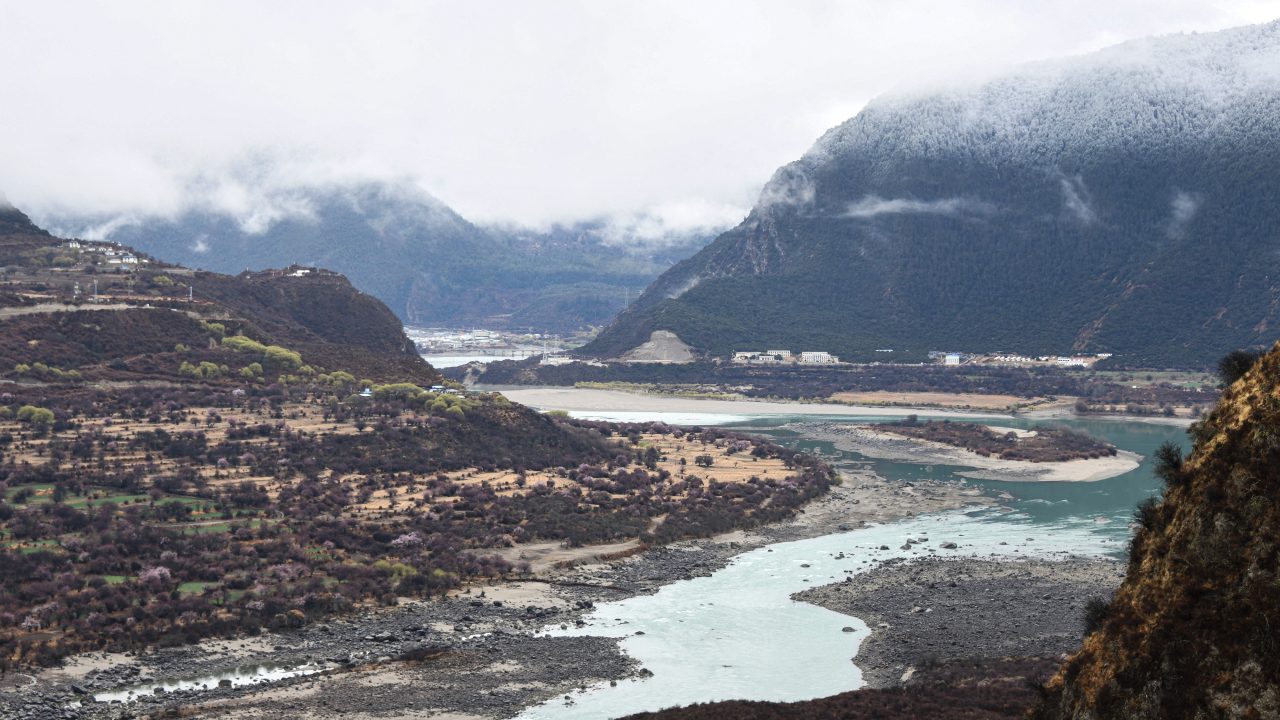
In late December, China approved the construction of what will become the world’s largest dam. The Chongyi Water Resources bureau estimated the hydropower output of the dam, located in the lower reaches of the Yarlung Tsangpo River, at three times that of the Three Gorges Dam, currently the world’s largest.
The project however has been the subject of significant criticism. China has been accused of abusing its upstream position in relation to a river that flows through Nepal, China, Bhutan, India and Bangladesh — and there are suggestions the project will have significant negative consequences for the environment.
Damning Criticism
There are three interlinking currents of criticism — international, regional and climatological.
Internationally, experts argue that the dam could reduce the river flow and disturb the availability of water downriver, pointing to accusations that in 2020 China exacerbated a drought in downstream countries such as Cambodia and Vietnam by holding back water from the Mekong River.
“We can clearly see what is happening in the Mekong region,” Dechen Palmo, an environmental researcher at the Tibet Policy Institute, said at an online event hosted by Institute for Security and Development Policy this week. “Many of the downstream countries in the Mekong are facing a lot of difficulties because of Chinese … dams on the upper level.”
In addition, John Jones, head of campaigns, policy and research at Free Tibet and Tibet Watch, raised the fact that some experts have speculated the location of the dam, near China’s border with India, may be about marking out territory.
Regionally, many arguments focus on the idea that Tibetans will be displaced by the building of the dam. Over one million people were previously displaced by the building of the Three Gorges Dam, and there have been protests in Tibet against another new dam in the past year because its reservoir would submerge a culturally and religiously significant area. The Chinese government has not said how many people would be displaced in this instance.
On top of this, there are major ecological concerns, notably relating to the dam’s position between two tectonic plates.
“As happens in most of the cases of dam constructions, we are also talking about increasing the risk of earthquakes. So even today this is a very seismologically active area, but if you put another dam — especially such a huge vast dam — then you further increase the risk of earthquakes,” Antonina Luszczykiewicz-Mendis, a research fellow of the Central European Institute of Asian Studies in Bratislava, said at Institute for Security and Development Policy’s online event.
Climate Implications
The main argument in favor of this dam is climatological. Hydropower electricity production doesn’t release carbon dioxide into the atmosphere and it negates the use of fossil fuels in the country generating the largest carbon emissions in the world. Once completed, the Motuo Power Station this dam will feed into will have a total installed capacity of 43.8 million kilowatts.
However, these benefits are contested, too.
Hydropower has gone out of fashion in many parts of the world due to the long periods of time projects take to build, the lack of reliability in river flows exacerbated by climate change, and the potential for releasing methane from submerged vegetation in hydropower reservoirs.
On top of these, there are a number of location-specific criticisms of this project’s climate impact.
“When we talk about climate impact, I think we have to take into account building these massive concrete structures does burn fossil fuels, and there’s also a subplot with dams in higher reaches where they might be built on Tibet’s permafrost,” Jones said.
Tibet’s permafrost is thawing and beneath it is a “time bomb of methane which is even more harmful in terms of trapping heat than carbon dioxide,” Jones added. This could be exacerbated by a dam which is why leading Tibetan environmentalists recommend solar power and wind be utilized instead.
Is It Worth It?
Are these trade-offs worth it for that 43.8-million-kilowatt capacity? Fan Xiao (範曉), former chief engineer of the Regional Geological Survey Team of the Sichuan Geology and Mineral, believes even that benefit may be overrated.
In a report for Probe International, the high-profile Chinese geologist wrote that “In terms of Tibet’s own energy needs, there is no requirement for constructing mega-hydropower stations in the Yarlung Tsangpo Great Bend.” This alluded to the fact that because its energy-intensive industries aren’t very large, Tibet consumes very little energy.
Fan also downplayed the value of transmitting the electricity elsewhere. “Even when considering the possibility of transmitting electricity from Tibet to other regions (such as eastern China), there are significant challenges related to high transmission costs,” he wrote. “Given that hydropower stations in Sichuan and Yunnan provinces have to release excess water without generating electricity, there appears to be a lack of demand in the electricity market.”
That argument may not address the climatological benefits of actively replacing existing energy supply with carbon free electricity, but it adds to a large list of concerns, and it comes with the suggestion that GDP growth, tax revenues and investment is the primary motive behind the project.
“Fan attributes the desire for tax revenue from hydropower to local governments, i.e transfers from the central government to local,” Jones explained to Domino Theory by email. “In this case, we would be talking about the Tibet Autonomous Region [as beneficiary.]”
At the same time, actors in the hydropower industry likely want contracts for these projects or related services. “Many of these companies in addition to being state-owned have a public spin-off that can attract private, including international, money,” Jones pointed out, suggesting the company responsible for the Medog Hydropower Station, Power Construction Corporation of China, could be one example.
Damned if They Do, Damned if They Don’t?
Put together, this looks like a fierce case against the dam — and the Chinese government’s positioning. But when Domino Theory asked whether China was in a “damned if you do, damned if you don’t” position regarding its attempts to mitigate its carbon emissions, Luszczykiewicz-Mendis said she did not believe so.
“Nobody’s denying the fact that China also needs to tackle or fight its own internal problems,” she said. “What I suppose we would all agree here is the criticism about how China is doing that without any input from the local population … and without sufficient or with no consultations with the international community — particularly when it comes to those downstream countries.”
None of the panelists at the Institute for Security and Development Policy’s online event expressed any real optimism about that dialogue taking place in the current geopolitical climate.






Leave a Reply