With the U.S. election campaign ramping up, the positions of Vice President Kamala Harris and former President Donald Trump on China are subject to much discussion. Trump, in fact, offered some Trumpian dialogue on the subject this week: “They’ll walk all over her,” he said of Harris on Fox News, “She’ll be so easy for them. She’ll be like a play toy. They look at her and they say, ‘We can’t believe we got so lucky.’”
Much less well discussed in Western media, though, is how China sees things. Whoever wins the election, how does China respond to the U.S.’ increasingly hawkish approach toward it — on issues such as technological development and Taiwan?
Enter: a new report from Chatham House.
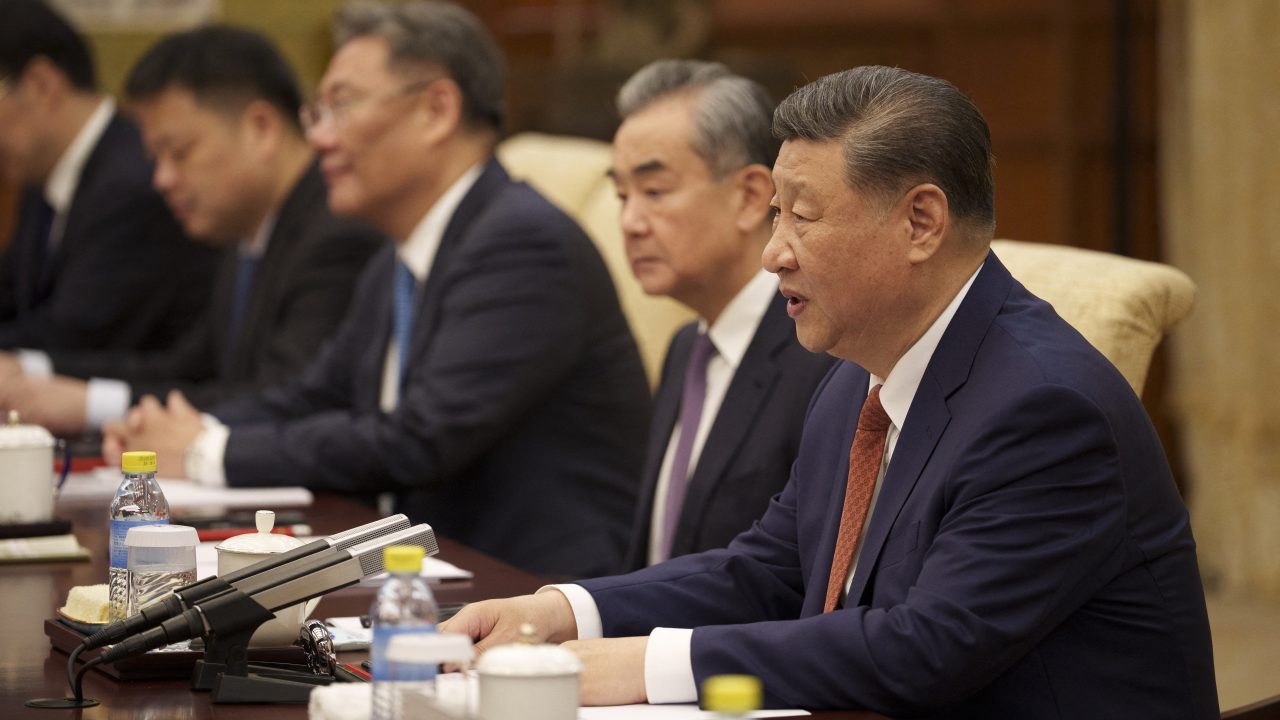
Based on large scale analysis of public remarks by politicians, retired officials, think tankers, academics and military officials in influential positions within China, the report first and foremost concluded that, “despite the centralization of foreign policy decision-making” under Chinese President Xi Jinping (習近平), a range of voices still impact Chinese foreign policy.
Across that range, pessimism about the future direction of relations with the U.S. was found to have increased over the past three years, informed by U.S. sanctions and rhetoric. A “triumphalist” belief in the likelihood of a peaceful power shift toward China has given way to the idea that declining U.S. relations can’t be reversed and that protracted competition is inevitable — even as there remains consistent belief that China will continue to rise.
“Beijing has a very strong sense of being under siege by United States and the collective West, and that has really shaped Beijing’s policymaking — not just with really within the realms of foreign policy, but also extended into the realms of economic governance, into the realms of national security,” report author Yu Jie (喻潔) explained at a Chatham House Zoom meeting last week.
But the report also identified three further layers within this thinking:
- “International pessimists,” who tend to travel most regularly to the West, argue U.S. decline may be both gradual and unpredictable, and as a result China should take a more measured approach to it.
- “Cautious optimists,” who tend to be from government-affiliated think tanks, believe the U.S. is in steady decline, but advocate for peaceful co-existence.
- “Ultra optimists,” who tend not to be U.S. foreign policy specialists, believe China can beat the U.S. and “should not be scared by the renewed strategic pressure from the U.S. in regional flash points…”
Different layers were also set out on key issues.
U.S. semiconductors sanctions, for instance, have been widely criticized by scholars and former diplomats in China, according to the report. But while some believe they can be overcome internally, others believe in building a “wider trade and critical materials supply chain network with other regions.”
And a similar situation is described regarding Taiwan.
The report said official statements don’t suggest plans to initiate conflict in the short term (“The 2027 deadline is not in the official documents at all,” Yu Jie added via Zoom.) It also noted there has been “remarkable consistency” over 20 years in the way two key planning documents outline a position on Taiwan. But a general sense that the pro-independence Democratic Progressive Party (DPP) being in power is “unsustainable and precarious, requiring stronger deterrence actions to send warnings to both Taipei and Washington,” is identified — and within this a dividing line between how media commentators and scholars see things is proposed. Media commentators suggest “Beijing’s increasing military capability and regional influence means that time is on China’s side,” while scholars “believe peaceful unification will only happen when coupled with some form of coercion [both through the economic or military means].”
Speaking on Chatham House’s Zoom meeting, Zhu Feng (朱鋒), professor and executive dean at Nanjing University’s School of International Studies, noted that there are also external limits to Chinese policy responses based on its strategic position.
Zhu said “consensus” among high ranking officials was to “completely reject” any idea of taking on a new Cold War because of lessons learned from the Soviet Union. He said that despite the Soviets’ technological and military positions being relatively stronger than China’s when it did challenge the U.S., it still collapsed.
The alternative path already being carved out, Zhu said, was taking “precautionary countermeasures,” in case of a “worst case scenario” where the U.S. decoupled entirely from China. These measures include creating technological self-reliance and guaranteeing food security, as well as creating closer links with the Global South.
But a secondary point made by Zhu was notable, too. Regarding technological self-reliance in particular, Zhu said the problem was still being “worked out,” because of a need to balance security and innovation. There is “no way” China’s technology industries could achieve high levels of technological innovation if it was fully decoupled from the international community, he said — referring to the most highly developed countries.
Taken as a whole, this kind of analysis might sound banal to the ears of a prospective U.S. policy maker. Or a leader who just likes saying the word China over and over again. But editorials that take for granted the idea of a unified Chinese view are common, and bad assumptions ultimately make for policy that responds to things which aren’t there. It is, then, always useful to remember that the other side contains dynamic decision making and different shades of opinion, just like your own.




Leave a Reply