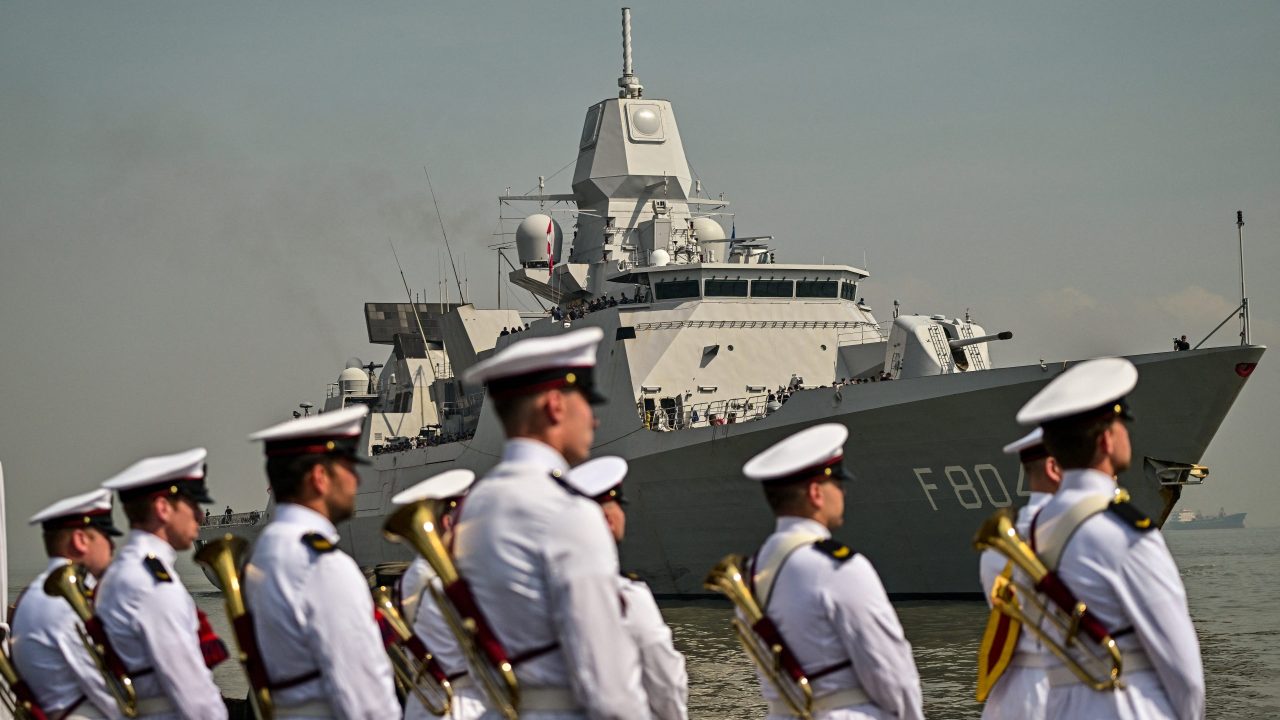
China reacted with predictable indignation yesterday when a Dutch navy frigate sailed close to the Paracel Islands in the South China Sea. But the incident is unlikely to impact the broader relationship.
Exact details of what happened with HNLMS De Ruyter are still unclear. The Chinese military’s Southern Theater Command’s Chinese language statement on May 27 said that the Chinese military took measures including voice warnings and cautionary electronic interference to force the frigate to leave.
Zhai Shichen (翟士臣), spokesman for the Chinese People’s Liberation Army Southern Theater Command, was quoted in Chinese state media Xinhua yesterday saying the frigate illegally trespassed into the Paracel Islands and that the ship’s helicopter conducted operations violating China’s territorial airspace. The vessel was driven away and expelled, by his account.
A different spokesman, Jiang Bin (蔣濱) from China’s Ministry of Defense, said today that it was only the helicopter that intruded and was “dispelled.”
For its part, the Dutch Ministry of Defense told Politico the frigate was operating “in accordance with international law, including the United Nations Convention on the Law of the Sea (UNCLOS).” It’s far from clear where exactly the ship was and what part of UNCLOS the Netherlands considers to be relevant.
China, Vietnam and Taiwan all claim sovereignty over the Paracels, but the islands are occupied solely by China. China built or expanded multiple islands and features in the Paracels in the 2010s and recently has restarted this work, creating potentially the largest feature yet on Antelope Reef. China claims a baseline around the entire Paracels and argues the waters between the islands are also Chinese territory, but this claim is not accepted by other states.
China seems to be increasing the intensity of electronic warfare operations and other non-lethal means of interference, said Alex Luck, a freelance naval analyst based in Australia. But he pointed out that both Chinese and Western governments seem to be communicating more about what is happening in these encounters than before, making it hard to reliably gauge what is new, escalatory behavior.
It is relatively common for navy ships from European and other developed liberal democracies to conduct Freedom of Navigation operations, or FONOPS, when they sail through the South China Sea, to demonstrate that they don’t acknowledge Chinese territorial claims there. Similarly, navies may sail through the Taiwan Strait, which even China acknowledges is not anyone’s territorial sea. The U.S. made fewer strait transits last year than in 2024, but other Five Eyes countries made more, according to the South China Morning Post.
The De Ruyter is in the Indo-Pacific as part of a much larger deployment that will see it circumnavigate the globe. Most recently it made a port call in Manila, and in June and July the frigate will take part in the 2026 Pacific Rim military exercises, involving 31 countries.
The Dutch frigate’s captain, Rodger de Wit, told the Manila Bulletin on May 22 that they had had a “brief but highly professional” with a Chinese naval helicopter, which had not issued any territorial challenges. In 2024 a different Netherlands frigate, HNLMS Tromp, was circled by Chinese fighter jets during enforcement of sanctions against North Korea, in an encounter the Netherlands defense ministry described as “potentially unsafe.”
This latest incident falls onto a rather peculiar backdrop in Dutch-Chinese relations. Last year the Netherlands attempted to seize control of a Dutch semiconductor company, Nexperia, which is owned by Wingtech, a Chinese company. In return China restricted critical exports to Nexperia until the Netherlands government backed down. Last week Wingtech filed a lawsuit seeking $1.18 billion in compensation from Nexperia, potentially reopening the affair.
The Netherlands is also at the center of wider European Union efforts to redress economic imbalances with China, circulating a joint paper last week with Spain, France, Italy and Lithuania that propose ways to make it easier to impose tariffs on imports.
The new Dutch government has indicated it wants to communicate with Beijing and that Beijing has indicated it also sees this new chance, said Sense Hofstede, head of the Brussels Office of the China Team at the Association for International Affairs thinktank. “Nexperia is still an issue,” he added, but said there is no big political tension in the relationship now and that he doesn’t think the incident with HNLMS De Ruyter will have a lot of consequences.
Somewhat ironically, yesterday news also broke that the Netherlands trade minister, Sjoerd Sjoerdsma, will visit China in July. Sjoerdsma was until recently sanctioned by the Chinese government for “severely harming China’s sovereignty and interests, and maliciously spreading lies and disinformation” about Xinjiang.
In a now-deleted post on what was then Twitter, Reuters reported that Sjoerdsma wrote: “As long as human rights are being violated, I cannot stay silent. These sanctions prove that China is sensitive to pressure. Let this be an encouragement to all my European colleagues: Speak out!”
He may have more to speak out about in July than he previously anticipated.





Leave a Reply