Chairman Mao stares down from his portrait, but not only at Tiananmen. He also serves as the banner on the LinkedIn page for a British company which exists to promote business and cultural ties with China. This might be the first clue as to the 48 Group Club’s alignment.
The 48 Group Club might be ideologically fringe, but it maintains and provides unparalleled access to Chinese leaders. That access has been used in the past by many senior British political figures, including, allegedly, some now associated with the current Starmer government. Why has this strange private company, in the same family for three generations, been able to operate almost as a shadow trade consulate for so long?
The 48 Group Club dates back to 1953 when the grandfather of the current chairman Jack Perry, also called Jack Perry, was part of a group of 48 British businessmen known as the “icebreakers” who were among the first Westerners to visit the People’s Republic of China.
The following year, the 48 Group of Companies was set up, seemingly to promote Sino-British business relations and at the behest of Chinese Premier Zhou Enlai (周恩來). In 1991, a “semi-official trade body known as the Sino-British Trade Council” merged with the 48 Group of Companies to form the China-Britain Trade Group, which changed its name to the China-Britain Business Council in 1998, per its own website. The book “Hidden Hand: Exposing How the Chinese Communist Party Is Reshaping the World” says that following the merger, “the 48 Group Club was launched to broaden the membership of the original group beyond business elites.”
Ideology and Influence
Speaking about the 48 Group Club and the Perry family, the younger Jack Perry told the Global Times last year that “we align ourselves with China.” Indeed, as Clive Hamilton and Mareike Ohlberg write in “Hidden Hand,” the Perrys have a long history of regurgitating CCP talking points. At various moments, Stephen Perry has advocated for increased Party control within China, defended the abolition of presidential term limits and even said Chinese President Xi Jinping (習近平) “is responsible for freeing our minds.” Keith Bennett, the group’s vice chair, leads an explicitly Marxist organization based in London called Friends of Socialist China.
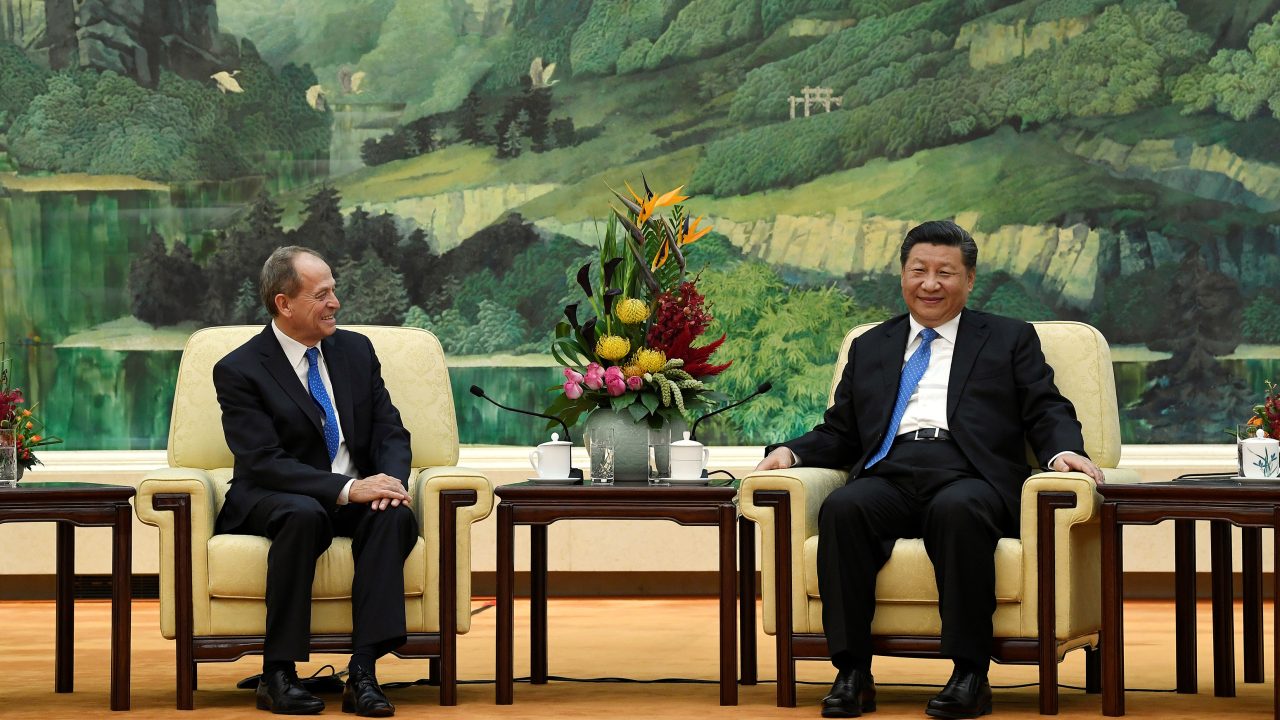
Ohlberg told Domino Theory that the club is “closer to what would be considered the political fringe in Britain, I would say, in terms of their affinity to Chinese ideology, to Marxism.” As Ohlberg writes with Hamilton in “Hidden Hand,” “No group in Britain enjoys more intimacy and trust with the CCP leadership than the 48 Group Club.” Stephen Perry received the China Reform Friendship Medal from Xi in 2018 and is pictured sat chatting with the Chinese president at the event, indicating an astonishing level of access. “Friendship ultimately is a political term,” said Ohlberg, adding that the medal is a “sign of [Perry] being an old friend of China, someone who is trusted and who is seen as politically reliable in the long term.”
Based on the list of high-profile members from China, Ohlberg and Hamilton also concluded in “Hidden Hand” that “Beijing rates the 48 Group Club very highly in its overseas influence effort.” Indeed, the current “Icebreakers” include former Chinese ambassadors to the U.K., a former vice president of China and the former chairman of the Foreign Affairs Committee at the National People’s Congress. Alleged Chinese spy Yang Tengbo (楊騰波), scrutinized for his relationship with Prince Andrew, was even once listed as an honorary member of the club.
The question that follows: Is the 48 Group Club a “united front” organization? The group itself has denied that they are “in any sense” a vehicle for Beijing. And there seems to be some disagreement over how influential the group is today. Steve Tsang, director of the SOAS China Institute, wrote in an email: “It doesn’t really do much.”
Still, the group evidently accesses and convenes people at the highest levels of British politics and business. Numerous political elites have been associated with the club, such as former Prime Minister Tony Blair, as well as former British ambassadors to Beijing, former foreign ministers and former deputy prime ministers. Their events currently gather Britain’s biggest businesses, including HSBC, Barclays, KPMG and Circle Health.
The 48 Group Club also regularly collaborates with more mainstream organizations, such as the China British Business Council and the China Chamber of Commerce in the U.K., including on the annual Icebreakers Chinese New Year Dinner. The event is marketed as “an unparalleled opportunity to engage with senior executives and policymakers from across the U.K. and China.” In 2021, Chinese Premier Li Keqiang (李克強) gave a virtual speech at this dinner.
“It’s a fairly blatant expression of the elite capture element of ‘united front’ strategy,” said Andrew Yeh, executive director of the China Strategic Risks Institute. Yeh added that the British political elite that have been listed on the 48 Group Club’s page do appear to be of the 2000s and 2010s cadre. He said it’s unclear what an association with the club, like being listed as a fellow, actually entails.
In essence, the 48 Group Club appears to serve as a kind of middleman placing senior British political figures in close proximity to those they would otherwise be unlikely to associate with. “They’re not powerful, per se, and they’re not particularly rich or influential, but they still run an effective format that a lot of people use. And that’s ultimately why they’re relevant,” Ohlberg said.
Starmer Connections
A number of influential figures within the Labour Party were previously listed as “fellows” on the 48 Group Club’s website. This includes former Blair, former British Ambassador to the U.S. Peter Mandelson (he was ousted from this role in September over his ties to Jeffrey Epstein), National Security Advisor Jonathan Powell and Labour donor David Sainsbury. While each is a part of Starmer’s circle, Powell is considered the most influential foreign policy advisor in Starmer’s government at the moment. He is currently implicated in the controversial China spy case involving the “two Chrises.”
The fellows page was still up in August but seems to have been removed since then, perhaps because several people have complained about being listed as fellows without their permission. After “Hidden Hands” was published in 2020, Blair denied that he was a fellow and said he was “not linked” to the group. Around the same time, Mandelson said he did not know he was a member of the club — there is, however, documentation that he attended at least one meeting in 2014, and he traveled to Beijing with Stephen Perry to accept his friendship medal in 2018.
Powell has also reportedly denied membership in the club. This month, Security Minister Dan Jarvis stated in parliament that Powell “does not have any links to the 48 Group.” This suggests that his advisors considered the allegation of association to be enough of a threat to prepare against (a minister knowingly misleading parliament is expected to resign). Ultimately, the extent of Powell’s and Mandelson’s involvement with the club remains unclear.
A recently appointed Starmer advisor with a current and explicit connection to the 48 Group Club is Greg Jackson, the founder and CEO of Octopus Energy. Jackson has joined the Cabinet Office board, where he will serve a three-year term. As the largest energy provider in the U.K., the Labour Party has an apparent interest in Octopus Energy. Prior to his official appointment, Jackson met with the Starmer government at least 10 times, according to Politico. Jackson is actively involved with the 48 Group Club, having given a keynote address at a club event in the spring. A senior representative from Octopus Energy attended another 48 Group Club event last month.
There is also an interesting overlap between Vice Chair Keith Bennett’s commentary on U.K.-China relations and the Starmer government’s stated policy on China. Bennett wrote an op-ed for China Daily in 2022 about how the U.K. needs to build a “grown-up” relationship with China, essentially advocating for closer and friendlier ties. Former leader of the Liberal Democratic Party, Vince Cable, used the same phrasing in an op-ed for The Independent the following year. This could be a coincidence, but Bennett seems to have interviewed Cable in 2020 at a 48 Group Club event, which has been almost completely scrubbed from the internet. Importantly, the Starmer government has also adopted the term “grown-up” to describe its approach to China.
There is no evidence that the 48 Group Club does anything illegal. They provide high-level access in China for British politicians and business leaders. If they didn’t do it, someone else would.
The 48 Group Club has been able to maintain its access to the highest levels in China because, as Ohlberg said, it is seen as loyal to Beijing. But it is also vulnerable to Beijing. Everything that the Perrys have built over three generations could be taken away in an instant, far more so than if they were aligned with the U.K. government. This allows the Chinese Communist Party to more effectively control this elite access provision.
Ultimately, British politicians, and probably businesses as well, should consider whether they are prepared to be associated with an organization that is full-throatedly supportive of a state the director of MI5 said poses “a daily national security threat to the U.K.”
“I’m from the family of icebreakers, but I haven’t ice-broken yet,” said the younger Jack Perry when he took over leadership of the 48 Group Club last year. “My goal is just to do what’s in our DNA. We are not shying away that we are a friend to China, and we would stand up even when the weather might be turbulent.”





Leave a Reply