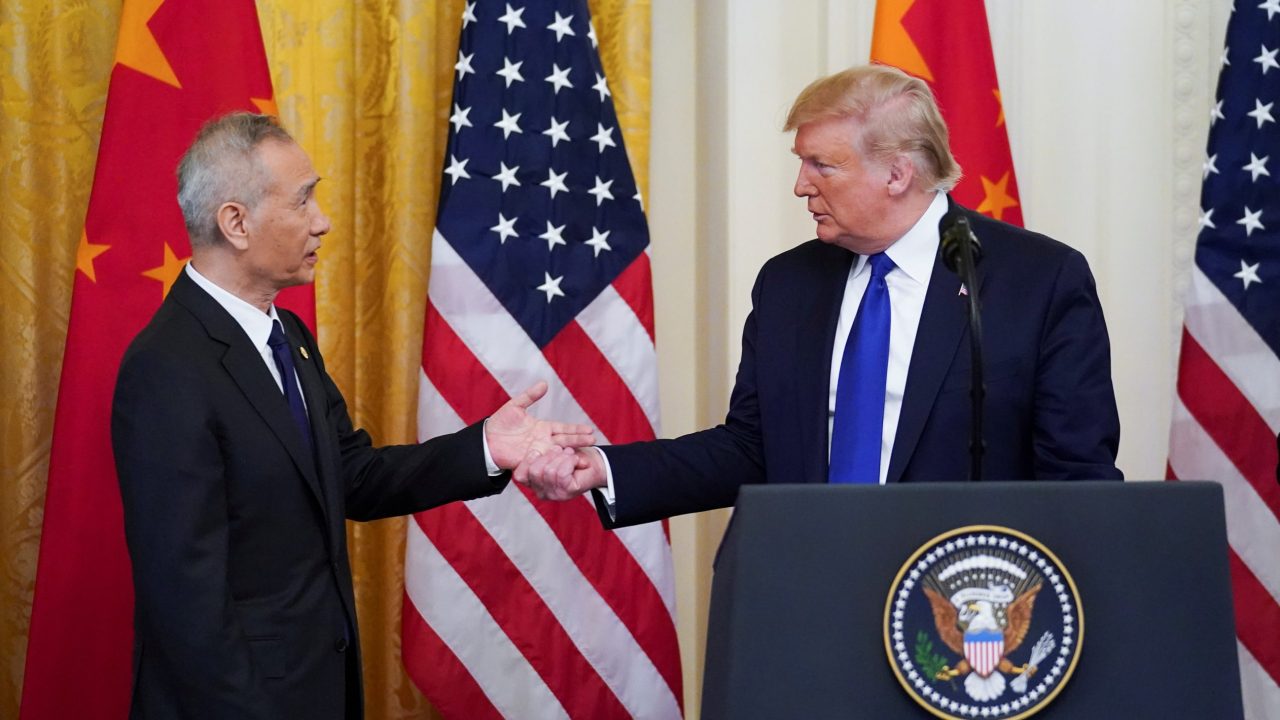
Trump’s imposition of 10% tariffs on Chinese goods shows that Trump wants to play ball. While these initial tariffs are linked to stymying the fentanyl trade, Trump’s tariff strategy probably also aims to pressure China into making some sort of deal that rectifies another main grievance: the trade imbalance and China’s unfair trade practices. The problem for Trump is that China is playing a different game.
Specifically, China is playing the long game. “If you know tai chi … you know [China’s] basic strategy,” said Charles Wu (吳崇涵), chair of the Department of Diplomacy at National Chengchi University. Tai chi is a Chinese martial art focused on slow, precise movements. The Americans, in contrast, are boxing.
Tzeng Wei-Feng (曾偉峯), assistant research fellow at the Institute of International Relations at National Chengchi University, said the official term for China’s approach is “strategic patience.” Trump will only be in power for four more years, and if the 2026 midterms go poorly for the Republicans, then his influence will wane after two. This means Chinese President Xi Jinping (習近平) can afford to wait until he feels China is in an ideal position to negotiate with Trump.
While Trump must face the immediate pressure of proving his China policy before midterm elections, Xi has more flexibility because he is not held accountable by elections, said Fang-Yu Chen (陳方隅), an assistant professor at Soochow University specializing in U.S.-China-Taiwan relations. Even if Trump’s escalation of tariffs is felt in China, Xi can employ “rally around the flag” rhetoric to counter domestic discontent. By lending legitimacy to the narrative that the U.S. is a corrupt, hostile power, Chen thinks Trump’s tariffs will bolster Chinese nationalism.
According to Tzeng, two things would bring China to the negotiating table. First, China feels as though it has brought its faltering economy back to a stable, stronger place. This is China’s current priority. Second, China thinks Trump is willing to budge on key issues like lowering American export controls on critical technology. Trump might be more willing to do so as he increasingly feels the pressure to prove his China policy.
However delayed a deal might be, China is likely preparing its end of it right now, said Chen. Having learned Trump likes to see impact through numbers, this is where China’s focus is. The volume of trade between the U.S. and China creates an opportunity to present an impressive offer to Trump, even if China has no intention of following through on it. Wu and Chen both noted any deal China signs might ultimately be symbolic. This was the fate of the Phase One trade deal signed under the first Trump administration, which Trump hailed as momentous and remarkable but was by all accounts a failure. Although China promised to purchase an additional $200 billion worth of U.S. goods, only 58% of its commitment was ultimately purchased.
Indeed, Trump’s desire to rectify the trade imbalance does not align with China’s domestic priorities. China seeks to diversify its imports and become more self-reliant so it is not vulnerable to U.S. coercive economic policy. On the whole, China has been successful at this. Experts say China is less reliant on trade with the U.S. now than it was during Trump’s first term — this is most apparent in energy, high-tech manufacturing and agricultural products.
The failure of the Phase One trade deal also reveals market limits on a future trade deal. China was unable to purchase the additional $200 billion in American exports it committed to in 2020 for many reasons, including the Covid-19 pandemic and ensuing economic challenges. Since then, the Chinese economy has been slow to recover, hit by the property sector collapse in 2021 and additional Covid-related restrictions in 2022.
China’s sluggish economy has in turn led to falling import demand. China imported a record number of goods in 2022, but this was hampered by the factors mentioned above, which undermined consumer confidence and weakened corporate investment. Several of China’s major trading partners are exporting less to China — another sign of economic slowdown. But imports are not uniformly falling — agricultural and steel imports saw dips last year, but demand for high-tech imports remained strong. This indicates that strategic priorities, not just economic constraints, have shaped China’s trade behavior.
Trump might not appreciate China’s diminished ability to import goods, as China’s exports are thriving. Since Trump’s main goal during the first trade war was to rectify the imbalance in U.S.-China trade — which he considers to be unfair — China’s widening trade surplus probably stings. Trump also has Elon Musk in his ear, who is surely telling him about the record number of Teslas sold to China last year.
Whether or not Trump ultimately pursues a trade deal with China, avoiding past mistakes will require that Trump avoids throwing haymakers and slows down enough to consider China’s objectives and limitations.




Leave a Reply