
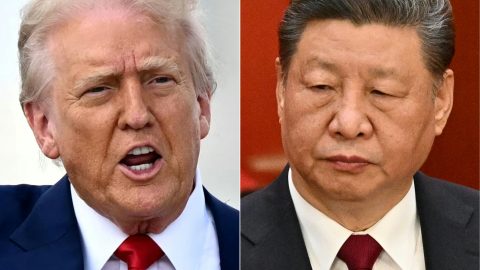
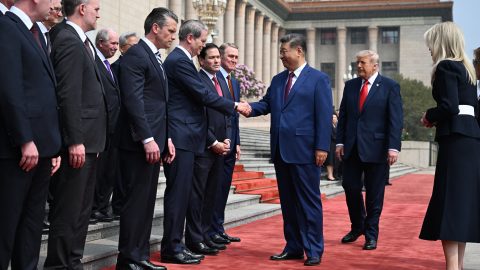
Taiwan may finally be close to getting clarity on the most consequential foreign policy issue of President Donald Trump’s second term: the U.S.’s approach to China. On Friday, following a phone call with Chinese President Xi Jinping (習近平), Trump announced on Truth Social that they had discussed issues including trade, the war in Ukraine and a deal to sell Chinese-owned social media giant to a group of U.S. investors. “I also agreed with President Xi that we would meet at the APEC Summit in South Korea,” Trump said, “that I would go to China in the early part of next year, and that President Xi would, likewise, come to the United States at an appropriate time.”
The Chinese Embassy in Washington declined to confirm plans for the meeting, and the Chinese readout of the call did not mention the topic. On Tuesday, U.S. Ambassador to China David Perdue appeared to hedge Trump’s statement. “We’re looking forward to getting together, as President Trump said, and potentially in the near future, but certainly next year,” he told reporters in Beijing.
The in-person meeting at APEC, which would take place in Gyeoungju on October 31 or November 1, would be all the more anticipated because, in the first nine months of Trump’s second term, his administration has yet to coalesce around a clear China policy. In advance of the potential summit, Domino Theory is recapping the tumultuous development of U.S.-China relations so far in Trump’s second term, from the opening trade skirmishes in February and March, to the rapid escalation following what Trump called “Liberation Day,” when he imposed sweeping tariffs on nearly all of the U.S.’s trading partners in early April, to the slow thaw in relations from early May until now.
Opening Skirmishes (January 17 – April 1)
Trump’s discussions with Xi Jinping began before his second inauguration. On January 17, the two spoke for the first time since Trump’s first term. Afterward, Chinese state media said that Xi had congratulated Trump on his election victory and urged him to handle the Taiwan issue “with caution.” According to readouts from the call, other issues discussed included trade, fentanyl and what proved to be Trump’s most immediate concern: the fate of TikTok. Former President Joe Biden had signed into law a bipartisan bill banning the app in the U.S. unless it was sold to a buyer from America or one of its allies. In one of his first actions as president, Trump signed an executive order delaying the enforcement of the law for 75 days. That delay has been extended repeatedly since, and remains in effect to this day.
Other high-level meetings took place around Trump’s inauguration. While in Washington as a special representative of Xi, Chinese Vice President Han Zheng (韓正) met with Vice President-elect JD Vance, as well as business leaders including Elon Musk. In Trump’s inauguration speech, he mentioned China just once, arguing that the U.S. should not cede control of the Panama Canal to China. (Trump did not mention China at all in his first inaugural). That has proved not to be a throw-away line. So far, perhaps the second Trump administration’s greatest departure from the U.S. foreign policy status quo has been its approach to security in the Western Hemisphere.
In the following months, citing China’s role in the production and trafficking of fentanyl precursor chemicals, Trump slowly escalated tariffs on China. In February, he announced a 10% tariff on all Chinese imports, directed the U.S. Postal Service to suspend all parcels from China and Hong Kong and imposed a 25% tariff on steel and aluminum imports from all trading partners. China responded by implementing export controls on rare earth metals, a move that has since proved a formidable bargaining chip in the ongoing negotiations. On February 10, Trump told Fox News that he had spoken to Xi since his inauguration, but neither side confirmed details of the call.
In early March, Trump doubled tariffs on Chinese goods to 20%. China responded by imposing duties on U.S. agricultural products, one of the few areas where the U.S. maintains a trade surplus with China. In late March, U.S. Trade Representative Jamieson Greer held a video call with his Chinese counterpart, Vice Premier He Lifeng (何立峰). He, whose ties to Xi go back to his time in Fujian province in the 1990s, has emerged as an important figure on the Chinese side, known to Western diplomats and executives as a Xi yes-man who knows how to get things done.
By the end of the first period of U.S.-China relations during Trump 2.0, a pattern had emerged. Trump would impose higher tariffs on all Chinese imports; China would respond with more targeted retaliations. The relationship had not gotten off on the positive note that both sides claimed they had hoped for, but the rate of escalation was similar to what had taken place during Trump’s first term.
Rapid Escalation (April 2 – April 21)
Then came “Liberation Day.” On April 2, as part of his sweeping tariffs on nearly all of the U.S.’s trading partners, Trump raised Chinese import duties to 54%. He also announced that he planned to close the de minimis exception, a loophole that allowed low-cost goods to enter the U.S. tax-free. China retaliated with a 34% tariff on all U.S. goods and additional sanctions on American companies. On April 9, Trump first raised the rate to 104%, to which China responded with an 84% tariff on all U.S. goods. Then Trump raised the rate again to 125%. A day later, the White House clarified that U.S. tariffs on Chinese goods now stood at 145%. China responded with a 125% rate, and said it would no longer respond to U.S. hikes. By this point, which represented the high watermark of economic conflict between the U.S. and China, the rate of tariffs between the two countries was reaching the point of an effective all-out embargo.
Facing turmoil in the stock market, the Trump administration showed signs of wavering. On April 11, the U.S. granted exemptions for computers, smartphones and other tech products arriving from China, a move that spared Apple from the conflict’s worst effects. Despite the sky-high tariffs staying in place for weeks, the markets stabilized as investors began to doubt the Trump administration’s willingness to stand by its strategy in the face of economic pain. Financial Times columnist Robert Armstrong would later coin this phenomenon the “Taco theory,” or Trump Always Chickens Out.
The Slow Thaw (April 22 – Present)
On April 22, the Trump administration started to signal its desire for an off-ramp. Bloomberg reported that at a closed-door investor summit that day, U.S. Treasury Secretary Scott Bessent had said that the tariff rates were “unsustainable” and that he expected the situation to deescalate. Markets surged on the news. Later that day, Trump told reporters that he planned to lower the rate. “145% is very high and it won’t be that high,” he said. “It’ll come down substantially. But it won’t be zero.”
On May 10 and 11, Greer and Bessent met with He during the vice premier’s visit to Switzerland. Following the discussions, the sides released a joint statement committing to lowering tariff rates from 145% to 10% for a period of 90 days, beginning May 14. Since then, the total baseline tariff rate on all goods has stood at 30%, higher than the rate from Trump’s first term, which Biden maintained, but lower than the rate immediately prior to “Liberation Day.”
Thus began the slow thaw. On June 5, Xi and Trump held another phone call and discussed the possibility of a future meeting. In the following months, the two countries’ trade officials began meeting more regularly: from June 9 to 10 in London to discuss rare earth metals; from July 29 to 30 in Stockholm to discuss fentanyl. On August 12, Trump signed a 90-day extension to the tariff truce that had begun in May.
Throughout this time, U.S. actions at the departmental level have continued to signal a tough stance on China. In May, the U.S. Commerce Department warned Chinese companies against the use of certain Huawei chips, alleged that China had unfairly subsidized the production of key battery components, and ordered companies to stop exports of key chip materials and software to China. Also in May, the U.S. State Department said that it would “aggressively” start revoking Chinese students’ visas.
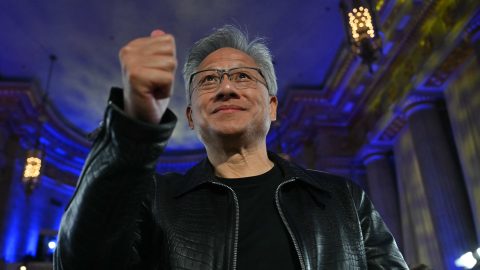
But Trump’s actions have often seemed to contradict this approach. According to a recent report by The Washington Post, Trump this summer declined to approve a package of weapons earmarked for Taiwan, a move many have seen as a deliberate olive branch in his negotiations with Xi. In August, he struck a deal with American chipmakers Nvidia and AMD to let them do business in China. Later last month, he told reporters that the U.S. loves to have Chinese students come to study at American universities.
In the last few weeks, engagement between the two countries has begun to accelerate. On September 9, U.S. Defense Secretary Pete Hegseth held a video call with Chinese Minister of National Defense Dong Jun (董軍). On September 10, U.S. Secretary of State Marco Rubio held a call with Chinese Foreign Minister Wang Yi (王毅). Then, on September 15, officials on both sides confirmed that they had reached a framework agreement for the sale of TikTok following meetings between He, Greer and Bessent in Madrid.
Which brings us to Friday, when more specifics of the TikTok deal began to emerge following Trump’s call with Xi. On Monday, the White House said it was “100 percent confident” that the deal to sell TikTok to American investors would go through. According to Politico, the app’s algorithm, which has been the main focus of national security concerns, would be leased from ByteDance, TikTok’s Beijing-based owner, and then duplicated and inspected by American cloud computing giant Oracle. The Trump administration — which has already taken a stake in chipmaker Intel and rare earth producer MP Materials, both of which it deems crucial to national security — will reportedly not do the same with TikTok.




Leave a Reply