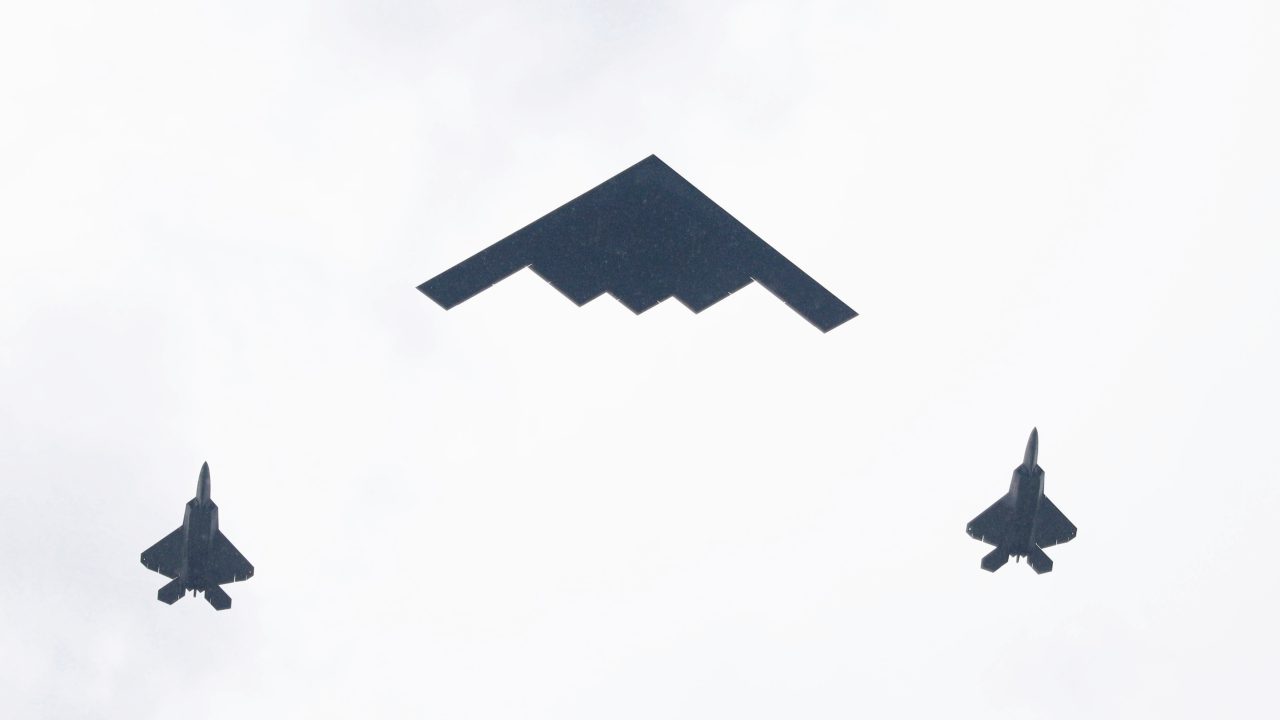
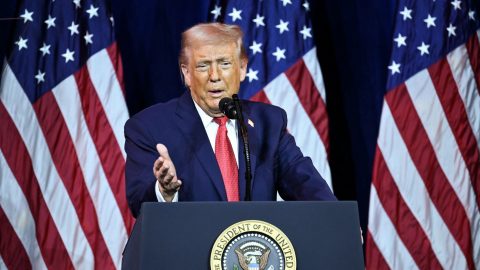
Audio has emerged from the campaign trail last year of U.S. President Donald Trump saying he told Chinese leader Xi Jinping (習近平) that he would bomb Beijing if China invades Taiwan. The remarks were part of a wider set of comments delivered at a private gathering of donors and first reported by CNN.
U.S. policy on a war in the Taiwan Strait has traditionally been “strategic ambiguity,” refusing to clarify whether Washington would intervene to dissuade both sides from precipitating a crisis. Trump’s remarks suggest this could have been upended.
Whether or not Trump actually told Xi he could bomb Beijing, the public airing of this recording will complicate the Chinese government’s view of any potential U.S. intervention in a Taiwan contingency. If Beijing finds this threat credible, the chance of a Chinese attack before 2029 is much lower than previously thought.
“I said, you know, if you go into Taiwan, I’m going to bomb the shit out of Beijing. He [Xi] thought I was crazy.” This is a verbatim quote from the audio file of the 2024 fundraiser. Trump appears to have been playing into his own perception that unpredictability is a foreign policy asset. Employing the Madman Theory, to put it less charitably, which was a strategy used by the Nixon administration to try to persuade the North Vietnamese to negotiate an end to the Vietnam War.
It must be emphasized that this audio, although seemingly genuine, is Trump reporting on his own private conversation with Xi. At the time of writing, there has been no comment from the Chinese government on these remarks, except a Chinese embassy spokesperson in Washington telling Newsweek he was “not aware of the situation.”
The U.S. has long maintained a policy of “strategic ambiguity.” This entails a refusal to say whether it would intervene to help Taiwan if China attempted to invade. The U.S. has had no treaty obligation to aid Taiwan since the termination of a mutual defense treaty in 1980, although the Taiwan Relations Act of 1979 does state that it is the policy of the U.S. to “maintain the capacity of the United States to resist any resort to force or other forms of coercion that would jeopardize the security, or the social or economic system, of the people on Taiwan.”
The logic is that by refusing to clarify, the U.S is able to deter Chinese aggression without formally tying itself down. Historically, Washington also wanted to deter Taipei from declaring formal independence, but shifting domestic politics in Taiwan and shifting strategic realities in the strait have left this less of a concern.
During Joe Biden’s presidency, on several occasions he said that the U.S. would defend Taiwan, or that it had a commitment to, but each time his staffers clarified that he was not changing U.S. policy or existing commitments. This left strategic ambiguity rather less ambiguous, but still open to interpretation.
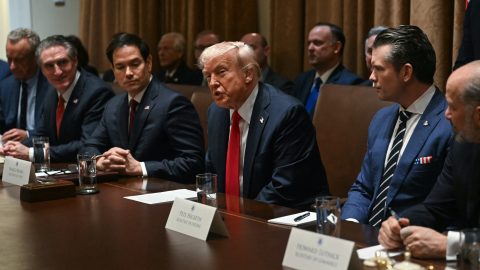
When Trump entered office, it seemed the pendulum might swing the other way. There has been anxiety that Trump would either make a deal with Beijing to formally abandon Taiwan, or else that an isolationist America first policy that included ending military aid to Ukraine would have the same effect. These fears were exacerbated in February when Trump refused to comment on China invading Taiwan during a televised cabinet meeting.
These comments mark a dramatic shift in tone from Trump. “If Trump is telling the truth, and not bragging for donors, the concept of ‘strategic ambiguity’ over how the US might respond to a PRC attack on Taiwan is dead,” wrote Bill Bishop, author of the influential China-watching newsletter Sinocism on Substack.
Trump says in the recording that Xi “didn’t believe me either, except 10% and 10% is all you need.” This suggests that he may believe he was sowing doubt, rather than convincing. Even if Trump was lying to the donors and never said any of this to Xi, this audio is hardly going to be music to Beijing’s ears. The doubt is effectively sown, however and whenever those words are first heard.
During his first term, a narrative emerged that Trump was adverse to launching military action. “Donald Trump is the first president in modern history [sic] did not start a new war,” Donald Trump Jr. tweeted in 2021.
That narrative has taken a huge beating due to the American strikes on Iran in June. “The recent USAF bombing of Iran reinforces [Trump’s] comments,” Guermantes Lailari, a retired U.S. Air Force officer and current visiting researcher at the Institute for National Defense and Security Research, a government-affiliated military thinktank in Taipei, told Domino Theory in a written statement.
Lailari suggested Trump’s reported comments “shift the U.S. framework towards strategic clarity and make the CCP think twice about their war plans.” Strategic clarity is the removal of strategic ambiguity.
The general implication of all this is very clear: “A threat from a sitting US President to ‘bomb the sh&t out of Beijing’ has to be taken very seriously, and efforts to make the US think that would be a very bad and dangerous idea would need to be accelerated.” Bill Bishop wrote. But what specific actions could Beijing take?
The timing of the remarks is key. Given that they were delivered to donors in 2024, Trump must be claiming he said this to Xi during his first term, before 2021. The last in-person meeting of the two was in Osaka, in 2019, but Trump appears to be referring to his 2017 visit to Beijing, when he talks about being greeted by “100,000 troops.” Any response to Xi receiving this information could therefore have been playing out for up to seven years already.
This could cast China’s rapid expansion of its strategic nuclear weapons capabilities in a new light. The Pentagon’s 2024 report on China’s military development estimates that China has almost tripled the number of warheads it has in its operational stockpile since 2020, from the low 200s to more than 600. (The U.S. self-reports having 3,748.)
China was discovered to be building 119 new missile silos in 2021, from The Washington Post’s reporting. By 2024, the number of new silos reported by the Bulletin of the Atomic Scientists had climbed to “approximately 320,” across three new sites. The Pentagon thinks those silos are already being filled with DF-31 Intercontinental Ballistic Missiles capable of reaching Washington.
U.S. admiral Samuel Paparo announced in 2022 that the Chinese navy had begun fielding the more advanced JL-3 submarine-launched ballistic missile. The JL-3 has a much longer range than its predecessor and is estimated to be able to target the continental U.S. from the South China Sea.
If China really believed that Trump wanted to bomb Beijing, a phone call from Xi reminding him the People’s Liberation Army Rocket Force had many more ways to strike the American capital than four years ago would be one way to try to deter him.



Leave a Reply