Ever since Donald Trump won the U.S. presidential election last year, Taiwanese have feared, quietly or out loud, that he will suddenly say without warning or reason that America would not defend Taiwan from Chinese invasion.
Such a proclamation would bring decades of Taiwanese and American security policy crashing down and would be an invitation for China to instigate a new phase of coercion with the goal of annexing Taiwan within Trump’s term, rather than at some indefinite date in the future.
That is not what happened yesterday.
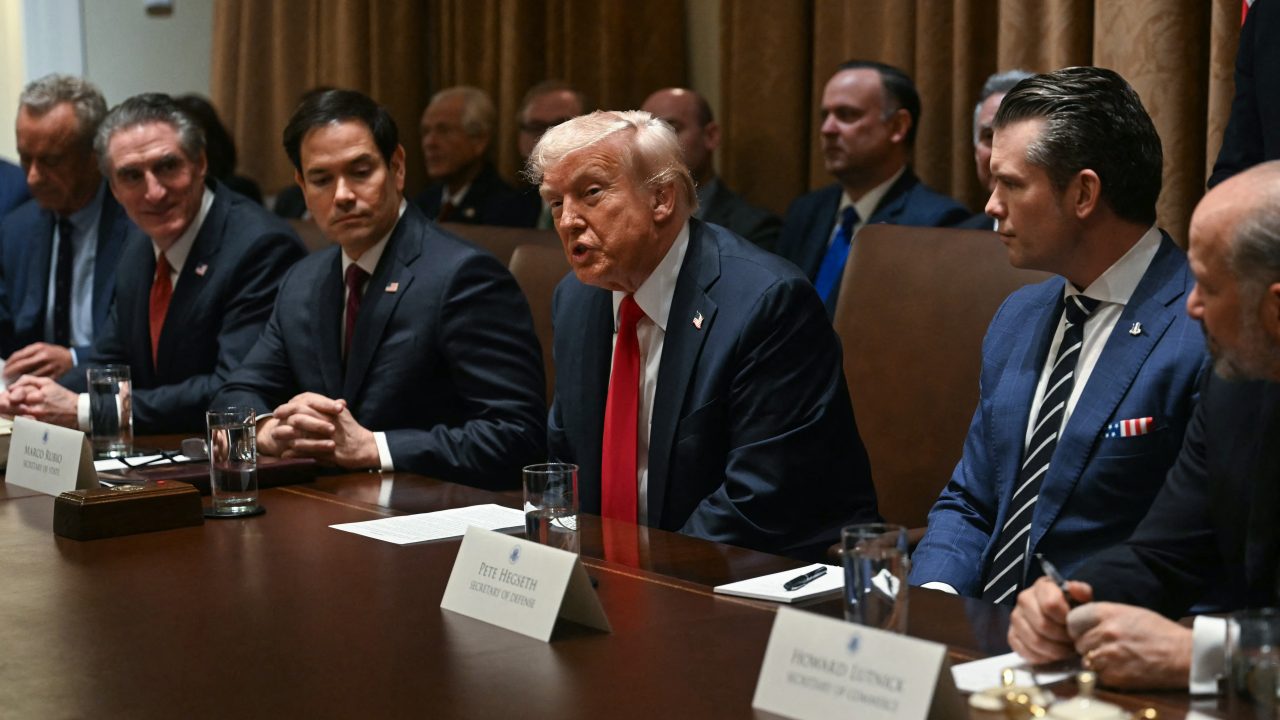
Answering a reporter’s question on whether China will ever take Taiwan by force while he is president, Trump said: “I never comment on that. I don’t comment on any [sic] because I don’t want to put myself in that position. And if I said it, I certainly wouldn’t be saying it to you, I’d be saying it to other people, maybe people around this table and very specific people around this table.” Trump was speaking during a cabinet meeting.
He went on: “I have a great relationship with President Xi” and then discussed wanting a good economic relationship with China, including Chinese investment in the U.S. and vice versa. Tellingly, he disputed that he “doesn’t want China in this country.”
People have already begun to interpret these remarks as Trump giving China a green light to take Taiwan. The obvious reality that America is withdrawing its support for Ukraine under Trump is of course shaping this view, as is the U.S. president’s propensity to speak glowingly about authoritarian leaders like Xi Jinping (習近平).
No one can dispute that there will be more unease in Taipei today than yesterday. But what Trump actually said is not what people fear. It has long been American policy to avoid giving a firm commitment to either defend or abandon Taiwan, the so-called strategic ambiguity. It was actually Biden who strayed from this by repeatedly saying he would intervene.
It was obvious even at the time that while this felt good for Taiwan in the short term, it created the potential that his successor would not repeat his comments and thus generate a period of heightened risk where it looked like American resolve was wavering. That is what has happened, and it has been compounded by the behavior of the Trump administration in Europe and towards its neighbors in the Americas.
What we know about Trump indicates that he has a complicated set of feelings towards China and seems to care little for Taiwan. But he has surrounded himself, packed his administration, with people who firmly believe that China is a huge threat to America. That starts with Vice President JD Vance, and goes down through Secretary of State Marco Rubio, Under Secretary of Defense for Policy Elbridge Colby and many others.
International Law Professor Julian Ku posted on X just one hour before the news about Trump’s comments broke, saying “Trump II will have a similar hawkish adviser, dovish president dynamic.” It was a remarkably prescient observation.
Yesterday a second set of comments also broke cover but has received rather less attention. Secretary of State Rubio gave an interview to Fox News, seemingly before the cabinet meeting where Trump spoke about Taiwan. In it he said the following:
“We have a longstanding position on Taiwan that we’re not going to abandon, and that is: We are against any forced, compelled, coercive change in the status of Taiwan. That’s been our position since the late 1970s, and that continues to be our position and that’s not going to change.”
At the time of writing the American Embassy in Beijing has chosen to publicize these remarks and not those of Trump. Make of that what you will.
Trump’s second term was always going to be a bumpy ride for Taiwan. It would be extremely foolish to bet that Trump isn’t going to say “worse” things than he did yesterday in the months and years ahead. But as long as Trump’s team is full of China hawks, there are also going to be plenty of good moments.
There is a fundamental problem in media commentary about Taiwan and Trump. People who don’t cover the region constantly assume and assert that he will sell Taiwan down the river. In the end, he might, which is indeed a huge problem, but there is a large body of evidence from his first term, and first month of his second, that suggests that he won’t.
That is, at least for the moment, the real strategic ambiguity that Taiwan will have to hold onto.





Leave a Reply