
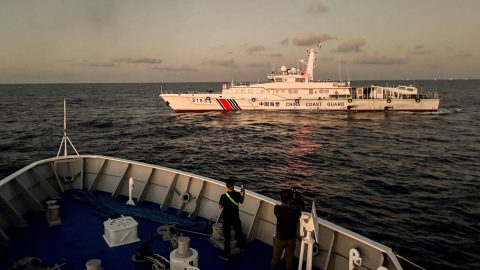
On June 17, Chinese Coast Guard vessels attacked Filipino resupply boats attempting to reach the Sierra Madre on the Second Thomas Shoal in the Spratly Islands. Several Filipinos were injured, and one lost a thumb. It is reported that Chinese ships rammed, boarded the Filipino vessels and even seized the soldiers’ weapons.
The Sierra Madre is a former U.S. Navy World War II tank landing ship that was sold to the Philippines and then intentionally run aground on the Second Thomas Shoal to give a permanent presence on a reef with no dry land. That was in 1999. Twenty-five years later, the 80-year-old ship is said to be falling apart. It urgently needs the kind of reconstruction that requires serious amounts of material to be brought in, otherwise it may literally disintegrate under the feet of its Philippine marine inhabitants.

This is what has precipitated the current crisis. China sees an opportunity to remove the Philippines from the reef without firing a shot by simply denying Filipino ships access if they are carrying the building materials necessary to repair the Sierra Madre. Further, China claims it had a “gentleman’s agreement” with the previous Filipino government, under Rodrigo Duterte, that no construction materials would be supplied to the grounded ship. Duterte is reported to have acknowledged this agreement existed, but others in his administration deny it. President Ferdinand Marcos Jr. has decried any such deal.
While the Philippine Navy is modernizing, it is no match for the People’s Liberation Army Navy. Similarly, the Philippine Coast Guard cannot hope to square up to its Chinese counterpart. This is why the Philippines has adopted its asymmetric strategy of “measured transparency,” trying to damage China in the international court of public opinion instead of damaging the ships that ram and pummel its own.
Into this mix is thrust the U.S., which is a treaty ally of the Philippines. While it is dangerous to make assertions of this kind, it is very, very hard to imagine that the Philippines could win even a highly localized and contained maritime conflict with China over the Second Thomas Shoal, which China calls the Renai Shoal (仁愛暗沙), without the U.S. If it comes to an attempt to push Filipino marines off the reef, American support would be crucial.
Where then is the U.S.? After each incidence of violence surrounding a resupply mission, Washington has issued a statement saying that it will honor the treaty and calling on China to stop its aggression. The U.S. Department of State made such a statement on June 17. Notably however, the U.S. government has not publicly clarified exactly where it would draw a line and consider that its ally had been attacked. Deputy Secretary of State Kurt Campbell repeated that the treaty extends to “armed attacks on Philippine armed forces.”
This is where strategic ambiguity rears its head. Given that by some reasonable definitions China has already conducted armed attacks on the Philippines, I argue that the U.S. is now effectively employing a localized strategic ambiguity policy around the Second Thomas Shoal. It’s no longer obvious to public observers when, where and if the U.S. will defend Filipino sovereignty. An assumption can then be extended that it’s not obvious to China, either.
The Sierra Madre is going to rust away, absent intervention. That would mean the end of de facto Filipino sovereignty over the Second Thomas Shoal. Effectively the U.S. has two distinct choices. It can either commit U.S. forces to support the reconstruction of the Sierra Madre or not, and it can make it clear to China whether it will do so or not.
China has already decided to use violence against the Philippines to prevent the maintenance of the Sierra Madre. However, it is not known, publicly at least, whether it would do the same against American ships and personnel if they became involved.
These two sets of calculi make it clear why the U.S. would choose a position of strategic ambiguity. If it shows its hand, it could either put itself on a collision course with China over territory that is not the U.S.’s own, or it could give China free rein to take said territory from an American ally (of course, it could also force China to back down). By not revealing its position, the Biden administration must hope it introduces enough uncertainty into the Chinese decision tree that it won’t press the issue.
Here is where the parallel to Taiwan’s situation must become obvious. Taiwan is not a treaty ally of the U.S. today, although it used to be, but the modern working defense relationship between the two goes back to Taiwan Relations Act of 1979. The U.S. has always been careful to ensure Beijing would find it credible that it would defend Taiwan, but for various and evolving reasons typically avoids definitively stating that it will.
This lack of true reassurance continues to have a large impact on Taiwanese security, including on Taiwan’s force structure and defense procurement. Strategic ambiguity is often given as a reason why Taiwan can’t or won’t fully adopt the asymmetric defense strategy the U.S. believes would bring it the most security, because that strategy takes as implicit American involvement, when Taiwan very reasonably thinks those decisions should be taken on an explicit understanding.
At the moment, people still characterize Chinese actions against the Philippines as existing in the “gray zone,” below the threshold that somehow delineates actual war or conflict. This concept is also used to describe actions against Taiwan such as damaging undersea cables or holding military drills in the waters around the island. However, the interdiction of ships going to the Sierra Madre shows how much worse things could get. Apart from anything else, Taiwan also holds territory in the Spratly Islands. Taiping Island, also known as Itu Aba, is large enough to have its own airstrip, but China could equally decide to embark on similar unsafe maneuvers in the air.
At the “Boiling Moat” event last week in Taipei, American defense analyst Ivan Kanapathy said Taiwan needs to be careful not to get caught up in symmetrical responses to gray zone activities in international waters or airspace. I wonder if he is right. The case of the Sierra Madre shows that the gray zone not only gives China cover to escalate, it also potentially allows the U.S. to vacillate on its commitments.
Taiwan might do better to try to “squeeze” the gray zone or delineate its edges with red, such that both China and the U.S. understand better when conflict might be triggered by Taiwanese responses to Chinese actions. This is something the Philippines has finally done. It might be instructive to compare the results of both the Philippines and Ukraine trying to be a good ally with Israel’s approach of daring America to withdraw its support when it acts against the U.S.’s interests.
It should be obvious that right now Washington’s strategic ambiguity around the Second Thomas Shoal is not deterring Chinese aggression. The Philippines might be winning the PR battle, but they are losing the ship-to-ship fight. China knows that if it can maintain the status quo it will be able to occupy the reef, likely within years. The situation for Taiwan is different. China needs to be deterred from changing the status quo. However, it should concern everyone that a strategy which has been the lynchpin of the security of Taiwan for decades is failing dramatically in a real-world test hundreds of kilometers to the south.


Leave a Reply