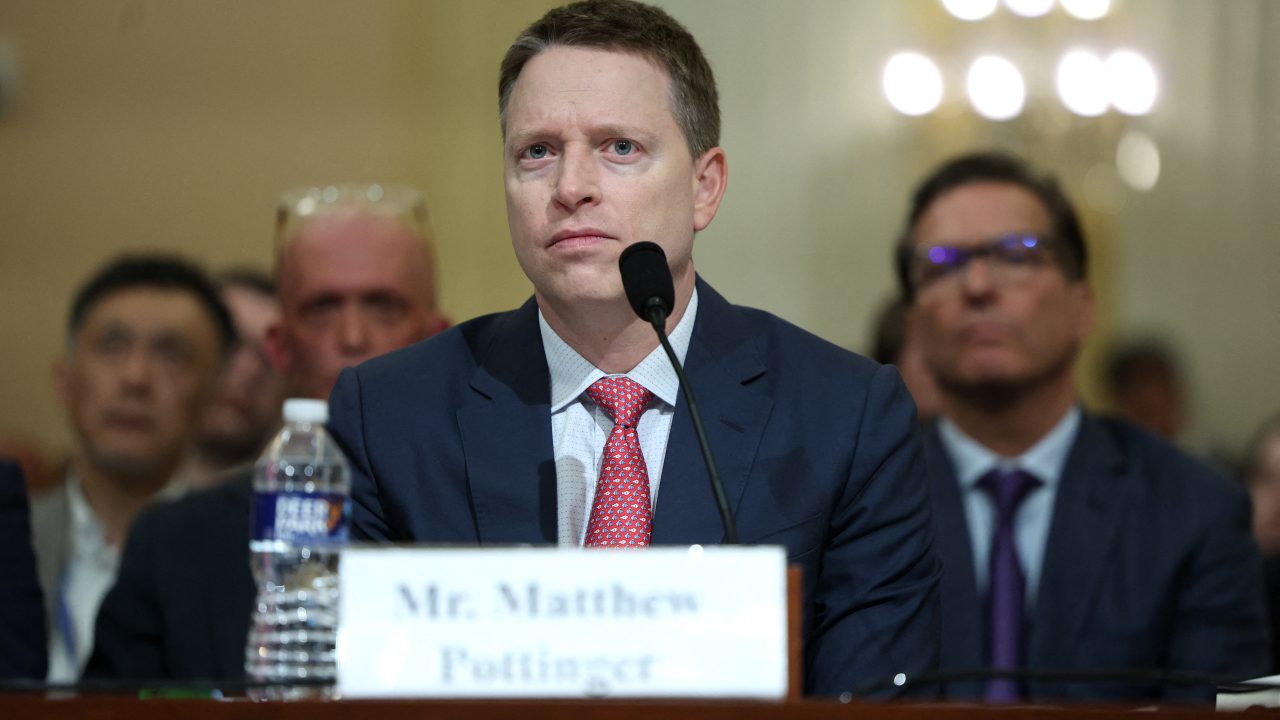
“Deterrence is actually an act of psychology. You don’t deter a nation, you deter decision makers in a nation, and when you’re dealing with a dictatorship like the one in Beijing you’re really trying to deter one person … Deterrence is about eroding the dictator’s sense of optimism about what he can achieve in warfare.”
That is a quote from former U.S. deputy national security advisor Matt Pottinger.
On the afternoon of June 13, Taiwan’s best and brightest minds in media and foreign policy filled an auditorium at National Taiwan University for the launch of “The Boiling Moat,” a new book edited by Pottinger. The event was hosted by Enoch Wu (吳怡農), who was also a contributor, and his organization Forward Alliance. Former director for China, Taiwan and Mongolia on the White House’s National Security Council Ivan Kanapathy, who authored several key chapters from the book, completed the panel.
“The Boiling Moat” is a “how to” guide, a blueprint for Taiwan and its allies on how to deter China from launching an invasion. Indeed, deterrence is the key theme of the book. As Pottinger said, “Deterrence is so much cheaper than war, in terms of the human cost [and] the economic cost.” The phrase ‘boiling moat’ comes from a Han dynasty allusion to a city which should not be attacked, and the imagery of the Strait literally being inhospitable to ships crossing it is a powerful one.
The book is divided into sections, called “Taiwan’s Job Now,” “America’s Job Now,” “Japan’s Job Now” and “Australia’s and Europe’s Jobs Now,” as well as an opening part from Pottinger himself. Several of the unofficial embassies sent people to listen, and the event was actually opened by Chief Representative Kazuyuki Katayama of Japan, who said he “expects that the book shows us practical steps we must take.”
During the event Wu, Pottinger and Kanapathy didn’t pull their punches. They gave a clear account of some of the things they think that Taiwan and the U.S. are currently doing wrong.
“When this book is translated in Chinese, I think you’re going to hurt a lot of feelings,” Wu said.
However, Kanapathy pointed out, “It’s an optimistic book … We have been deterring [China] for decades. The problem we see is that maybe that deterrence is starting to erode.” This, he said, is “a recipe to make sure we continue to win.”
Wu opened the discussion period of the event by outlining what the book sees as three key military mistakes Taiwan is making:
- Taiwan is not prepared for rapid mobilization, nor prolonged conflict.
- Taiwan is misallocating precious defense resources.
- The Ministry of National Defense leadership has long stood in the way of progress, which affects the public’s confidence in our military.
These three diagnoses are brought together in what seemed to be the key recommendation from the book, as initially outlined by Pottinger:
“Democracies need to work together better to solve … the problem of insufficient defense industry capabilities for making munitions.”
This was later further developed by Kanapathy, who said that while the land war in Ukraine needed artillery shells, the defense of Taiwan would be a maritime fight, requiring primarily missiles and drones, including so-called smart munitions . He said Taiwan and its allies need to increase the number of the system in their arsenals by “orders of magnitude.”
Kanapathy also introduced a concept from the U.S. Marines. He said that while people talk about 100 miles of Taiwan Strait as being a long distance for the Chinese navy to cross (Pottinger’s “geography matters”), in terms of the battlefield it’s “stand-in, not stand-off.” What this means is that platforms operating at that distance should be able to survive under immense amounts of fire, so they need to be resilient. That means being small and mobile. Kanapathy said “The U.S. and Taiwan should have long-range weapons, but we’re not going to base them here … they’re way too vulnerable.”
Kanapathy closed this technical portion with “deterrence by detection.” Using a host of relatively inexpensive ISR (intelligence, surveillance and reconnaissance) platforms, an adversary should always feel watched. They should be intimidated and know they’re “not going to get the jump on us.”
Drawing on a discussion with veterans in Ukraine, Wu, with agreement from Pottinger and Kanapathy, discussed the need to reform the organizational culture of Taiwan’s military. All three approve of the appointment of a civilian Minister of National Defense, Wellington Koo (顧立雄), and saw the fact that the military was resistant to his initial reforms as a sign he’s on the right track.
In closing, Pottinger addressed some questions from the audience. He said that in an invasion or blockade, Taiwan is on more solid ground to food security than they feared when they began their research, but that fuel and energy is a real issue. He emphasized the importance of nuclear power for Taiwan.
And then this: Pottinger said “The government in Beijing talks about what it calls the three warfares … information warfare, psychological warfare and legal warfare.” He said the blockade drills after Lai’s inauguration were an act of psychological warfare, to create a sense of futility. Pottinger said TikTok is an information warfare weapon. “It is a big, big mistake for people in Taiwan, young people or old, to be using these apps.”
“The Boiling Moat” will be published on July 1, and can be found for sale online here: https://www.amazon.com/Boiling-Moat-Urgent-Defend-Taiwan/dp/0817926453



Leave a Reply