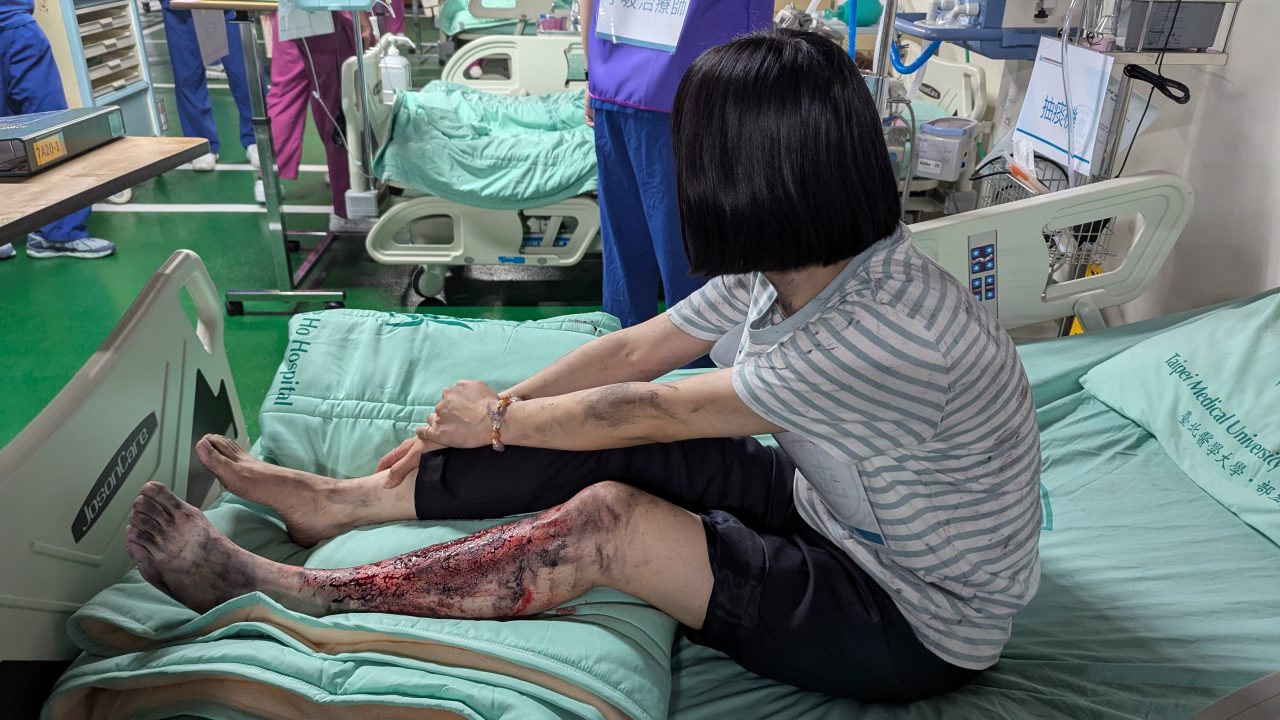
On the ninth day of Taiwan’s annual Han Kuang military exercises on Thursday, the government tested how hospitals would maintain essential services during a wartime emergency.
At Shuang Ho Hospital in New Taipei’s Zhonghe District, medical professionals simulated converting a hospital’s underground parking garage into an emergency medical center as part of the Urban Resilience exercises.
The drills are intended to test whether Taiwan’s government and essential service providers can continue to operate in the event of a Chinese attack.
The underground medical facility on the third basement level of the hospital was equipped with 50 beds for intensive care patients, three beds for dialysis, 90 all-purpose beds, about 500 blood bags, which could last between three to five days, and a dedicated area for family members to rest and wait.
Taiwanese President Lai Ching-te (賴清德) visited the exercise with Raymond Greene, director of the American Institute in Taiwan, the de facto embassy of the United States, Canadian representative Marie-Louise Hannan and New Taipei Mayor Hou You-yi (侯友宜).
When asked about the disadvantages of working in an underground medical facility a nurse at Shuang Ho Hospital who would only give her English name, Lily Ku, said because the space contains dust and debris, “it definitely won’t be as clean as the upper floors.”
Medical professionals face high levels of stress from heavy workloads, long hours and emotional trauma. “If we can have shifts, that’s the most ideal. But if manpower is not enough, there’ll be no choice but to push through,” Ku added.
On getting and replenishing medical supplies, Ku said a supply list would be created to keep track of things. “If it’s really not enough, we will see if there’s a way to replenish. We also receive their [Central Emergency Operation Center] notices before we carry out these procedures,” she explained.
A disruption to mobile communications would significantly impact a hospital’s operations, said Katie Chou (周卓穎), a deputy business director at Shuang Ho Hospital. Chou said she had received the government text message warning about the planned mobile network slowdown.
If those connections were disrupted, hospitals would switch to their intranet, a private, secure computer network that only people inside a specific company or group can use. “Hospital network security and safety are relatively stricter and more heavily protected than general civilian environments,” said Chou, adding that even with intranet connection in place, ”any impact on external connectivity would still significantly affect operations. It would cause a major disruption.”
Chou, along with two other hospital employees posed as patients, were made up to look injured and weren’t actually treated. If the drill demonstrated anything of practical importance, it is that hospital equipment can be turned on in a basement-level parking garage.





Leave a Reply