
What would happen if, halfway through reading this article, you received an alert on your phone saying Chinese missiles were inbound to Taipei and you needed to seek immediate shelter?
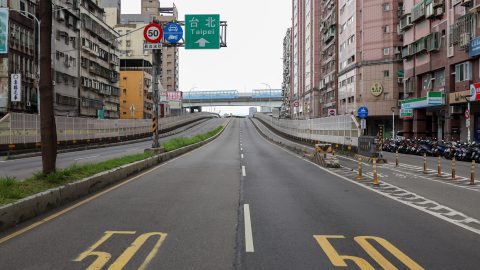
Every year, Taiwan practices this exact scenario. An alert is sent to every phone, and sirens sound. Vehicles stop driving and the streets clear. People are told to go down into their nearest shelter and wait out the 30 minutes of the drill.
Taiwan should be well prepared for this.
But overwhelmingly, Taiwan is not.
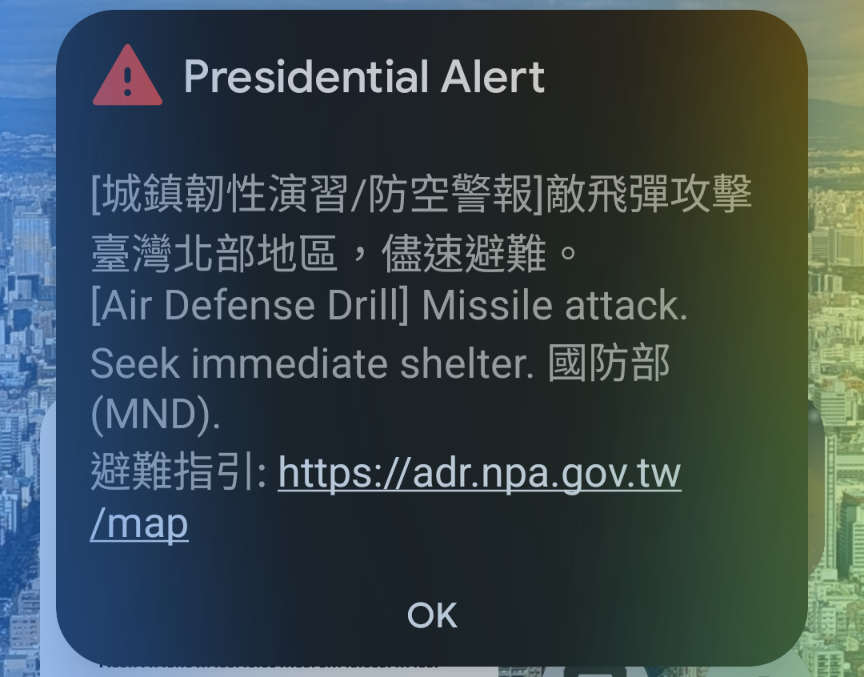
During civilian air raid drills held each year during the annual Han Kuang military exercises, the vast majority of people stay above ground, either at their desks or in their homes. If they happen to be outside, they simply stand in any local business or sheltered space that remains open (many businesses pull their shutters down during the drill, as they should).
If you live outside Taiwan, even if you are a Taiwan specialist, you might not be aware of this, because every year after the drill both Taiwanese and international media publish photos of people crouched in shelters in the braced position, and government officials will say how Taiwan is taking things more seriously and people really did go into the shelters this year.
But everyone in Taiwan knows this is not true. They know it because they are not doing it.
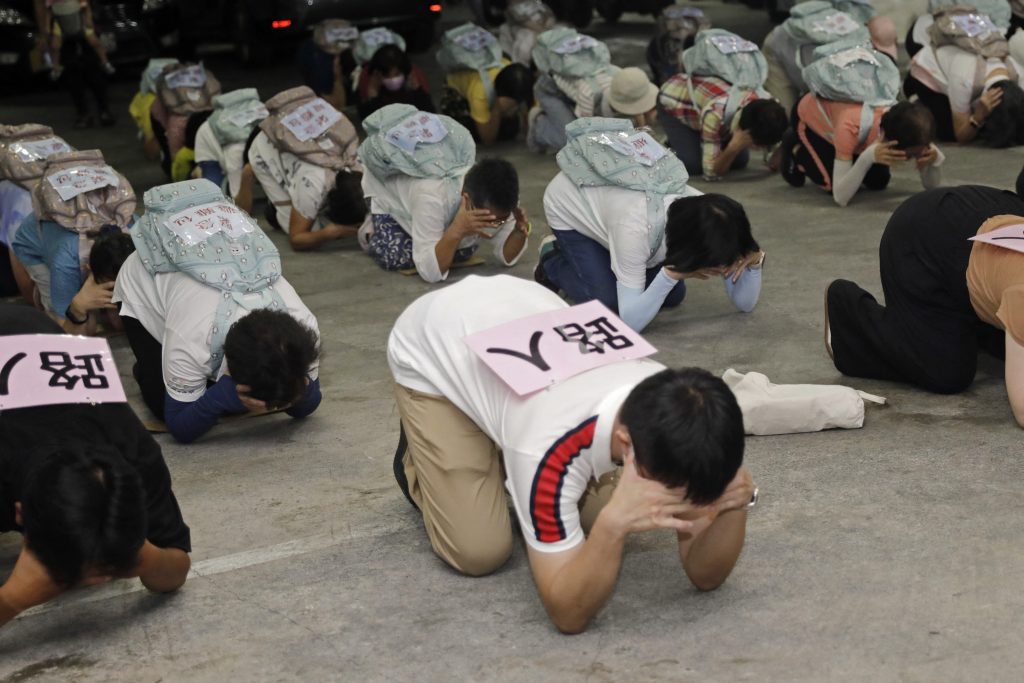
Domino Theory has covered the air raid drill in a very specific way for the last two years, avoiding the shelters where media are invited to view volunteers participating in the exercise, and instead going basically anywhere else, trying to understand what a more authentic shelter experience would look like.
Last year, we visited 22 such shelters in Taipei during the annual air raid drill. This year, we visited 60 shelters in Taipei during the air raid drill on August 13. We also visited several shelters in Taichung during the air raid drill in that city on August 10.
The alert has just sounded. You drop your coffee and run.
The government says there are about 24,000 air raid shelters in Taipei City alone, with enough space to hold more than 13 million people, far more than is required. Those air raid shelters should be clearly marked at street level, and can all be located on maps provided online.
How will you find your nearest shelter?
This year, the government simulated the internet slowing down during the drill due to attacks on communications infrastructure. Now that online map doesn’t work.
There are many designated shelters, but they are still often some distance from each other. You really don’t want to be running the streets trying to organically see one. So you probably can’t find a shelter unless you already know where the nearest one is.
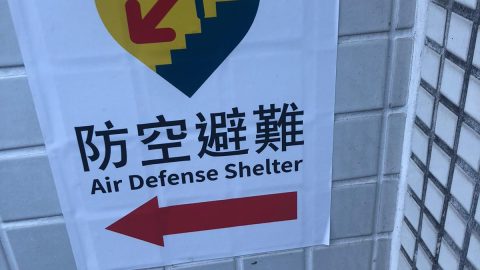
Somehow you find yourself at the nearest pin on the map. Our reporting showed that in many neighborhoods in Taipei’s Daan district, it’s highly likely there will be a sign at this location indicating the presence of a shelter. But in other parts of Taipei, like Ximen, there’s a real possibility you’ll find nothing when you get there.
And finding the sign is really just finding the next potential problem. At some signs, no shelter can be found. Many signs are fixed next to doors on residential buildings that can’t be accessed by the public.
You may now be locked out of the place the government told you was safe.

If you do find an open shelter, it is likely either an underground parking garage or a basement. This is where the fact people are not actually going down into these spaces and practicing using them really bites. If they did, there would be outcry about the condition of the shelters, and the feasibility of having dozens or hundreds of people confined in them for 30 minutes for a drill, let alone hours for the real thing.
The basements are dusty. The parking garages are hot. Mostly these spaces seem poorly ventilated. The shelters overwhelmingly lack drinking water or prepositioned food supplies. They don’t have medical supplies, or camp beds and blankets.
These shelters are no more and no less than existing underground spaces. Taiwan has not prepared them in any meaningful way.

Taiwanese officials say these supplies would be moved in if tensions rise. But every year, Taiwan practices the scenario of tensions rising and the shelters remain unchanged and unused.
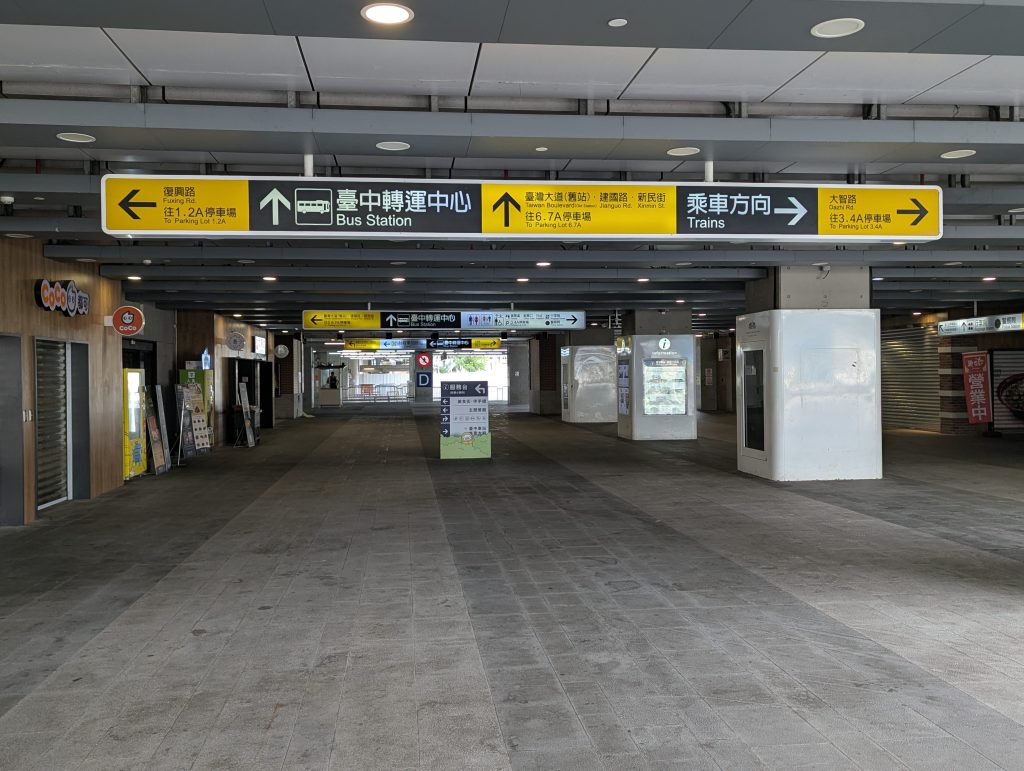
It simply isn’t enough to have volunteers show the media it’s possible to set up a single shelter and use it. This is something every person, every shelter, needs to practice every year. It’s not enough for the media to document the clearing of the first floor of Taipei Main Station to the underground levels, as many outlets did.
When reporting for these stories, building staff were mostly very happy to bring Domino Theory down to a designated shelter and let our reporters take a look. But the most common thing they would say was: “When the drill actually happens, there’s really no need to come down here. You can just stay upstairs.”
The government has provided no incentive for its citizens to take these drills seriously. This is a problem in itself, clearly. But it’s equally a problem that the communication to the rest of the world is so broken.
After last year’s exercises, Global Taiwan Institute, a leading Taiwan-focused think tank based in the U.S., said this:
“For the most part, civilians are instructed to wait in shelters until the simulated strikes are over. In some instances during the exercises, this instruction was not provided, with shelters occasionally unavailable, aged, or in poor working order.”
This paragraph directly cites our reporting, but inverts it. For the most part, shelters were not used, and were unavailable, aged or in poor working order. In only some instances during the exercise did civilians wait in shelters.
Taiwan’s allies deserve honest communication about the current shortcomings, so they can take a proper gander at what’s actually happening. And Taiwanese deserve a system that will actually keep them safe if it’s ever not a drill.



Leave a Reply