
Jonathan Czin’s “China Against China,” in the May edition of Foreign Affairs, arrives with impeccable credentials, and that is precisely the problem. Czin was director for China at the National Security Council from 2021 to 2023, coordinating every one of Biden’s interactions with Xi Jinping (習近平). The Washington he now diagnoses from Brookings is the Washington he helped run.
That matters most at his sharpest line. Czin warns that the United States risks a “Reverse Roosevelt” posture — speaking loudly about American power while wielding an ever-smaller stick, indulging Cold War rhetoric without the appetite for rebuilding the defense industrial base or securing supply chains. Fair criticism. Also autobiography. None of that work was done on his watch either, and the essay’s distance from that fact does a great deal of quiet labor.
Czin’s Xi is not Mao reborn but a leader curing the pathologies of China’s own success — a “counterreformation” against the drift of the reform era. Crackdowns become adaptive governance, contraction becomes rebalancing, purges become feedback. The trouble is that no observation counts against the thesis. Growth is resilience; stagnation is discipline. Consolidation is correction; instability would be the correction working. A framework that absorbs every outcome is not humility. It is a hedge, and hedges are what you write when you need to be defensible rather than right. Czin calls his method cognitive empathy — reasoning from behind Xi’s desk. Unobjectionable as tradecraft, but it yields an asymmetry: Beijing always has reasons, Washington always has pathologies. The Chinese state gets interpreted; the American one gets scolded.
The simpler story is on the books. Property sales are down roughly 65% from their 2020 peak, LGFV liabilities sit near 40% of GDP, producer prices have been negative for three years, and second-quarter growth was the weakest since the 2022 lockdowns. Not collapse — something duller: an economy that has lost its internal engine of demand and not replaced it.
The error of the Trump administration early on in the second term with China was real: a year spent chasing a deal that came back as modest soybean commitments, restored beef listings, and an underwhelming Boeing order. His administration, especially Commerce, badly overestimated what Xi could deliver.
But tariffs are a separate question from summitry. Chinese goods entered the United States at an average effective rate near 11% at the end of 2024 and 29% by January 2026; even after the Supreme Court struck the IEEPA tariffs, it stood at 23% in May, with a Section 301 regime carrying no statutory sunset now in its place. Volumes moved with rates: Imports from China fell nearly 30% in 2025, then another 41% year-on-year in early 2026. Beijing did not concede — but it did not hold the one market where its exporters earned the best money.
The United States took the tariff shock inside an economy that still has demand, and the bill is visible in prices. But that is the cost of too much demand chasing dearer goods. China’s problem is the opposite and harder: Households will not spend, firms will not invest, and three years of supply-side stimulus have not manufactured demand. Washington’s inflation is a policy problem with known instruments; Beijing’s deflation has defeated every instrument tried against it.
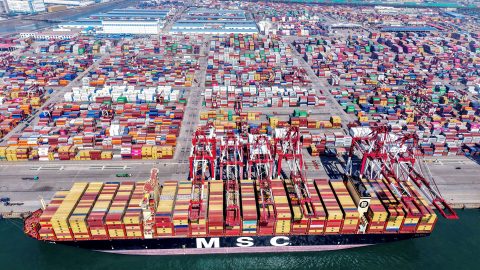
The counterpoint deserves stating: Exports hit a record $397.85 billion in July, and anyone arguing China is losing has to answer that number. The answer is that volume is not strength. The surplus is the arithmetic of an economy producing more than its citizens can buy, at margins the world will no longer subsidize. Records set on those terms describe a country selling harder, not doing better. Certainly not earning more.
Which brings us to the people writing the reviews. The Soviet analysts of the 1980s were wrong about a great deal, but inside an institution that offered no second act. This cohort has one. That America is failing at competition with China is not merely an assessment; it is a credential for the next administration, advanced loudest by those who held the file when the vulnerabilities went unaddressed.
Rare earths are the clearest case. That leverage was built over three decades, and neither the Obama nor the Biden NSC — nor Trump’s first term — did the expensive work of breaking it. The failure is now the centerpiece of the case against Trump’s tariffs. Rush Doshi makes it as well: Washington opened a tariff offensive before fixing its exposure, then backed down twice when Beijing answered with export controls. But the chokehold is depreciating. Disclosed to every capital at once, it triggered a G7 sourcing floor, Pentagon equity stakes, and a magnet buildout that did not exist in 2023. Leverage used is leverage spent — and none of it establishes that the tariffs failed. The two questions have been quietly merged into one.
Washington wants a peer competitor formidable enough to vindicate 20 years of its own advice. What it has is a rival that loses slowly, and no framework for that, because there is no career in describing it.



Leave a Reply