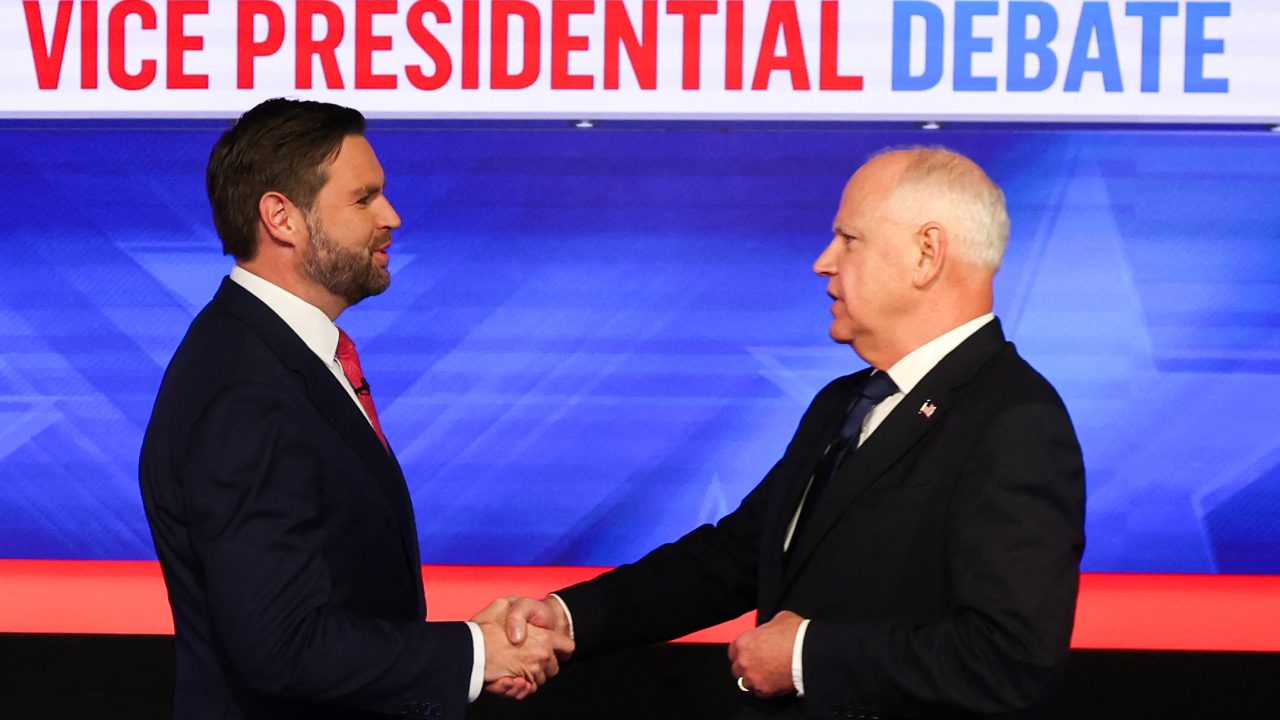
During the U.S. vice presidential debate on Tuesday night, Senator J.D. Vance paid a compliment to President Joe Biden — albeit at Vice President Kamala Harris’ expense. “The one thing Joe Biden did is he continued some of the Trump tariffs that protected American manufacturing jobs,” Vance said, “and it is the one issue [on which] Kamala Harris has run away from Joe Biden’s record.”
Although their debate was remarkably well-mannered compared to the political discourse Americans have grown accustomed to, that doesn’t mean Vance and Minnesota Governor Tim Walz didn’t engage in the misleading oversimplifications apparent in the Harris-Trump debate. Vance is correct in pointing out that Trump initiated a shift in protectionist trade policy toward China that Biden has continued and even deepened. However, while Harris is opposed to Trump’s latest proposal to tax all imports from China, she is not anti-tariff and likely would not pivot from Biden’s approach.
Bob Davis, a former Wall Street Journal reporter who covered U.S.-China economic relations, argues in Foreign Policy that Biden’s trade policy reflects a broader bipartisan shift toward trade protectionism. Despite initial pushback from some members of his cabinet, notably Treasury Secretary Janet Yellen, the Biden administration chose to retain most of Trump’s tariffs because China hasn’t altered its unfair trade practices — such as intellectual property rights abuses and forced technology transfer. Conceding to China unilaterally could provoke backlash from both Republicans and some Democrats. Data suggests that Americans generally only support lowering tariffs if other countries reciprocate.
Biden even increased Trump’s tariffs on goods like solar cells, electric vehicles and semiconductors. His administration believes that the subsidies for these industries should be complemented by tariffs to protect domestic production. Pairing trade protectionism with robust industrial policy is a diversion from Trump’s approach.
Like Biden, Harris supports focused tariffs aimed at protecting critical industries. In a statement given to The New York Times, Charles Lutvak, a spokesperson for the Harris-Walz campaign, said Harris would “employ targeted and strategic tariffs to support American workers, strengthen our economy, and hold our adversaries accountable.” On her campaign website, Harris alludes to Biden’s recent expansion of tariffs on critical technology, writing that she “will continue to support American leadership in semiconductors, clean energy, AI, and other cutting edge industries of the future” and “will not tolerate unfair trade practices from China or any competitor that undermines American workers.”
Vance likely framed Harris’ position as a deviation from the protection policies that Trump implemented and Biden maintained because most of Harris’ (and Walz’s) commentary on tariffs has focused on criticisms of Trump’s new tariffs proposal. But this is a misleading conclusion to draw. While Trump’s first-term tariffs were in the range of 25% and concentrated on specific industries like semiconductors and steel, he is now proposing a blanket 60% tariff on all imports from China and up to 20% tariffs on all other imports. Harris and Walz have dubbed this plan “a sales tax on the American people,” arguing that it will lead to nearly $4,000 “in the hole” for American families each year. In a briefing last May, Biden echoed this concern: “My administration is combining investments in America with tariffs that are strategic and targeted … And now, Trump and his MAGA Republicans want across-the-board tariffs on all imports from all countries, if reelected.”
Trump’s tariff proposal is premised on similar reasoning to the Biden administration’s tariffs: protecting domestic industry and inducing China to alter its trade practices. But his proposal — and at the very least, his rhetoric — is more extreme. Trump has argued that this tariff hike would help pay for social welfare policies, such as reducing the cost of childcare. A study conducted by the Committee for a Responsible Federal Budget found that these tariffs could generate $2.4 trillion in revenue but only if trade behavior remains static, which is highly unlikely. Other economists argue that any money generated from tariffs would go toward covering the tax cuts Trump is also proposing, which could cost $5 trillion over ten years. Voters are more optimistic, narrowly supporting Trump’s tariffs, according to a Reuther/Ipsos poll.
While Harris would likely maintain the protectionist pivot that Trump initiated in his first term, aligning in particular on strong tariffs in critical industries like solar, EVs and semiconductors, Trump’s 60% tariff proposal is certainly a major deviation from Harris’ platform. Although both approaches would ultimately shrink U.S.-China trade and raise costs for American consumers, Trump’s tariff hike would cost much more and practically wipe out trade with China, according to some projections.
But it is far from certain that Trump would follow through on this. Trump threatened to impose tariffs on all Chinese imports multiple times during his first administration, but often used threats like this to influence foreign countries. While the U.S. president has the authority to implement tariffs according to several laws — including Section 232 of the Trade Expansion Act of 1962 and Section 201 and Section 301 of the Trade Act of 1974 — it’s unclear whether it would be legal to impose a blanket 60% tariff on Chinese imports.
By focusing her tariffs-related commentary on Trump’s proposal, Harris is expressing her pragmatic opposition to blanket tariffs while seeking to rhetorically differentiate herself from Trump, rather than opposing tariffs outright. The picture Vance painted — making the two candidates seem more different than alike — is more a product of election rhetoric rather than an accurate comparison of Harris, Biden and Trump’s stances on tariffs.






Leave a Reply