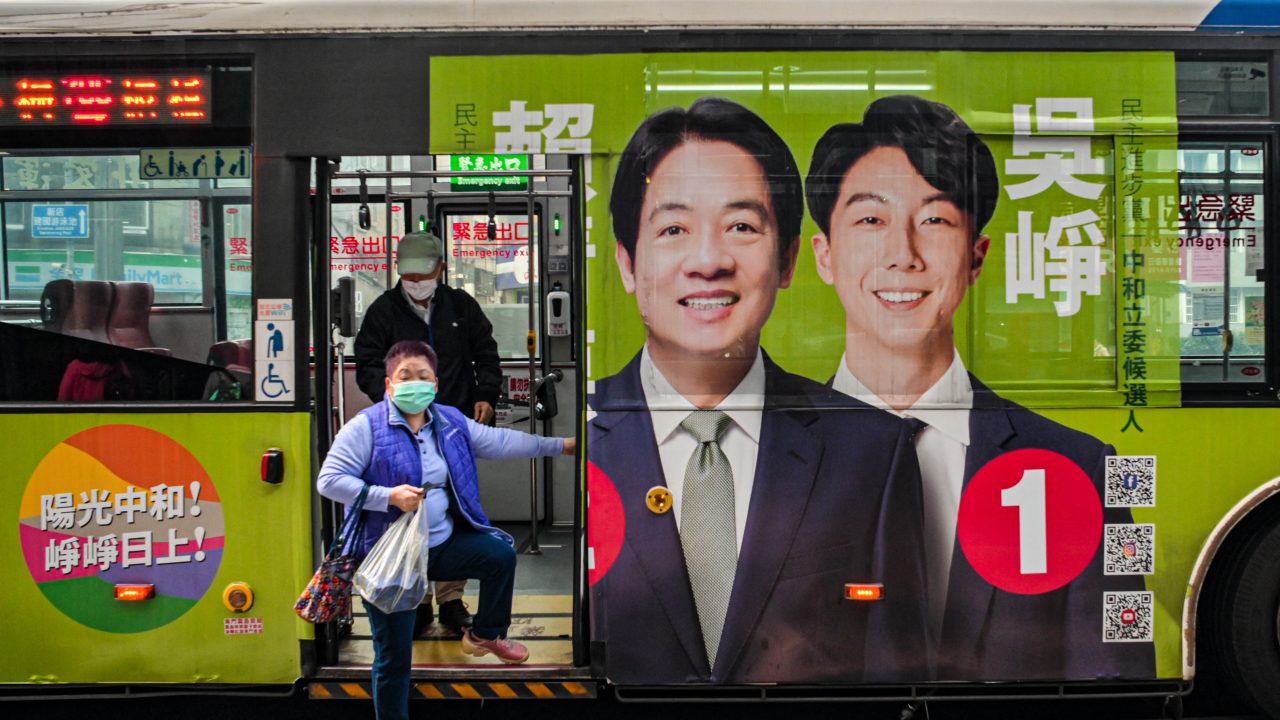
The candidates focused on domestic issues during Taiwan’s second and third televised presidential policy forums on Tuesday and Thursday, in contrast to the first forum’s focus on defense and cross-strait issues.
While China is an important element in every major Taiwan election, it must be noted that the candidates did not frame their discussions of domestic issues such as nuclear energy in the context of national security.
In the second forum, Taiwan People’s Party (TPP) candidate Ko Wen-je (柯文哲) laid out his education policy and criticized the Democratic Progressive Party’s (DPP) bilingual education policy as a failure that allowed political ideology to interfere with education. The former Taipei City mayor said that renewable energy should be developed steadily and that the operation of nuclear power plants should be extended, not cut off by 2025.
Alleging that the DPP has turned Taiwan into an island of fraud (詐騙島), Chinese Nationalist Party (KMT) candidate Hou Yu-ih (侯友宜), a former cop and current mayor of New Taipei City, proposed “three security arrows” to address fraud; drugs and firearms; and organized crime. Hou also called for extending the use of nuclear power.
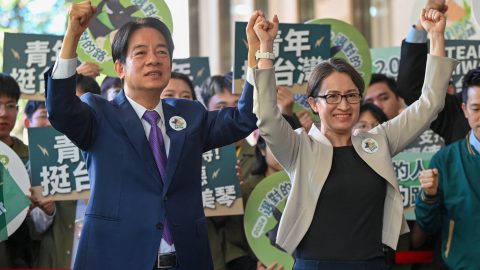
DPP candidate Lai Ching-te (賴清德) focused on highlighting the current DPP administration’s achievements in its eight years in power. Lai said that Taiwan’s electricity supply will become more stable in the future and that the age of power shortages is over. He claimed that power shortages were most severe when former president Ma Ying-jeou (馬英九) of the KMT handed power to current President Tsai Ing-wen (蔡英文). Lai then focused on education and housing issues.
In the third forum, all three candidates vowed to improve Taiwan’s social safety net following the recent incident involving a junior high school student who was stabbed several times with a switchblade by another student and died on Tuesday. The stabbing shocked Taiwan, a relatively safe country where such events are rare.
The TPP’s Ko Wen-je said he would reform Taiwan’s medical system and raise healthcare spending to 8% of the GDP. He denied accusations from Lai that he would attempt to bring Taiwan closer to China through stronger economic ties.
KMT candidate Hou Yu-ih presented plans to protect the working class and promised to establish a government that would focus on revitalizing Taiwan’s economy. He said he was the only candidate who could maintain peaceful cross-strait relations.
DPP candidate Lai Ching-te said he was the only candidate committed to the path of trusting Taiwan. He said his competitors both want to rely on China and adhere to the “One China” principle, with Ko accepting “1992 Consensus” (92共識), and Hou advocating “two sides of the Taiwan Strait are one family” (兩岸一家親).
Taiwan’s first presidential and vice presidential debates will be held at 2 p.m. on Dec. 30 and January 1, respectively.
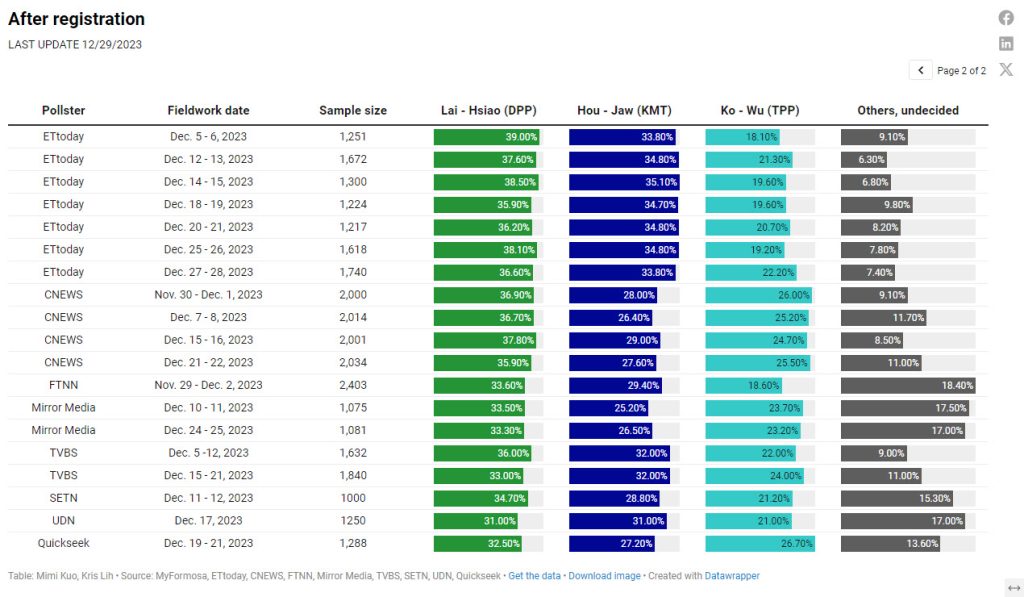
My-Formosa’s latest poll showed Lai maintaining steady growth in support, up to 40.2%, from 37.3% last week. Support for Hou dropped to 28.7%, compared to 33.4% last week. Ko was up slightly to 18.4%, from 17.7% last week. The percentage of undecided voters rose to 12.8%, from 11.6% last week.
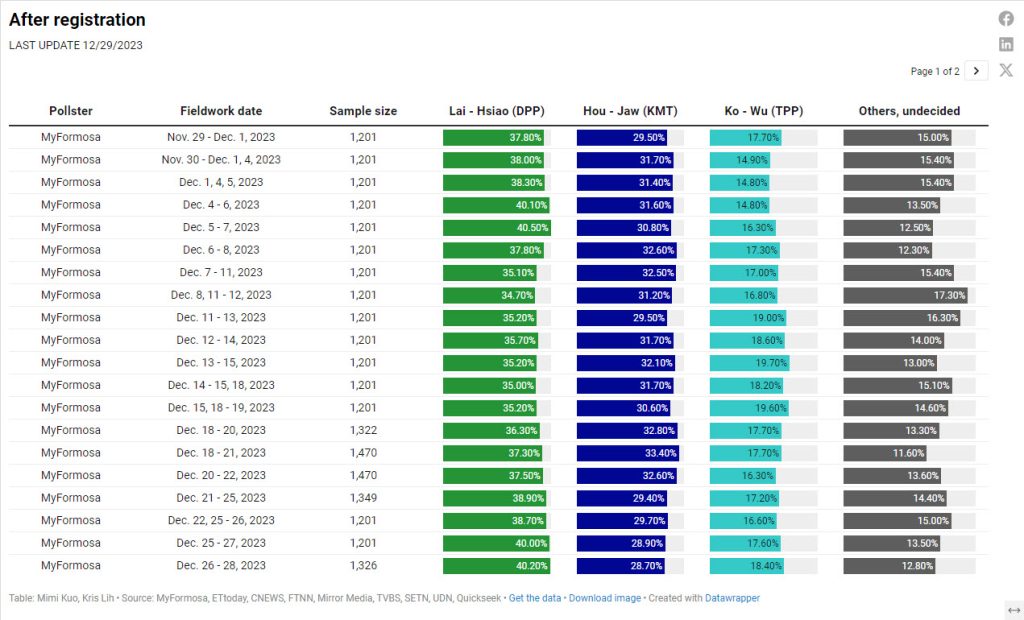
ETtoday’s latest poll showed support for Lai at 36.6%, compared to 36.2% last week. Hou registered 33.8%, compared to 34.8%. Ko rose to 22.2%, from 20.7% last week. Undecided voters decreased marginally to 7.4%, from 8.2% last week.
Taiwan’s Ministry of National Defense said this week that measures will be taken to ensure the nation’s 210,000 military personnel can cast ballots in the January 13, 2024 presidential and legislative elections, with the exception of 5,000 individuals who will remain on duty for potential emergencies. The defense ministry said that number is similar to the number of military personnel who could not vote in 2020 and 2016 presidential elections.



Leave a Reply