
A tactically appealing argument has been proposed recently that Taiwan should abandon its surface combatant tonnage race with the People’s Liberation Army (PLA) Navy and instead concentrate resources on building a large number of 700- to 1,000-ton stealth missile corvettes. This proposition argues that a small, dispersed and heavily armed “asymmetric” fleet is sufficient to deny a PLA amphibious landing across the Taiwan Strait. However, viewing this through the comprehensive lens of national interest, polarizing the navy’s development path into a single-purpose “anti-landing launch platform” reduces the strategic issue of national survival to a tactical beachhead annihilation battle. As an island nation highly dependent on the ocean, Taiwan’s maritime power development cannot be limited merely to wartime “sea denial,” but must encompass full-spectrum response capabilities during both peacetime and crisis periods.
Quarantine and Blockade: A National Crisis Without Firing a Single Shot
An ongoing approach of “unification without an explicit act of unification” in the maritime domain through coercive harassment or administrative interrogation has created a trajectory that could easily intensify into quarantine or blockade — threatening to destabilize the entire Western Pacific. Disproportionately directing defense resources toward countering a “Normandy-style” amphibious landing overlooks two fundamental realities: Taiwan’s evolving coastal geography and Beijing’s underlying political intent.
Given the realities of Taiwan’s coastline, it is debatable and controversial whether the so-called “red beaches,” which have long been perceived as the PLA’s likely amphibious landing zones, remain viable for deploying battalion-scale or larger forces in a regular and traditional landing operation.
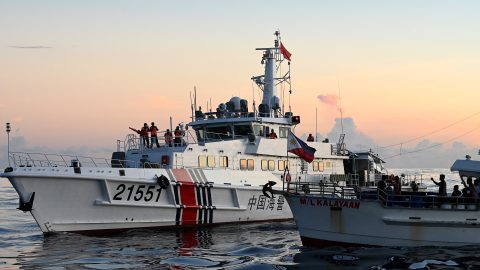
The most cost-effective coercive strategy employed by Beijing’s decision-makers is to exert extreme pressure without firing a single shot. In recent years, China has frequently used its coast guard and maritime militia to conduct gray-zone operations in waters surrounding Taiwan and Taiwan’s offshore islands, indicating that Beijing is more likely to achieve its political goal of “dominating Taiwan without fighting a war” through a maritime quarantine or even comprehensive blockade.
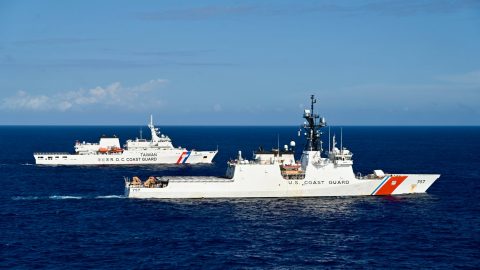
In a maritime quarantine scenario, China might use domestic law enforcement as a pretext to board, inspect or intercept commercial vessels entering and leaving Taiwan. Faced with this low-intensity pressure, a navy composed solely of small missile corvettes would fall into a severe “escalation trap.” Small vessels lack sufficient tonnage for maritime shouldering and escorting, nor can they carry helicopters or adequate boarding inspection teams. A Taiwanese commander would face the dilemma of either standing by while sovereignty is eroded or firing anti-ship missiles and provoking an all-out war. Medium-to-large surface combatants, on the other hand, provide national leaders with essential “non-lethal” response options; through their physical size advantage and extended at-sea endurance, they can reinforce Taiwan’s coast guard in substantively defending maritime borders in a law-enforcement capacity without firing a shot.
The Utmost Priority: Sustaining Economic Development and Maintaining Sea Lines of Communication
The utmost priority for Taiwan’s national interest is upholding its economic development and safeguarding its sea lines of communication (SLOCs). National security is not just about the outcome of military confrontation, but also about the continuation of national economic and social resilience. Taiwan’s energy and food supplies are highly dependent on imports, and the secure reserve periods for natural gas, coal and oil are extremely short. Once its SLOCs are severed, Taiwan’s power plants, semiconductor industry and civilian supply chains would face collapse within weeks.
The core of the sea denial strategy is preventing the enemy from using the ocean, yet this is by no means equivalent to ensuring Taiwan can use the ocean. The original design intent of stealth missile corvettes is to remain concealed in coastal waters on standby and launch surprise attacks; their seaworthiness and endurance completely preclude them from providing escorts for commercial vessels and energy transports in the deep waters east of Taiwan or along the vast Pacific routes. Abandoning large surface combatants equates to Taiwan declaring it is relinquishing the right to protect its own maritime lifelines, entirely handing over the throat of its national economy to others, which is an extremely fragile and irresponsible posture in terms of national interest.
Sovereignty Practice: Regional Stability and Diplomatic Signaling
Taiwan’s assertion of its own sovereignty helps to stabilize the contested islands and waters of the South China Sea and the East China Sea, where overlapping claims have long fueled regional tensions. In international politics, a navy is not only an instrument of war but also an extension of foreign policy and the practice of sovereignty during peacetime. The quality, scale and operational range of a fleet are the most concrete signals demonstrating national will to the international community. Large surface combatants possess powerful radar, command-and-control systems and excellent seaworthiness, enabling them to play a substantive and important role in promoting regional stability in disputed territorial waters and islands of the Western Pacific.
If Taiwan downgrades its navy to a light surface combatant force capable only of coastal defense, it will send the wrong diplomatic signal to the international community: implying that Taiwan has retreated to defending only its main island and lacks both the intention and the capability to shoulder maritime security responsibilities in the Indo-Pacific region. Maintaining a modernized surface fleet of a certain scale proves that Taiwan is a country with substantive maritime governance capabilities and an indispensable security partner to the international community.
Resource Allocation: Finding Common Ground Amid Differences Between Ruling and Opposition Parties on Building a Reliable Defense Force
Resource allocation is the center of gravity, but finding common ground between governing and opposition parties on how to build a credible defense force remains essential to Taiwan’s security. In a democratic system, the allocation of defense resources inevitably faces budget crowding-out effects and political scrutiny. Over the past few years, domestic debates in Taiwan over “traditional platforms” versus “asymmetric capabilities” have often devolved into a mutually exclusive zero-sum game. However, facing increasingly complex threats from across the strait, both ruling and opposition parties are striving to find common ground in their goal of building a reliable and resilient defense force.
Extreme force development paths cannot garner stable political support and long-term budgetary commitments. What Taiwan needs is a sustainable, cross-party defense consensus: acknowledging the high cost-effectiveness of asymmetric capabilities in beachhead defense, while also understanding the irreplaceable nature of traditional surface combatants in maintaining daily national operations and asserting sovereignty. Through transparent strategic communication, the public and the legislature ought to understand that the defense budget must simultaneously cover the dual needs of “war preparation” and “war prevention.”
Balanced Force Development: Countering the Development of Asymmetric Operations and Gray-Zone Tactics
Balanced force development is essential for Taiwan. Countering the rise of asymmetric operations and “gray-zone tactics” requires strategic equilibrium. Taiwan’s defense choices are not a binary contest between large ships and small corvettes but the deliberate construction of a high-low mix fleet capable of meeting an adversary whose coercive methods are themselves diversifying.
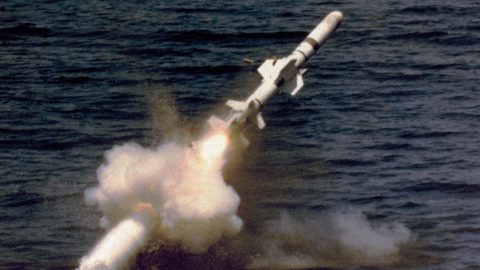
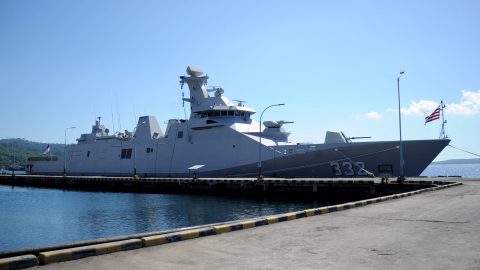
The PLA is not only developing robust amphibious landing capabilities but is also frequently using drones, maritime militias and coast guard forces to conduct gray-zone tactics. To counter these actions, Taiwan has already heavily invested in inexpensive, highly mobile small corvettes, shore-based anti-ship missiles, unmanned aerial vehicles (UAVs) and unmanned surface vehicles (USVs) to act as the “shield” of “asymmetric defense.” At the same time, however, it must maintain an adequate number of modernized medium-to-large frigates to serve as the “spear” executing escort duties, prolonged maritime standoffs and long-range air defense missions. Only through balanced force development can decision-makers be provided with corresponding tools during different phases of a crisis.
The Continuous Modernization Taiwan’s Armed Forces Need: Jointness and Interoperability
The continuous modernization of Taiwan’s navy requires a center of gravity on jointness in multi-domain operations and interoperability with allies and partners. Future naval warfare will not be defined by the tonnage or number of individual ships but by the contest between kill chains and integrated systems. Taiwan’s naval modernization must therefore move beyond debates over hull size and focus instead on implementing multi-domain operations, strengthening cross-service jointness and deepening coordination with allied forces.
Whether large frigates or small corvettes, every platform must be fully integrated into Taiwan’s national C5ISR+T (Command, Control, Communications, Computers, Cyber, Intelligence, Surveillance and Reconnaissance plus Targeting) architecture and equipped with a state-of-the-art Identification Friend or Foe (IFF) system capable of reliable communication and coordination. The navy must be able to share real-time data links with the air force’s airborne early-warning aircraft, the army’s shore-based missile batteries and sensors operating in the space and cyber domains. When small vessels possess target guidance relayed by large radars, and when large vessels can command drone swarms to conduct interference, Taiwan’s navy will truly be able to exert a multiplier effect.
Winning a battle and defending a nation are fundamentally different challenges. Taiwan cannot surrender its right to survival during peacetime and blockade crises simply to win a hypothetical landing scenario in a war game.
Taiwan must continue modernizing its armed forces to achieve multi-domain jointness and interoperability, balancing conventional capabilities with asymmetric capacities to safeguard the political and economic foundations that sustain its democratic resilience. A navy anchored in a strategic equilibrium of spear and shield is indispensable for Taiwan navigating the uncertainties of geopolitical competition and great-power rivalry in the Western Pacific while advancing its national interests.
Rong-I Arthur Hong is a defense technology entrepreneur. He has served as a security and defense adviser for previous Taiwan presidential campaigns, an adjunct faculty member at the War College of Taiwan’s National Defense University and the Taiwan country assessor for Transparency International’s Government Defense Integrity Index.
Yeong-Kang Richard Chen is a Taiwanese legislator and was formerly Taiwan’s vice minister of National Defense, commander of the Republic of China Navy and president of Taiwan’s National Defense University.

Leave a Reply