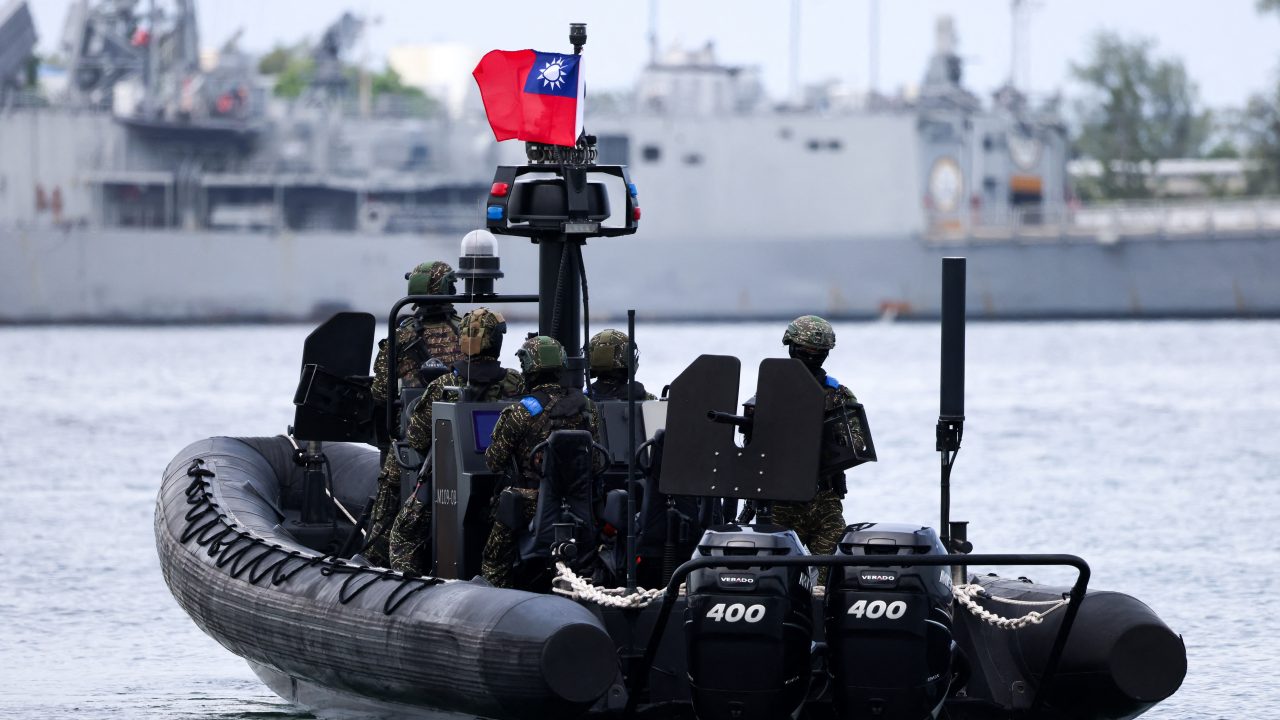
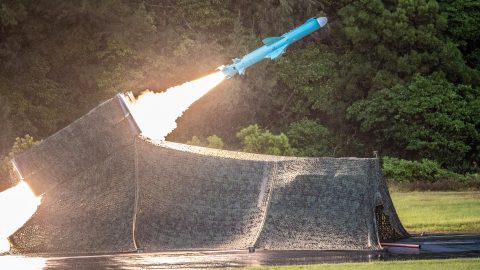
Taiwan will run its annual Han Kuang military exercise next month with a series of unscripted scenarios that officials said are meant to sharpen readiness against a Chinese invasion, with a new focus on the maritime blockade scenario.
The exercise will run from August 5 to August 14, and will be divided into four phases that include preparation, force protection, joint-landing operations and in-depth defense.
Defense officials stated that this year’s exercise will be more realistic and less scripted than before, as Taiwan tries to show it can sustain operations under Beijing’s military pressure and grey-zone tactics. “This is not a scripted exercise,” said Major General Lu Wen-yuan (呂文元), head of the Joint Operations Division, at a briefing today.
The exercise comes as Taiwan faces gradually intensifying military pressure from China, which views the island nation as its own territory and has stepped up drills and other coercive tactics around it.
A key new feature is an exercise designed to practice countering a maritime blockade and landing. Taiwan’s navy and coast guard would work together to escort critical supplies, enforce maritime security and keep sea lanes open, Lu said.
Taiwan set up a new Littoral Combat Command in July as part of efforts to strengthen defense along its coast.
Another new feature is a simulated slowdown of mobile networks in central and northern Taiwan, affecting jurisdictions that together cover about 73% of the population, according to Liang Po-chou (梁伯州), the infrastructure department director at the National Communications Commission. The regulator said emergency calls and core services would remain available, but tactical military software and ordinary communications could be affected.
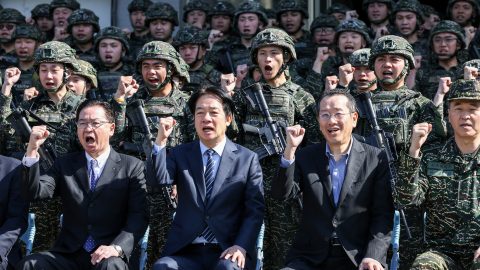
Earlier this year, Defense Minister Wellington Koo (顧立雄) said the Han Kuang drills, like last year’s iteration, would remain 10 days long, and focus on decentralized command, pre-designated kill zones and urban resilience, with “real troops, real locations, real equipment and real conditions.” The military also plans to include air defense, battlefield medical support in this year’s drill.
Last year, the defense ministry put a heavier emphasis on urban defense, rather than fending off a Chinese invasion at the beaches across Taiwan. Key beaches on Taiwan’s northwest coast were found to be almost unguarded, with no major deployments to defend the coastline, despite an announced mobilization in the area.
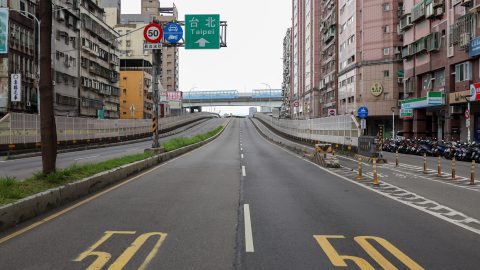
The civil defense part of the drills are meant to reinforce what Taiwan calls “whole-of-society resilience,” the idea that civilians, local governments and private companies would need to keep operating in a crisis. “Public morale cannot be so fragile that people would want to surrender after just two or three days without electricity and water,” said Chen Shih-min (陳世民), an associate professor of political science at National Taiwan University who specializes in international security.
In recent years, Taiwan has emphasized that it is moving to less-scripted exercises, a transformation much vaunted by international observers. But on the ground the script has often still been quite apparent. A civilian exercise last year intending to simulate the use of a grocery store cellar as an air raid shelter included actors posing as shoppers.



Leave a Reply