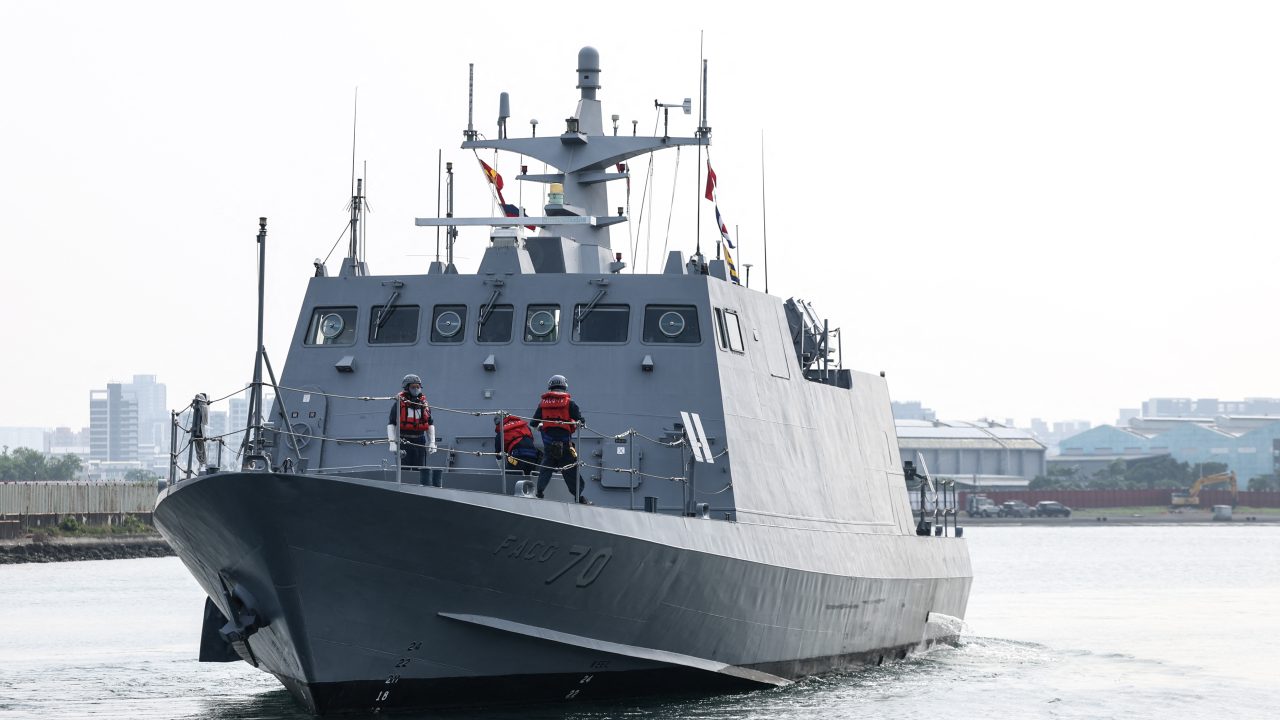
The Taiwanese navy’s new Littoral Combat Command is having its first run out as part of the nation’s annual Han Kuang military exercises. The army is also showing off its capabilities. But more drones are still needed.
Formed on July 3, the Littoral Combat Command brings together existing reconnaissance capabilities with coastal defense battalions equipped with anti-ship missiles. The new command is expected to receive attack and reconnaissance drones as Taiwan expands its drone arsenal.
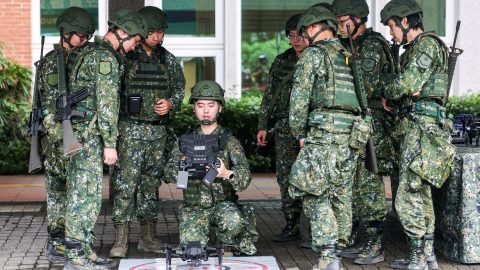
Two different drone types were demonstrated on August 8 during a coastal defense exercise in Kaohsiung in southern Taiwan, but the navy says they are still undergoing testing.
The acquisition of drones for the new command is mostly held up by political wrangling between the two main parties in Taiwan, the Democratic Progressive Party, or DPP, which controls the presidency, and the Chinese Nationalist Party, or KMT, which controls Taiwan’s legislature.
The DPP has proposed a special budget to buy more than 200,000 coastal attack drones. The KMT is refusing to approve the drone budget, saying it lacks sufficient oversight.
President Lai Ching-te (賴清德) attended the drill on August 8, giving a speech from one of Taiwan’s Kuang Hua VI missile attack boats. These were not integrated into the Littoral Combat Command as initially was announced, but are still expected to operate in close coordination. One of the Taiwanese Coast Guard’s Anping-class patrol ships also joined the exercise. These are a sibling class of the navy’s Tuo Chiang-class corvettes. During wartime, they can carry anti-ship missiles.
The two drone types on display included a quadcopter design described as an attack drone, and a winged design that is a medium-sized suicide drone with enough range to track its targets. The special defense budget included coastal attack drones of four kinds, including first-person-view drones with a range of seven kilometers, small suicide drones with a range of 30 kilometers, medium suicide drones with a range of 90 kilometers, and bomb-dropping drones with a range of 25 kilometers.
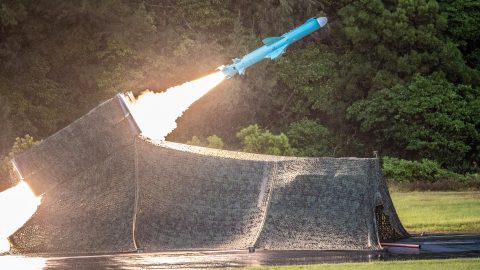
The Littoral Combat Command’s anti-ship missile units were also in action in an exercise in Penghu, a small archipelago in the Taiwan Strait. The new command deployed batteries of both the subsonic Hsiung Feng II (雄風二型) and the supersonic Hsiung Feng III (雄風三型) on Sunday. No missiles were fired; the exercise was a test of the ability to quickly deploy to key locations.
So far, the new command is living up to its concept as a mobile coastal-strike force. The Penghu drill matched the expected mission of dispersed, survivable, road-mobile anti-ship fires that can defend threatened littoral sectors, according to Bryce Barros, an associate fellow at the GLOBSEC think tank who is based in Taipei.
Taiwan is also exercising other capabilities to strike into the littoral domain. On Saturday, army troops on Kinmen, a Taiwanese island extremely close to China, used anti-tank weapons to hit targets offshore, simulating strikes on landing craft making the last push to the beach. The army’s gun artillery also drilled interdicting enemy forces landing on beaches on Taiwan’s west coast in Miaoli on Sunday.
In June, Taiwan’s army demonstrated hitting maritime targets using its ALTIUS-600M suicide drone. Taiwan purchased 291 of these drones from Anduril in 2024, and they arrived last year. Taiwan has subsequently ordered 1,554 of the larger ALTIUS-700M suicide drone, as well as 478 of a reconnaissance version called the ALTIUS-600ISR. Anduril says the 600M and 700M both have a range of 160 kilometers, whereas the 600ISR has a range of 375 kilometers.
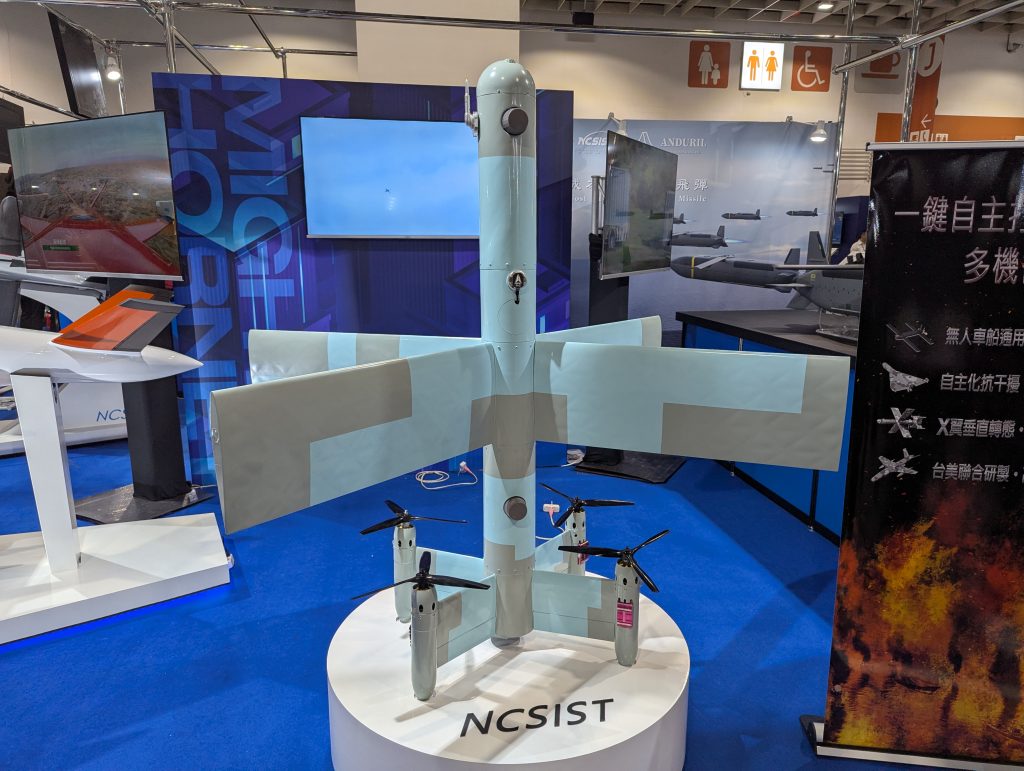
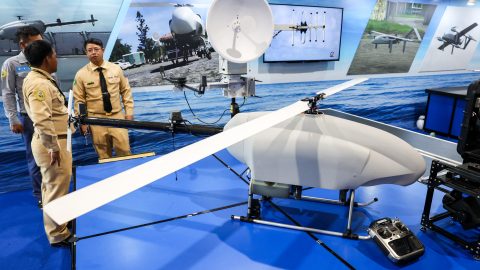
Taiwan’s marines demonstrated a domestically produced drone called the Mighty Hornet I (勁蜂一型) in January, using it to strike targets off a beach in Kaohsiung. It was developed by the National Chung-Shan Institute of Science and Technology, Taiwan’s military research body, and has a range of over eight kilometers, according to a plaque on display at the Taipei Aerospace & Defense Technology Exhibition in 2025. However, of the three drones fired, the first failed spectacularly, crashing into the sand.
Taiwan and the U.S. have agreed to jointly produce the Mighty Hornet I, which could be sold internationally by the U.S., according to a report in Taiwan’s Liberty Times newspaper citing a “high-ranking government official.” Like the Altius drone, the Mighty Hornet I is tube-launched and can be fired by infantry, vehicles, boats and aircraft.
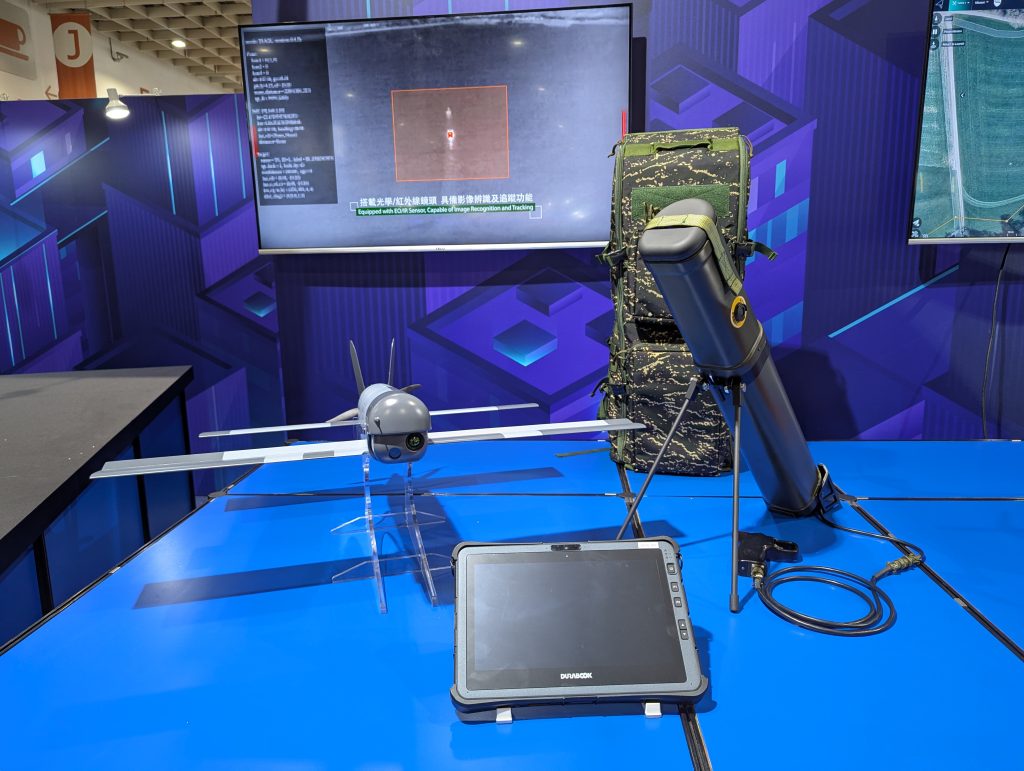
On August 6, U.S. company Shield AI announced a “successful field demonstration of a coordinated autonomous search mission” using three Mighty Hornet III (勁蜂三型) drones also developed by the National Chung-Shan Institute of Science and Technology. The institute’s engineers, supported by Shield AI, developed AI pilots and implemented them into the drones, Shield AI said.
The contract between Shield AI and the institute was signed in February this year. The Mighty Hornet III has a range of 50 kilometers and can take off and land vertically. It is equipped with an anti-armor warhead.
U.S. MQ-9B SeaGuardian drones also arrived in Taiwan this summer, in June. The MQ-9B is a large, long-range uncrewed aerial vehicle which can serve as a maritime patrol aircraft with surveillance and anti-submarine warfare capabilities.




Leave a Reply