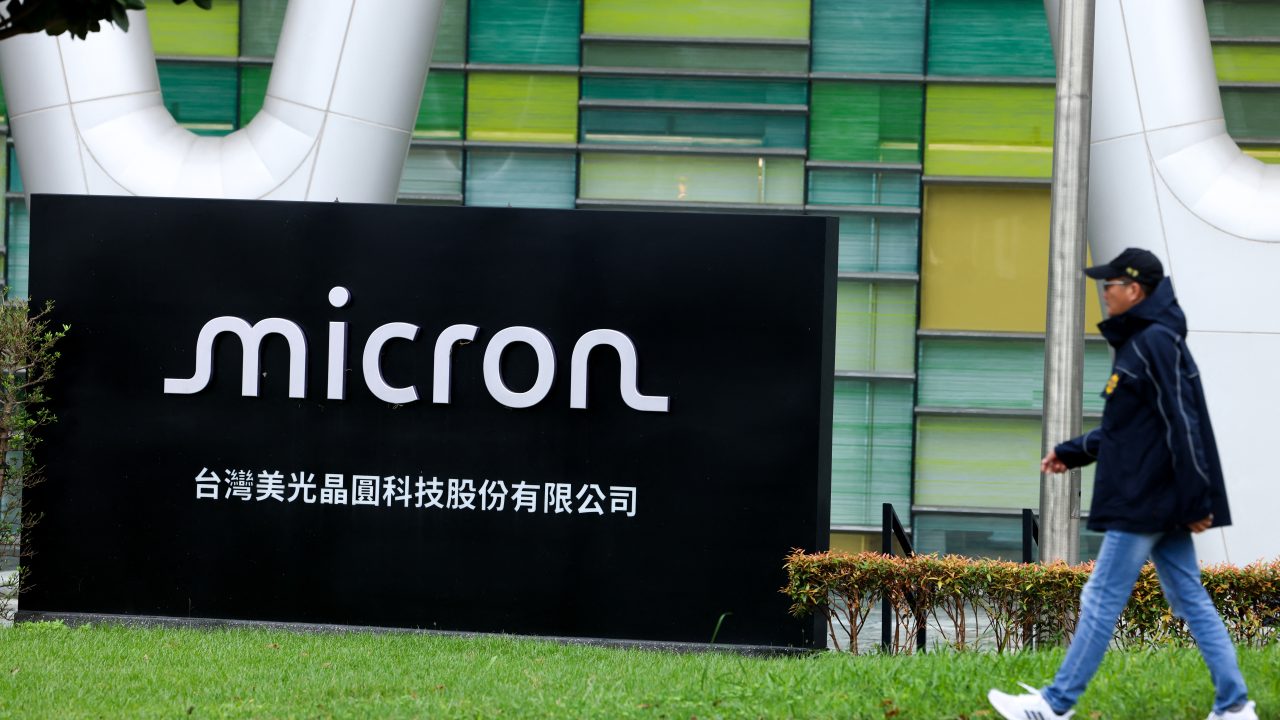
Micron and its labor union in the northern Taiwanese city of Taoyuan concluded their second round of wage negotiations today without a resolution to the dispute behind the first-ever strike in Taiwan’s chip industry.
The U.S. headquartered company, which is the third-largest memory chip maker behind SK Hynix and Samsung, employs upwards of 15,000 workers in Taiwan. The majority of Micron’s memory production capacity is based on the island, yet the company seems to be struggling to match both local compensation expectations and its competitors’ generosity.
The main qualms that the Taoyuan labor union has with Micron’s compensation system are that bonuses have not reflected Micron’s rapid growth in profit, and that bonuses are calculated without transparency. Micron uses an “incentive pay plan” that allocates bonuses according to salary, individual performance and a black-box metric called company performance.
Today’s negotiations followed a 24-hour strike by 11 Taoyuan union officials on Thursday, which commenced after talks with Micron failed on Wednesday. Micron’s rejected proposal included quarterly profit-sharing, higher retirement contributions and three additional days of paid leave. But the offer fell short of what the union is seeking: a one-off bonus of 83 months’ salary and a transparent and predictable profit-sharing scheme that allocates 15% of operating profits to workers’ bonuses, paid quarterly. The Taoyuan union said 1,633 of the 1,637 members who voted opposed the offer, representing nearly 70% of its total membership.
“What exactly is the percentage of these profit shares relative to our operating profit? Management didn’t give a direct answer. They kept saying that under U.S. securities exchange laws, it’s not permitted to disclose these figures,” said Yang Cheng-chih (楊正之), a deputy representative of Micron’s Taoyuan union, speaking after today’s negotiations.
Taoyuan has a long history of labor organizing, fostering a unique familiarity with striking among workers in the city, said Hsin-Hsing Chen (陳信行), a professor at Shi Hsin University who focuses on labor studies and the tech industry. He thinks the nature of the work lends leverage to the unions’ efforts: striking for a few days could lead to losses that rival the compensation demands the workers are seeking.
Farther south, a separate union represents workers at Micron’s plant in Taichung, where the company employs about 12,300 workers at its largest plant in Taiwan. Micron reached an agreement with the labor union in Taichung on Wednesday. Details of the deal have not been disclosed, although it seems to be along the lines of what was offered to the Taoyuan union, according to union representatives.
There has since been outcry about the deal, not only from the Taoyuan labor union, which complained about not being included in the negotiations, but also from the union members in Taichung, who say that their representatives signed on to an opaque deal that does not actually meet their demands.
Some members of the Taichung union came to Taoyuan for today’s negotiations. “We are here to support because of the loyalty they have shown,” said a member of the Taichung union surnamed Chen (陳), who asked not to be identified by his full name as he does not want to be targeted by Micron.
“Micron later presented us with terms that are different from what our union had agreed upon on October 21. This truly upset us the most,” Chen added. Chen said that Micron revealed after the fact that the profit-sharing scheme would only be available to people who have worked at Micron for over a year. “We feel that we have been lied to [by Micron].”
A female member of the Taichung union, who wished to remain anonymous, said Micron’s offer is seen as “running in the opposite direction” and not even close to what they are seeking.
The fissures that have appeared within Micron’s labor union in Taichung might destabilize their agreement reached last week. The Taichung labor union members Domino Theory spoke to said their next step is to petition against Micron’s offer and conduct their own election to pick new representatives for the Taichung union. They have not been able to get in touch with their current representatives since the deal was struck on Wednesday.
Micron is certainly not the only company adjusting to the riches of the AI boom. When it comes to allocating profits, chip manufacturers have three responsibilities, according to Hsin-Hsing Chen, the professor at Shi Hsin University: invest in new equipment, pay shareholders and compensate workers. Workers receive a relatively small share of the revenue because the industry is so capital intensive. But other companies, particularly TSMC, have done a better job of meeting workers’ demands, Chen said.
In the wake of the 2008 global financial crisis, TSMC laid off about one-third of its employees. The layoffs led to labor protests, including two protests in front of the Taipei residence of TSMC founder and former CEO Morris Chang (張忠謀). Galvanized by the uproar, Chang decided to return to TSMC as its CEO, rehired the laid-off workers and raised wages. “I think TSMC has [had] this culture since then that they tend to treat workers better,” Chen said. “Since they are the company that got the highest revenue in the industry, they want to make sure that their workers are paid among the best in the industry.”
The Micron dispute is in large part a communication issue and a question of how to effectively localize the operations of an American company in Taiwan, said Konrad Kwang-Leei Young (楊光磊), a former TSMC executive known as one of the “Six Knights of TSMC’s R&D.” Taiwan’s tech industry traditionally emphasizes bonuses in worker compensation packages, which Young thinks aids Taiwan’s high-tech industry by incentivizing hard work. “Micron needs to understand that when you are in Taiwan, the people have certain expectations about the bonus situation,” said Young.
On whether paying Taiwanese tech workers more could weaken Micron’s ability to reinvest in technology, experts told Domino Theory that it wouldn’t. Even after factoring in the terms of the Taichung labor union deal, Chen found that the amount that Micron pays to its employees in Taiwan represents roughly 1% of Micron’s projected revenue for this year. “So I would say that Micron can certainly afford more,” said Chen.
“At the same meeting of Micron management on October 8, [when] the board decided to reject the union’s requests, they also decided to buy back billions of dollars in stock,” said Judith Barish, the coalition director of CHIPS Communities United, a watchdog group for the chip industry. “I don’t think the company can claim that they don’t have enough money to reward the workers when they’re making the largest stock buyback deal in the company’s history.”
Moreover, SK Hynix and Samsung have both reached major wage and profit-sharing agreements this year. Samsung agreed to set aside 10.5% of profits for special bonuses in the form of stocks, while SK Hynix’s wage agreement will afford workers an average of $547,000 in bonuses in 2026. “They’ve managed to win a fair share of the extraordinary profits of this season. And I think Micron workers deserve the same,” said Barish.
A Taoyuan union representative said the next round of negotiations will take place at 2 p.m. on November 6.
Outside of Taiwan, Micron workers in the U.S., who are not unionized, are watching closely as the negotiations unfold. “A win for workers in Taiwan is ultimately going to be a win for workers in the United States as well,” said Barish.



Leave a Reply