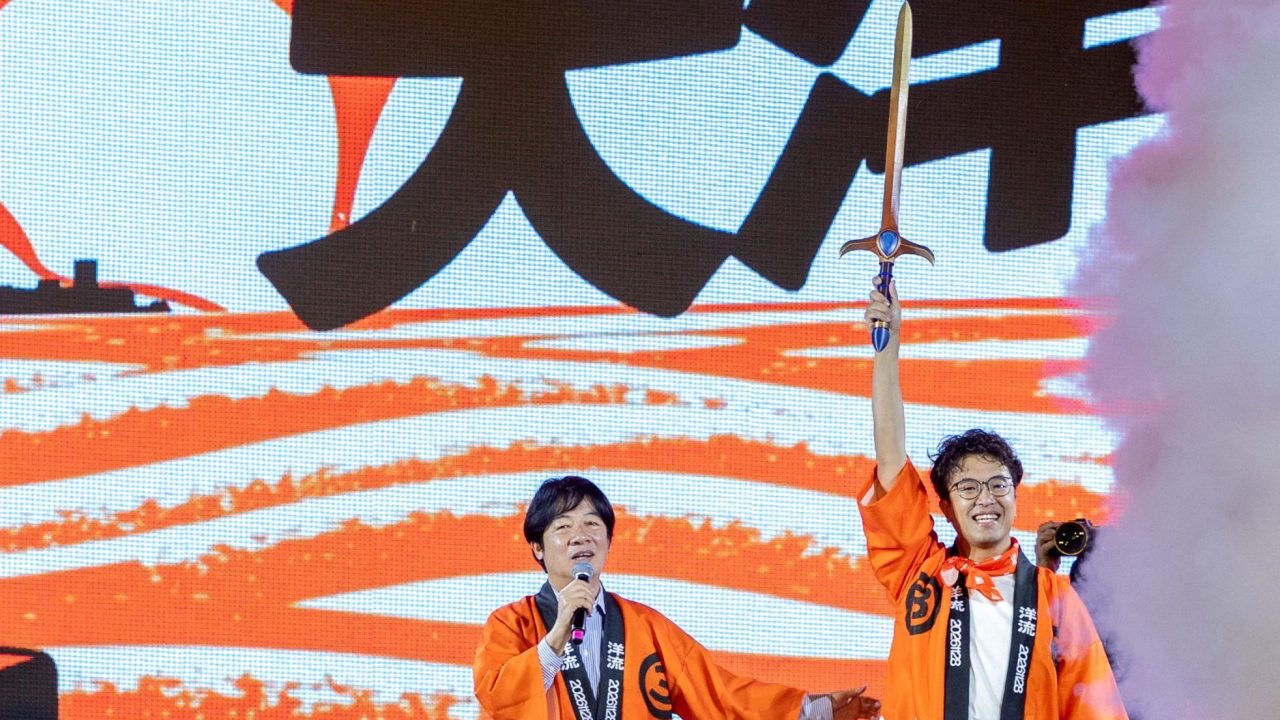
One candidate in Taiwan’s November 28 elections turned himself into a dumpling. Another put her dog on a campaign billboard. A candidate for village chief faced accusations that he tried to buy votes with cash and chickens.
Ahead of the country’s “nine-in-one” local elections, candidates across Taiwan are seeking attention through food, pets and unconventional proposals. Others are suspected of vote-buying cases or promoting unproven conspiracy theories, a mix of spectacle and serious allegations as voters prepare to choose leaders to represent their interests.
Taiwanese candidates often fashion slogans based on their ballot numbers, which are determined by a public draw.
Cheng Meng-ju (鄭孟洳), running for city council in the southern city of Kaohsiung, used the face of her black Shiba Inu on a billboard because she drew number 9, which sounds like “dog” in a local dialect.
Another Kaohsiung city council candidate, Chang Yi-li (張以理), blurted out “eight packs of pan-fried dumplings” after drawing ballot number 8. Chang has embraced the gaffe, wearing a dumpling-shaped hat and featuring dumplings on his campaign advertisements.
In New Taipei, Taiwan’s largest city, mayoral candidate Su Hui-huang (蘇輝湟) proposed allowing marriages involving one man and two women, or one woman and two men to address Taiwan’s low birth rate. Su insists he is not promoting polygamy.
In the capital of Taipei, mayoral candidate Tang Hsin-min (唐新民) made baseless claims that Puma Shen (沈柏洋) of the ruling party is an alien, a hybrid of man and lizard, and that the Freemasons had chosen his name.
Shen, who has denied accusations that he received funding from the CIA, responded: “Have I gone from the CIA to an alien?”
Tang also had this message for President Donald Trump: “If you want to arrest Jensen Huang, you should arrest me first. My crimes are a thousand times greater than his,” he said, without explaining what crimes he was referring to. Tang then became tearful and said he lost everything but is back to save Taiwan.
Tang also attracted attention for an election portrait that looked remarkably younger than his actual appearance, prompting online speculation that the image was generated by AI.
In Taiwan, anyone can run for elected office as long as they put down a deposit, do not have foreign citizenship and have not been convicted of a major crime.
Mayoral candidates in Taiwan’s six special municipalities, including Taipei and New Taipei, must pay a deposit of 1.2 million New Taiwan dollars (around $36,414).
Candidates in other municipalities have to put down about a tenth of that amount.
Those who receive fewer votes than a certain threshold forfeit their deposits, according to the Central Election Committee. For mayoral candidates, the threshold is 10% of eligible voters.
Hung Li-hua (洪麗華), running for mayor in Taichung, took out NTD 1.2 million from her retirement funds after the Buddhist deity Guanyin appeared in a dream urging her to run. “If I wasn’t in the race, many elderly would be dead,” she added.
Other elections have been marked by allegations of criminal conduct rather than campaign theatrics.
In Hualien County, on the east coast, a village chief candidate and his wife were accused of offering voters chickens and NTD 1,000 in cash. The candidate is running unopposed after the other candidate was disqualified.
In neighboring Yilan County, a man running for township council was detained on suspicion of vote-buying, even though he was heavily favored to win. Another candidate who received an award for being a good village chief was also arrested for vote-buying.
As of November 11, police had investigated 219 cases involving election-related disinformation or deepfake material, according to the Criminal Investigation Bureau.
Back in Kaohsiung, Chang’s concerns were more straightforward and non criminal. After building a campaign identity around dumplings, he had to make sure supporters could find the person behind them.
“There are no dumplings printed on the ballot,” he reminded voters.
(Note: Taiwanese law prohibits media outlets from reporting on polls less than ten days before an election. For a sense of where the races stand, readers are encouraged to consult coverage prior to November 17.)



Leave a Reply