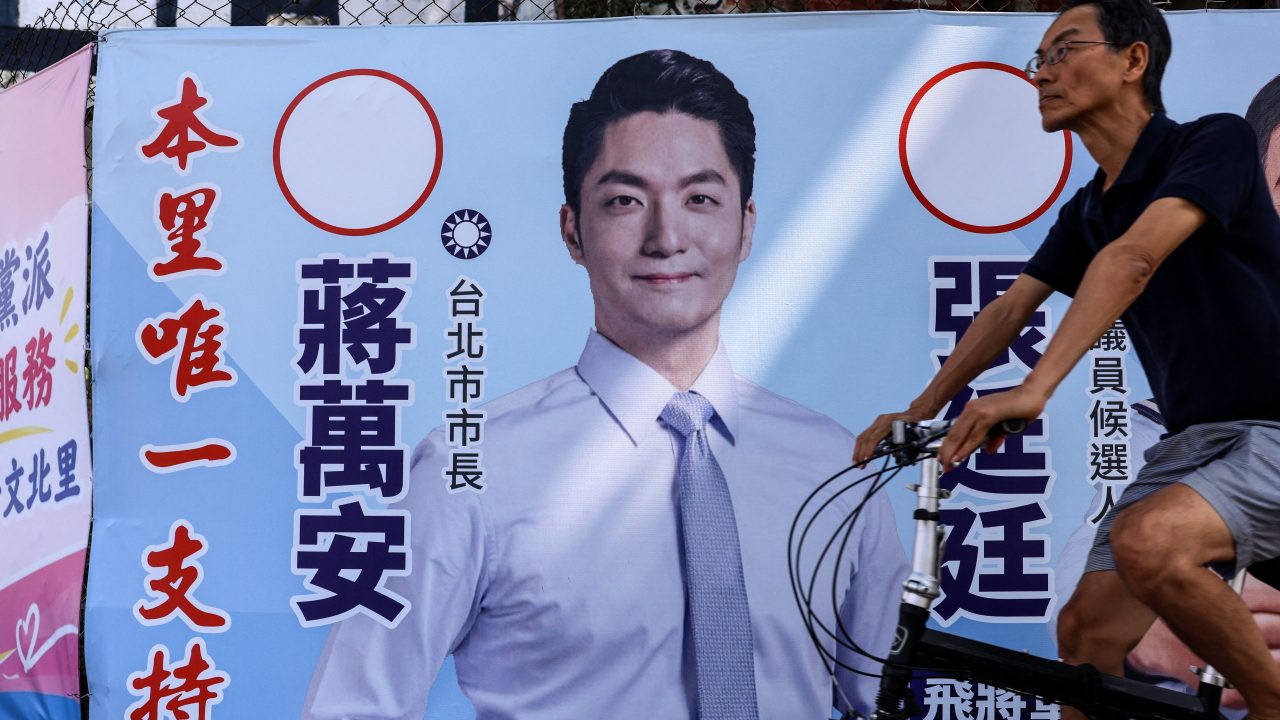
Taipei Mayor Chiang Wan-an (蔣萬安) is betting free school milk and Nvidia’s investment plans will help secure him a second term. His challenger, Puma Shen (沈伯洋), is trying to persuade voters over childcare, hiking and streets.
The race in Taipei is a test to see whether Chiang can withstand a challenger like Shen, who is gaining an image as a refreshing upstart. The result could refashion the political fortunes of these candidates and generate momentum for their parties in preparation for the 2028 presidential election.
Chiang represents the Chinese Nationalist Party, or KMT, currently Taiwan’s main opposition party. Shen is running for President Lai Ching-te’s (賴清德) Democratic Progressive Party, or DPP.
Shen is looking to return the DPP to the Taipei mayor’s office, often a stepping stone to the presidency, for the first time since 1998. Chiang is seeking reelection in a city the KMT regained four years ago from Ko Wen-je (柯文哲), the founder of the smaller opposition Taiwan People’s Party, or TPP.
While international coverage tends to focus on how Taiwan’s elections affect its relationship with China, experts say voters in this election care more about local issues.
“Who makes your everyday life feel better?” said Chen Fang-yu (陳方隅), assistant professor of political science at Soochow University. “Who makes municipal governance feel competent and well run?”
For voters like Mr. Mao (毛), a former business advisor in his late 60s who requested that he only be identified by his surname, it’s frustrating to see Taipei not improving. “Our city has not moved forward in a long time, and we are the capital of a country that produces semiconductors? Our stock gains almost hit the 50,000-point mark, and this city is not showing that.”
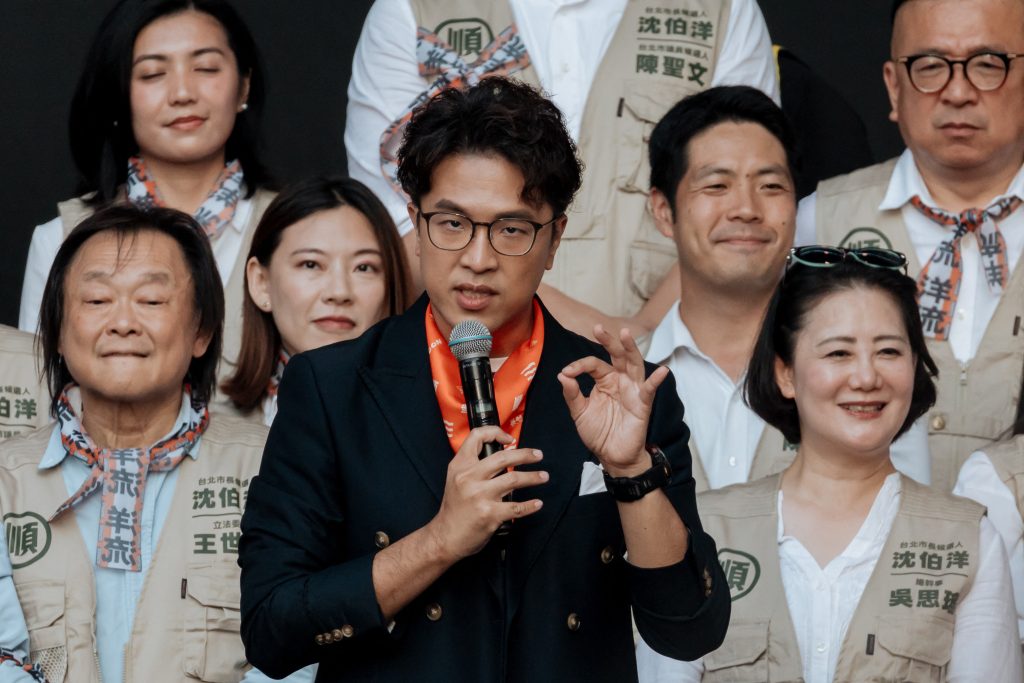
Shen, who rose to prominence as the leader of a civil-defense non-profit, has drawn attention by going beyond security issues. He says he is connecting with voters over issues like running paths, hiking trails, childcare and local history. These conversations attract people who rarely follow politics. “It gave everyone a fresh imagination of the city,” Chen said.
As an example, he mentioned community events like the soapbox speeches where residents are able to talk to Shen directly.
Niu Tse-hsun (鈕則勳), a political commentator and marketing professor at Chinese Culture University, said the campaign has developed into “an exceptionally effective mobilization mechanism for the DPP.”
Shen’s quick thinking has also helped him to stand out. “Chiang Wan-an tends to be steady and conventional, whereas Puma Shen feels more dynamic and adaptable,” Niu said.
Austin Wang (王宏恩), an assistant professor of political science at the University of Nevada, Las Vegas, pointed to another aspect that appeals to voters: Shen’s education and professional background. His path through leading schools and doctoral study in the U.S. could attract voters who place a high value on academic achievement, Wang said.
Chiang’s campaign initially underestimated Shen’s appeal, Niu said. The mayor has since moved toward a more direct attack on his competition. “Chiang Wan-an’s campaign, in the early stages, undeniably underestimated Puma to a degree,” Niu said.
This has forced Chiang to spend more time defending his record, including his handling of rat control and school meal safety issues, and taken attention away from his achievements, which include a land agreement for Nvidia’s Taiwan headquarters and a program giving elementary school and kindergarten students a free bottle of dairy milk or soy milk each week.
“For me, the city is running fine under Chiang. The traffic is the toughest task to tackle, but we are getting better steadily. I don’t understand why people complain about cutting trees. The city government has already started replanting them,” said Hsiao Yung-chen (蕭永誠), a small import-export business owner in his late 40s. “Puma doesn’t have relevant experience to run a city, and Chiang already has one term under his belt, so it would be nice to continue what he plans to achieve for the city.”
“The strategy looks boring and naive, but it indeed makes voters remember that ‘at least he has achieved something,’” Wang said.
Niu agreed that the record remains Chiang’s strongest argument. “The record of achievements is the anchor strategy the mayor will continually deploy,” he said.
Yet Shen faces his own obstacles, and whether he can turn his engaging campaign into effective administration is still a question. Niu questioned if he had presented “a fully comprehensive governance platform.”
Both candidates need to reach beyond loyal party supporters. Wang said Chiang has appeared on YouTube programs linked to the TPP, while enthusiasm for Shen is not proof that voters have made up their minds. “I do not see clear evidence that either of these candidates is winning the vote from nonpartisans or former supporters of the TPP,” Wang pointed out.
Recent polls have skewed along partisan lines. TVBS, a KMT-leaning broadcaster, released a poll at the beginning of the month that put support for Chiang at 49%, with Shen at 41%. But a poll earlier this week from the DPP-friendly Taipei Trust in Democracy Association found Shen beating Chiang 50.3% to 33.3%.
The November 28 outcome could reshape the political trajectories of both candidates.
Niu, the political commentator, says the race could put a dent in Chiang’s presidential ambitions.
Chen, the political science professor, thinks Shen has already strengthened his position by focusing the campaign on everyday issues, even if he loses the election. “He has already won by reshaping the political terrain, regardless of the final vote tally.”



Leave a Reply