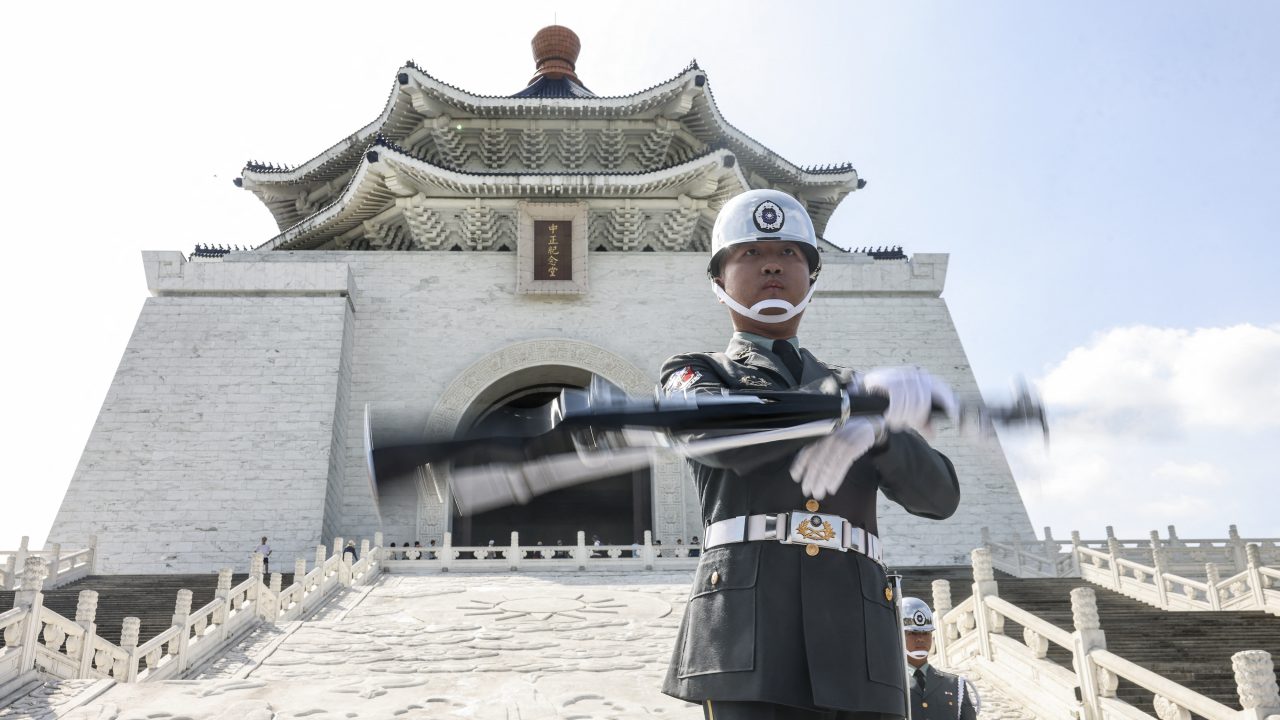
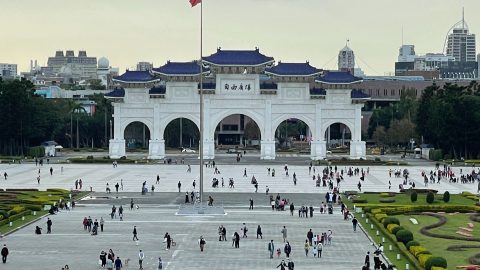
The sun beams off the white concrete and stone of the Chiang Kai-shek Memorial Hall, which is packed with people enjoying their Sunday afternoon. At the top of the monument’s 89 steps, a statue of former Chinese Nationalist Party (KMT) leader Chiang Kai-shek (蔣介石) sits in bronze. But most visitors don’t seem eager to climb up to the statue. Instead, crowds gather at the bottom of the steps to watch the hourly ceremonial military drills. More people cram into the underbelly of the memorial, which is ironically — or fittingly — filled with exhibitions about the history of human rights abuses perpetrated by Chiang’s government in Taiwan.
The memorial has been criticized for being an emblem of authoritarianism, reflecting the outdated notion that the KMT government in Taiwan would retake China. Taiwan looks much different today than it did back in 1980 when the memorial was erected. Since democratization in the 1990s, Taiwan has become one of the freest places in the world. And Taiwan’s residents have increasingly identified themselves as Taiwanese, as opposed to Chinese or both Taiwanese and Chinese.
In response to a question about how he personally identifies, Tang Jung-kuan (湯榮寬), a Chiang Kai-shek visitor who was roaming an exhibition on freedom of speech in Taiwan, answered matter of factly, “I am Taiwanese.” Still, he insisted that Taiwanese identity continues to be debated, as that is the nature of the democratic process.
Most of Taiwan’s population will continue to politically identify solely with Taiwan. But as Tang noted, Taiwanese identity is still being debated, particularly the extent to which China is centered in it. The ongoing discussion around historical architecture and monuments in Taiwan — particularly the redesign of the Chiang Kai-shek Memorial — is just one manifestation of this evolving national identity.
“The Taiwanese identity, if there is such a thing, I would say that it has been a century in the making,” said Ming-sho Ho (何明修), a professor at National Taiwan University who specializes in political sociology and social movements.
Taiwan’s Democratic Transformation and the Emergence of a Taiwanese-Centered Identity
Although Taiwan’s democratic transformation didn’t happen until the 1990s, the formation of Taiwanese political consciousness began during Japan’s rule at the turn of the 20th century, according to Ho. Japanese occupation highlighted for Taiwan’s inhabitants that they had an identity that was separate from China, but not Japanese, either.
Upon retreating to Taiwan in 1949 after losing to the Chinese Communist Party, Chiang and the KMT instituted martial law and implemented policies to “sinicize” the island. At that time, “according to government policies, we were representing authentic China, we were more Chinese than PRC,” said Ho. These policies included changing the national language to Mandarin Chinese and teaching a China-centric education. “I was born in 1973 so when I went to school … we were told everything about Chinese geography, Chinese history… but the textbooks didn’t mention Taiwan,” said Ho.
Ho argues that native identity was one of the driving forces for the democratic opposition that emerged in the 1970s, with the belief that “Taiwanese should take control of their future into their own hands.” Democratization and elections further strengthened this identity, with slogans like “new Taiwanese” and “shared community” uniting people for political support, said T.Y. Wang (王德育), a professor emeritus at Illinois State University and expert on Taiwanese national identity.
Taiwanese Identity Today: Deepening Taiwanese Identification Despite a Continuation of Push and Pull
Hsin-I Sydney Yueh (岳心怡), a professor at the University of Missouri and an expert on identity politics in Taiwan, says that “the majority of Taiwanese have reached a point of no return in [terms of no longer] considering themselves ROC-ruled Chinese … Regardless of how Taiwan’s relationship with China evolves, this shift in identity is unlikely to change.” This shift is reflected in data collected by the Election Study Center at National Chengchi University, which shows that the proportion of people who solely identify as Taiwanese has risen from 17.6% in 1992 to 64.3% in 2024.
Wang argues that generations born after the mid-1980s are overwhelmingly likely to identify as solely Taiwanese simply because — in contrast to many of their China-born parents and grandparents — they were raised in Taiwan. “Why am I Taiwanese? Because I was born in Taiwan. I drink Taiwan’s water, I eat Taiwanese rice and I speak the language. Therefore, this is my country,” said Wang.
Hostility from China has helped solidify Taiwanese identity, according to a study Wang conducted between 2018 and 2020. Wang discovered a causal relationship between an increase in the China threat during those years — repression in Hong Kong and increased military intimidation — and a shift toward more strongly identifying with Taiwan.
But Taiwanese national identity is still being debated to an extent, shaped by the push and pull between KMT and the Democratic Progressive Party (DPP). While the KMT insists that a connection to China is essential to Taiwan’s identity, the DPP promotes a more Taiwan-centered approach and a cautious stance toward China.
A rapid rise in the proportion of people identifying as Taiwanese occured during Ma Ying-jeou’s presidency. Ma is a member of the KMT and was Taiwan’s president between 2008 and 2016. According to Ho, Ma wanted to “restore a Chinese centric perspective.” He encouraged people to read simplified Chinese and also tried to “re-sinicize” education in Taiwan by changing the historical content of school textbooks. Ho argues that the surge in Taiwanese identity in response to these policies was “like self-defense … an allergic reaction to an overwhelming insertion of Chinese influence in Taiwan.”
Taiwan’s current president, Lai Ching-te (賴清德), also faces pushback for the way in which he frames Taiwanese identity, which may be seen as inherently linked to the issue of independence. When Lai spoke on the importance of developing a unified Taiwanese national identity — notably in Taiwanese, not in Mandarin — at the DPP National Congress this past summer, KMT Legislator Lo Chih-chiang (羅智強) criticized him, stating that “Anyone who does not agree with [Lai’s] definition of national and cultural identity is seen as a source of disunity and as supporting the annexation of Taiwan by Beijing.” When Lai talks about identity, he is actually talking about independence, said Wang, “using [identity] as a way to promote Taiwan’s separate and independent status from the Chinese mainland.”
Yueh thinks that “More and more people are recognizing that supporting a Taiwanese political identity — identifying as Taiwanese, not Chinese — does not require abandoning all Chinese cultural elements in their daily lives.” Taiwan is developing its own spin on Chinese culture that incorporates “other cultural influences, such as Japanese comic characters, boba tea imagery, drag queens, etc., creating their own unique interpretations and expressions,” said Yueh. Taiwanese are also perhaps able to display Chinese history and culture more authentically than China, said an assistant curator at the National Palace Museum, Kuo-Sheng Lai (賴國生). Since elements of Chinese history and culture might be censored in China, museums in Taiwan can provide a freer forum for relevant exhibits.
The Chiang Kai-shek Memorial Redesign
As national identity in Taiwan has evolved, the question of how Taiwan’s monuments can be reimagined to better reflect modern Taiwanese identity and values has been a hot topic among activists, politicians and design experts. Two years ago, Taiwan’s Ministry of Cultural Affairs funded a competition to develop and showcase ideas for the potential redesign of the National Chiang Kai-shek Memorial Hall.

Jeff Hou (侯志仁), a juror for the competition and a professor at the National University of Singapore, described some of the winning proposals. One idea keeps the memorial but creates new structures facing it, which would change the dynamic of how visitors engage with the memorial — instead of looking up at it in reverence, they could look at it straight on. This is meant to symbolize history being interrogated. Another proposal aims to highlight the transition from authoritarianism to democracy by removing the statue of Chiang but keeping his chair, and allowing anyone to sit in it.
In terms of the future of the redesign, Hou says it is controversial. The administration of former president Tsai Ing-wen (蔡英文) wanted to be cautious because the KMT could use the backlash from the initiative to mobilize their base. But he thinks Lai might pick it up at some point during his term. “You have to make these small steps so that eventually, when the policy windows open, then we have something to offer,” said Hou.



Leave a Reply