
U.S. defense industry figures discussed the current state of play in Taiwan’s external military purchases yesterday, as Taiwan continues to reckon with the implications of the special defense budget passed by its legislature earlier this month.
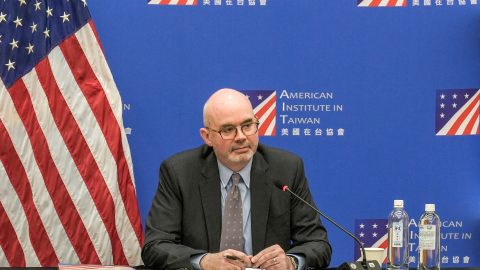
The 2026 Taiwan-U.S. Defense Industry Forum was co-organized by the U.S.-Taiwan Business Council and the Taiwan External Trade Development Council, or TAITRA. It featured opening speeches by Charles Flynn, former commanding general of U.S. Army Pacific; James Huang (黃志芳), chairman of TAITRA and former Taiwanese foreign minister; and Rupert Hammond-Chambers, president of the U.S.-Taiwan Business Council, and a question-and-answer session with industry leaders, hosted by Hammond-Chambers.
Much of the audience was made up of a delegation of visiting industry executives, as well as their Taiwanese counterparts, and media and academics. Questions from the floor immediately turned to Taiwan’s recently passed special defense budget, and the implications for U.S. companies looking to sell to the Taiwanese government or to Taiwanese defense firms.
When President Lai Ching-te’s (賴清德) administration proposed a $40 billion special defense budget last year, to be spent over eight years, the budget contained two broad kinds of acquisitions: purchases from the U.S., and from Taiwanese companies. When Taiwan’s legislature passed a reduced $25 billion special budget on May 8, all of the domestic acquisitions had been stripped out.
That meant that most of the drone acquisitions in the special budget were removed. Many observers, like Cathy Fang (方怡然) from Taiwan’s Research Institute for Democracy, Society and Emerging Technology, or DSET, are worried that this leaves Taiwan in danger of falling behind on the modern battlefield.
“I actually am quite bullish that the original [Lai administration] submission will eventually all be funded,” Hammond-Chambers told the audience yesterday. But he said that the question was how, and by what mechanism.
The visiting delegation had met that morning with the speaker of Taiwan’s legislature, Han Kuo-yu (韓國瑜), from the Chinese Nationalist Party (KMT), which pushed through the reduced budget, Hammond-Chambers told the audience. They also spoke with members of Lai’s executive team this week. “I remain confident that we’re gonna see they’re gonna find a mechanism to fund the remaining 15 billion,” Hammond-Chambers said.
Certain items that were removed should have passed, said Brady Crosier, vice president of business development at communications firm DTC, adding that he thinks people on all sides believe this. He emphasized that the matter is an internal Taiwanese decision, but said he had “a feeling” that the unmanned systems would be reintroduced later.
The drone purchases currently unfunded include 208,200 coastal attack drones and 1,758 maritime and coastal surveillance drones. The KMT has said Taiwan’s unmanned vehicles should be funded by the regular defense budget, not special budgets. But that means their acquisition would slip back a year to 2027. Lai’s administration says it intends to resubmit the drone package as a new special budget this year, but has yet to offer a theory of why it might pass a second time around. It’s also possible some funding could be found in the existing spending in the “multi-year emerging projects budget.”
Most of the $15 billion in funding that wasn’t passed was intended to support domestic production and the Taiwanese drone industry. But from the way U.S. business leaders were talking yesterday, it’s obvious they think there will be a substantial role for American companies to play within the wider Taiwanese drone ecosystem. So their optimism for future unmanned system orders might be worth tempering just a little.

Leave a Reply