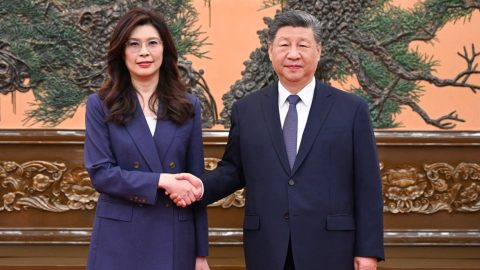
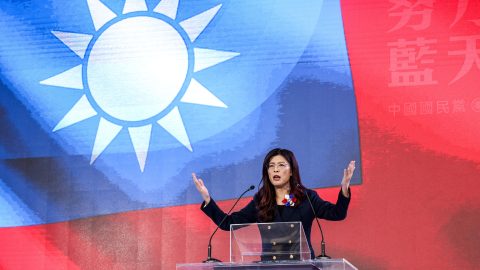
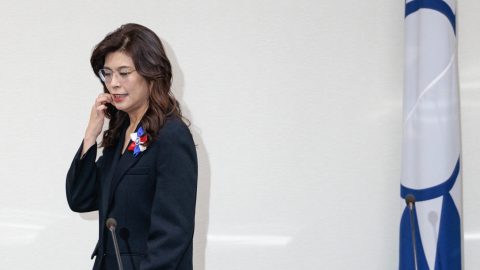
In April, Chairwoman Cheng Li-wun (鄭麗文) of the Chinese Nationalist Party (KMT) traveled to Beijing to meet with China’s president, Xi Jinping (習近平), the first Taiwanese opposition leader to do so in more than a decade.
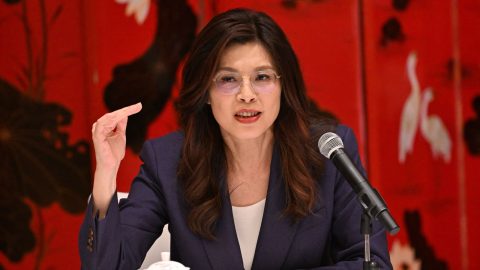
Now, Cheng is preparing to take what she has called her “peace mission” to the United States, visiting a string of cities around the country before closing out her trip with meetings in Washington the second week of June. Cheng has said that she would welcome a meeting with Donald Trump, but there has been no indication from the U.S. president on whether she will get one.
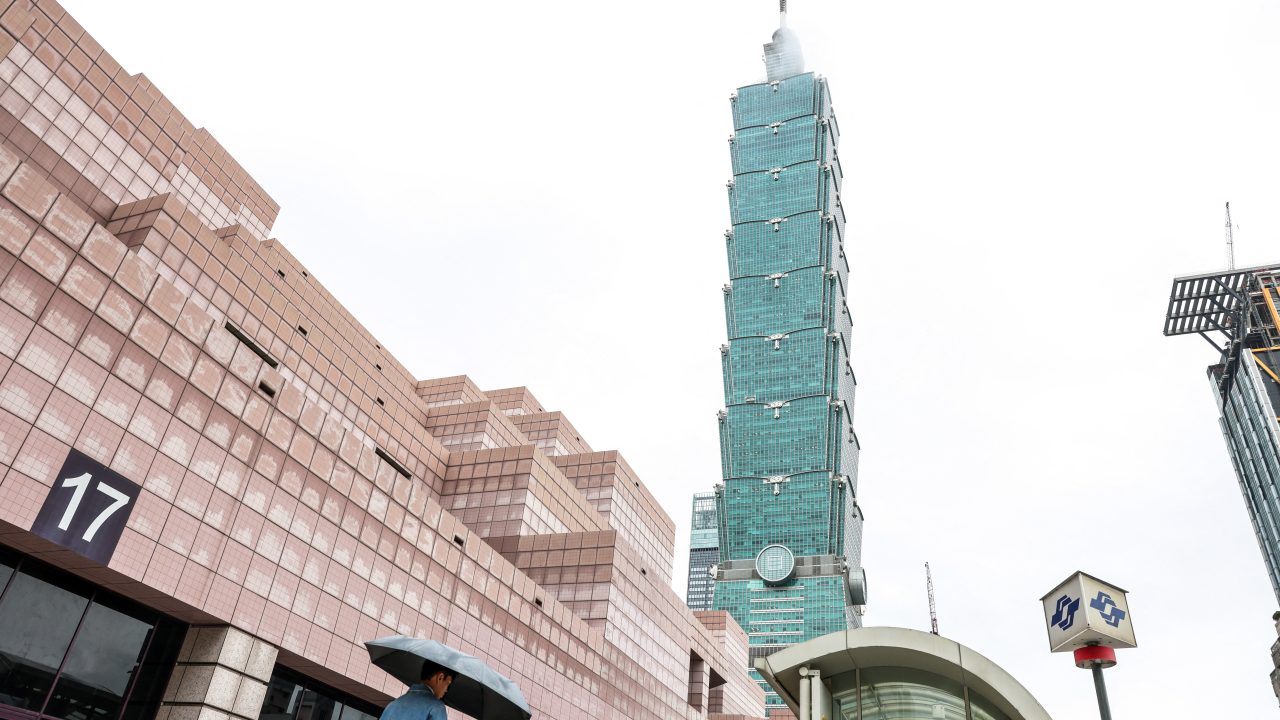
This past Wednesday, we roamed the streets of Taipei to find out how Taiwanese people are feeling about Cheng, Trump and the state of U.S.-Taiwan relations.
Chang Yuan-shuo (張元碩), 40, a tutor who works in Taipei, said he’s skeptical about the prospects for Cheng’s trip. “I think if she’s going to do something helpful for Taiwan, then I support it,” Chang said while standing with his girlfriend in Taipei’s bustling Xinyi shopping district on Wednesday afternoon. “But when she went to mainland China before, it seemed like it wasn’t viewed very favorably by the public, so we’ll just have to see how it goes.”
Chang Hao-cheng (張皓程), 29, who works as a freelance lighting designer, voiced a concern shared by many of Cheng’s opponents in Taiwan — that her “peace mission” messaging is a cover for doing Beijing’s bidding. “We don’t know what she is planning to do, or the type of message that the Chinese Communist Party has expected her to send to the U.S.,” Chang said on Wednesday evening, in a rush while he walked through Ximending, a popular nightlife spot. “I don’t think she represents the entire country, but she represents a certain voice we have here. It’s a free country, after all.”
Back in Xinyi, Ms. Song (宋), 30, a doctor of Chinese medicine, said that she expects officials in the United States to hear a very different message from the one Cheng brought to Xi when she visited Beijing in April. Song, who, like many people interviewed for this story, asked to be referred to by her surname to protect her privacy, said that while the KMT is known for its closer relationship with China, she expected Cheng to “choose the parts that are good for Taiwan,” in her meeting in the U.S.
A nearby college student who asked to be called Little A. voiced a more apathetic view. “This matter has nothing to do with me or the people of Taiwan,” she said. “This is a power struggle within politics.”
Lin Chia-han (林佳翰), 36, who works as a swim instructor, was optimistic about the prospects for Cheng’s visit. “It should be quite good,” he said. “It should be able to promote a kind of peace in U.S.-China relations. Especially since Trump recently had those meetings and whatever with Xi Jinping.” He paused for a moment to ask if what he was saying was too ambitious, then continued: “There very likely might be the possibility of establishing diplomatic ties, the possibility of Taiwan and the U.S. re-establishing formal relations.”
On Trump, Lin said that while the American president can be a bit crazy, he admires his efforts to transition the United States toward a healthier balance between the services and manufacturing sectors. “Americans — if I say this, the people next to me might hit me — Americans have been too lazy. Lazy for too long. I mean, look at why chips are made here by Taiwanese people, while the U.S. side doesn’t seem to be moving forward.”
Lin’s cautious praise for Trump puts him in the minority in Taiwan, where citizens’ trust in Trump has ranged from 11% to 22% during his second term. In the latest poll conducted by MyFormosa this month, 19% of respondents said that they trust Trump, compared with 67% who do not.
“Everyone thinks Trump is arrogant and lacks vision,” said Ms. Hsu (徐), a service worker in her 50s who was hanging out with a group of friends.
“He messes around, he doesn’t act like a leader,” Hsu’s friend Ms. Huang (黃), who is slightly older and also a service worker, added. “He doesn’t have that kind of worldview of leading a country toward better, orderly development. He manages his own country from the perspective of a businessman chasing profit. Many people around me think this way.”
Song, the Chinese medicine doctor, explained that much of the concern here around Trump’s transactional instincts comes from the pressure he has put on Taiwan’s semiconductor industry. “What more people talk about is, for example, TSMC going to the U.S. to set up factories,” she said, before adding: “The U.S. is the major market for the products after all … You can’t just say, ‘Oh, we don’t want to,’ because that might lead to even greater negative impacts later on.”
Lin Ming-wei (林明偉), the 45-year-old boss of a local construction crew, summed up his view of Trump quickly. “Quite dictatorial,” he said, speaking in Hoklo, a local dialect. “A pretty overbearing president.”


Leave a Reply