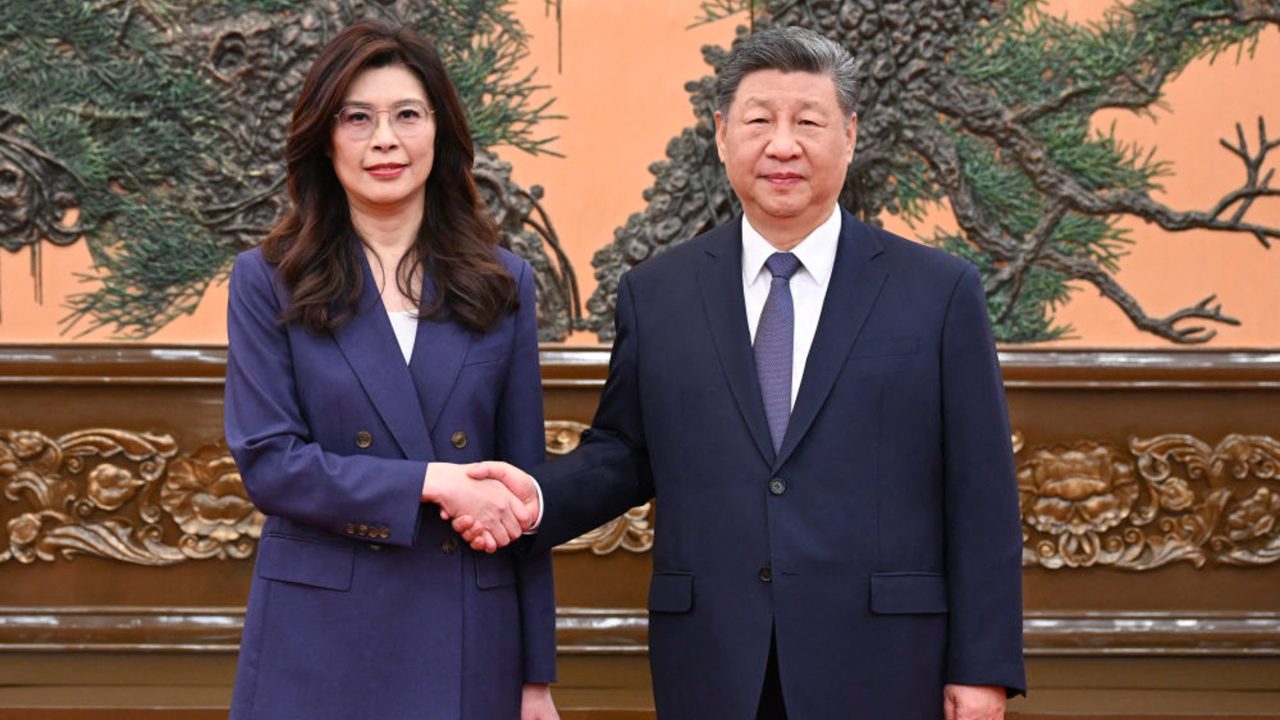
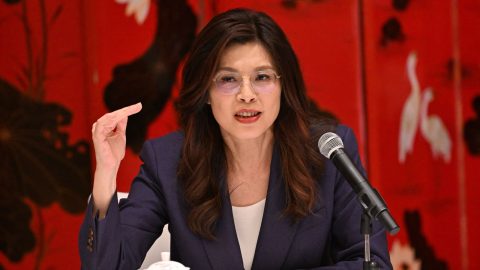
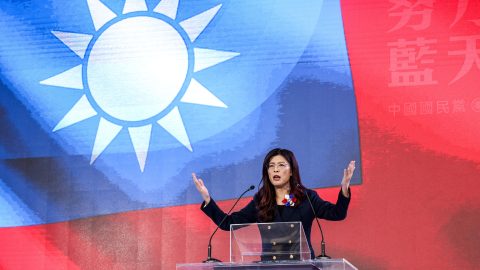
Taiwanese opposition leader Cheng Li-wun (鄭麗文) met Chinese President Xi Jinping (習近平) in Beijing last week. But her visit, framed by both sides as a gesture of “peaceful engagement,” has been met with skepticism at home.
Cheng met Xi in Beijing’s Great Hall of the People, the first such leader-level contact in a decade. Footage from Chinese state media showed a 13-second handshake, with Xi stressing “compatriots on both sides share one family bond” under the 1992 Consensus, which refers to the idea that there is only “one China,” but that Beijing and Taipei have different interpretations of what that means.
When asked whether she now shares Xi’s vision for “reunification,” Cheng said: “This is something we will do little by little, a road we will walk step by step.”
After the summit, Beijing announced 10 measures to promote ties with Taiwan, including direct flights and imports of Taiwanese aquaculture products. Taiwan’s executive branch rejected the proposal, comparing the measures to “the same old fruit basket being sent several times.”
Cheng has instructed deputies in her Chinese Nationalist Party (KMT) to form a task force to facilitate the implementation of Beijing’s 10 measures and establish a window for communication with China.
KMT caucus convener Fu Kun-chi (傅崐萁) urged the ruling Democratic Progressive Party (DPP) to support the proposal.
Wang Chan-hsi (王占璽), a deputy researcher at Taiwan’s Institute for National Defense and Security Research, said Cheng’s excitement during the post-summit press conference, where her answers echoed Xi’s statements, showed she is positioning herself as a supporter of Beijing’s position.
“Cheng Li-wun looks to be more so carrying the litter for Beijing and burnishing her own historical position through an empty political show,” said Wang.
Chang Kuo-cheng (張國城), deputy director at Taipei Medical University’s general education center, said the Chinese Communist Party appears to have lost interest in offering genuine goodwill measures. He noted ongoing Chinese military incursions on the day of the summit that saw 17 warplanes, seven Chinese navy ships and one non-military government vessel harassing Taiwan.
Public reaction in Taiwan was largely negative, with critics accusing Cheng of echoing Beijing’s line.
According to polls by National Chengchi University’s Election Study Center, over 82% of Taiwanese surveyed in December favored maintaining the status quo, in which Taiwan enjoys de facto independence from China but does not move toward a formal declaration of independence, while support for immediate unification hovered around 1%.
“I haven’t paid much attention to [the summit], but I don’t understand why [Cheng] thinks she can represent the entire Taiwan,” said a 35-year-old Taipei real estate agent surnamed Wu, who would not give his full name because he does not trust the media.
“We buy weapons [from the U.S.] for protection, which has allowed us to achieve so much economic success,” said 72-year-old Chen Yu-hsin (陳雨邢), a retiree. “Once you are occupied by the Communist Party, you will be left with nothing.”
But Echo, a 35-year-old marketing professional who did not want his full name published because he has businesses in both China and Taiwan, said he was not opposed to Cheng’s visit. “I think that the idea of achieving balance in this region without outside intervention is somewhat unrealistic. In general, I still hope that Taiwan can retain some autonomy.”
The Mainland Affairs Council, Taiwan’s political body in charge of Taiwan-China relations, published a warning on April 10 that “the so-called ‘peace framework’ is in fact a unification agenda.” It stressed that Taiwan’s future must be decided by its people and safeguard sovereignty, democracy and freedom.



Leave a Reply