
Chinese leader Xi Jinping (習近平) and U.S. President Donald Trump held an unexpected phone call on Monday. They discussed a range of issues including Taiwan, Ukraine and trade, but the most intriguing detail came from reporting after the call.
Lingling Wei (魏玲靈), writing for The Wall Street Journal, cited “people close to Beijing” saying that Xi had “made the outreach.” The only other instance when China has “initiated contact with an American president was on September 11, 2001, when Jiang Zemin (江澤民) sent a telegram of condolence to George W. Bush after the terrorist attacks,” Wei wrote on X.
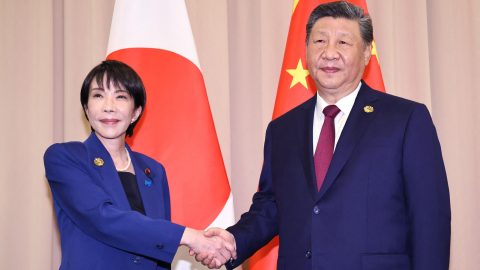
Reading between the lines of the Chinese readout on the call, it is clear Xi called Trump to talk about Japan. Beijing and Tokyo are in the middle of a bitter diplomatic spat after Japanese Prime Minister Sanae Takaichi said that a Chinese invasion of Taiwan might threaten Japan’s “survival,” which under Japan’s constitution would allow it to deploy its military outside its own territory.
Beijing has framed Japan’s stance as a “grave violation” of the “One China” principle and a revival of historical militarism, while Tokyo insists it’s consistent with its security laws and the U.S.-Japan alliance. China has continually escalated its responses, suspending the import of Japanese seafood and issuing travel advisories for those looking to travel to Japan.
In China’s readout of Xi’s call with Trump, Beijing underscored that “Taiwan’s return to China is an integral part of the post-war international order” and that “China and the U.S. fought shoulder to shoulder against fascism and militarism.” The latter is a clear reference to the U.S. and China fighting as allies against imperial Japan in World War II.
Xi likely decided to initiate a call now because he does not want rhetoric about intervening militarily in a Taiwan contingency to be normalized. China considers relations with the U.S. to have improved since APEC, and Xi might think there is a real chance that he can isolate Japan by convincing Trump that Takaichi is stirring up trouble. China also sees Japan as the U.S.’s junior partner, a subordinate enforcer of American hegemony who Washington can call to heel.
Takaichi’s approval rating has risen to 75% during the spat, with 61% of respondents deeming her parliamentary answer on a Taiwan crisis “appropriate” and backing potential collective self-defense. If China thought that the economic squeeze it is putting on Japan would hurt Takaichi, so far it’s not working, all the more reason for Xi might want to bring in Trump as support.
Takaichi said that she took a call from Trump after he spoke with Xi. “President Trump mentioned that he and I are extremely good friends, and that he would be delighted to receive a call from me at any time,” Takaichi said.
China’s readout from the Monday call between Trump and Xi grounds China’s claim over Taiwan in legal documents signed by the U.S. after World War II. China has increasingly leaned into the message that the return of Taiwan to China is integral to upholding the post-war international order. “The Cairo Declaration, the Potsdam Proclamation, and the Japanese Instrument of Surrender and so on, all affirm China’s sovereignty over Taiwan,” Xinhua, China’s state news agency, reported in August.
While the Cairo Declaration said that the territories Japan had taken from the Chinese, including Formosa, should be returned to China, the 1945 Potsdam Declaration was the surrender ultimatum to Japan that paved the way for the Cairo Declaration to be implemented.
At other points in the past year, China has employed very similar language to that which it used in the readout of Monday’s call. “As this year marks the 80th anniversary of the victory of the World’s Anti-Fascist War, it is imperative to remember the hard-won lessons of that warring era,” CGTN, the Chinese government’s international news broadcaster, wrote. “Given the current international landscape, upholding Taiwan’s return to China as a key outcome of the post-war international order is critical for maintaining peace and stability in the region and the world.”
Needless to say, many disagree with China’s view of history. Joseph Wu (吳釗燮), secretary-general of Taiwan’s National Security Council, posted on X this morning that World War II was not the PRC’s victory because the PRC “wasn’t even born yet.”
In fact, the Cairo and Potsdam declarations were signed by Chiang Kai-shek (蔣中正), the Chinese Nationalist Party (KMT) leader who later fled to Taiwan after losing the civil war to Chinese Communist Party. The Cairo Declaration specifically states that Taiwan should be returned to the “Republic of China,” a detail which Chinese state media prefers to leave out.
Trump’s response was cryptic. “Now we can set our sights on the big picture,” Trump said in his Truth Social post about the call. Without mention of Taiwan or Japan, he leaves the “big picture” a mystery.



Leave a Reply