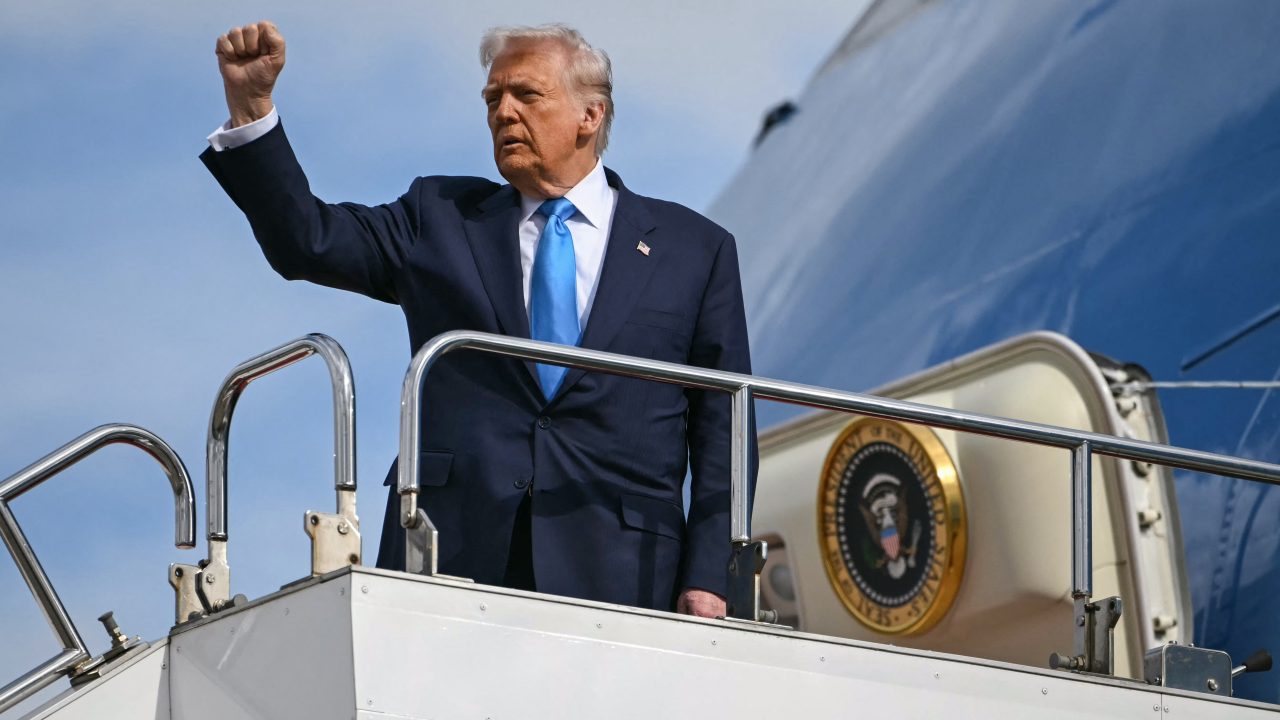
U.S. President Donald Trump will meet his Chinese counterpart Xi Jinping (習近平) on Thursday in South Korea. Trade and tariff talks are on the ticket.
Trump told reporters on Air Force One that he thinks there is a “really good chance of making a really comprehensive deal.”
There might be a good chance, but is there a good deal to be made?
Trump believes that China needs to buy more American exports to lower the trade deficit. But American companies in China are more pessimistic than ever before. Demographic shifts and economic policy have left the Chinese market less and less hospitable for the U.S.
China’s population is aging, with fewer and fewer young people due to its falling birthrate and the now-rescinded “one-child” policy. This leads to the twin problems of a shrinking workforce and an aging retiree class who need to be supported. For American companies looking to export to this huge market, that might be the first little red flag. But it doesn’t stop there. There are other concerns about Chinese consumers.
Despite China’s stated desire to increase consumption, it has mostly stuck with its old playbook of infrastructure investment and focusing on industrial production. Some policies that could boost consumer spending, like expanding support for lower-income households, clash with Xi and the Chinese Communist Party’s opposition to welfarism. Michael Pettis at Peking University has long argued that the CCP needs to transfer wealth to Chinese consumers to boost the economy, and that it struggles to do so because it fears the political ramifications of financially empowering its citizens.
China’s economy has been in the doldrums since Covid began, a situation worsened by a property market crisis that started in 2021. This is most obviously observed simply by walking around a Chinese city and seeing closed shops, or by talking with Chinese friends about their employment prospects and financial anxieties. It can also be seen in the grinding withdrawal from economic transparency — why else stop reporting so many indicators?
But these issues are not the only narrative that prevails about the Chinese economy. The other is based on the rapid technological development in Chinese industry and in Chinese urban life, newly apparent after Covid when China reengaged with the world. To some extent this perception is fanned by state media or by state-facilitated influencer content. When influencer IShowSpeed toured around China, his streams almost became adverts for many Chinese tech. products. But it is also a state of affairs confirmed by numerous reports that the U.S. is falling behind China in manufacturing. China now has more factory workers robots per 10,000 factory workers than any Western country.
In the long-term, this approach could offset the decline in workforce numbers that will soon kick in. Factory robots are already offering substantial benefits over human workers in both cost and productivity. However, widespread job losses are a concern, among a working class that is already missing out on the tier-one city benefits China enjoys thanks to their labor. China already saw unrest during the April tariff war as Chinese factories were forced to reduce their production.
Six hundred million workers losing the means to lift themselves into the middle classes would be another unwelcome challenge to increasing consumption, not to mention a social stability problem. But many of the four hundred million consumers who have already achieved a higher living standard are also pessimistic about the economy.
Even excluding the effects of automation on Chinese consumers, the rapid expansion of many tech industries in China raises its own questions. Specifically, questions about overcapacity. Many Chinese industries, whether it be electric vehicles (EVs), batteries, solar panels or even synthetic diamonds, have increased their production far beyond what the Chinese domestic market can consume. One factor that drives this are the large state subsidies that some industries in China receive, even when the companies concerned are not state-owned enterprises. This overcapacity has led to anxiety in other markets, even from countries friendly to China like Brazil, which is introducing tariffs on EVs.
Needless to say, it is impossible for American companies to compete on price in this environment, and the old adage that Chinese goods are low-quality also no longer largely holds true. In the auto industry, Tesla is now seen as the third-ranking in EV brand choice, behind both BYD and Xiaomi, and even as EV sales have risen to eclipse internal combustion engine vehicles for the first time, Tesla’s market share and overall sales are in decline. Ford and GM are in even more trouble.
Perhaps some will say “Many American firms are struggling or will struggle, but I personally am doing great.” After all, the U.S. still exported $143.5 billion of goods to China. Look again at the areas where American firms are still succeeding, and ask why they are still standing and whether that is likely to continue.
China’s rapid advances in EVs, robotics and green technology are no accident. The state subsidies that were directed into these industries were planned out in the “Made in China 2025” plan that was released in 2015. The goal of that plan was to reduce China’s reliance on foreign technology in these strategically critical areas. Ultimately the plan spooked other developed countries enough that China had to downplay it, but by 2024 it was determined that the goals of Made in China 2025 had already largely been met. Now China turns its attention to its next long-term vision, which is less well publicized but will seek to achieve similar aims in the remaining industries where China is behind.
China is still reliant on certain advanced products like advanced semiconductors or passenger aircraft and their engines, as well as some agricultural crops and some petrochemicals that the U.S. has and China does not. Ethane is of interest here, as it is a byproduct of shale gas extraction and it is used as a feedstock for many downstream products.
After the Biden administration cut off China’s access to the most advanced semiconductors, Beijing poured resources into its domestic chip sector. This effort is ongoing but still faces bottlenecks in sectors like lithography. China is currently bringing its first domestic narrow-body passenger jet into full operation, the Comac C919, with larger wide-body models to follow. The C919 is still dependent on many parts from the U.S. The C929 should be less so.
China has invested huge resources into green energy production, including green hydrogen and green methane, technologies that effectively use electricity to pull hydrocarbon-based fuels out of water and air, instead of drilling for them. There is no commercial process for green ethane yet. Want to bet that China isn’t working on that, too?
The reality is that China is a market which is already starting to contract even as it develops, it is a market which is saturated with cheaper domestically produced products, and it is a market that is actively trying to wean itself off the remaining goods it needs from the American producer.
So what is Xi going to offer Trump on Thursday? Buying the soy beans that China has effectively embargoed since earlier this year? That would be neither comprehensive nor even a win. Lifting the restrictions on rare earths would also be a step back towards the startline rather than real progress. There are reports that Trump could allow Nvidia to sell its new B30A chip to China, but if Xi gets it, that it would be a Chinese win in overcoming U.S. technology transfer restrictions.
The U.S. got burned in Trump’s first term when China failed to live up to its promises and purchases in the Phase One trade deal of 2020. Since then the landscape has shifted even more unfavorably for American producers.
There is no pot of gold at the end of this rainbow.




Leave a Reply