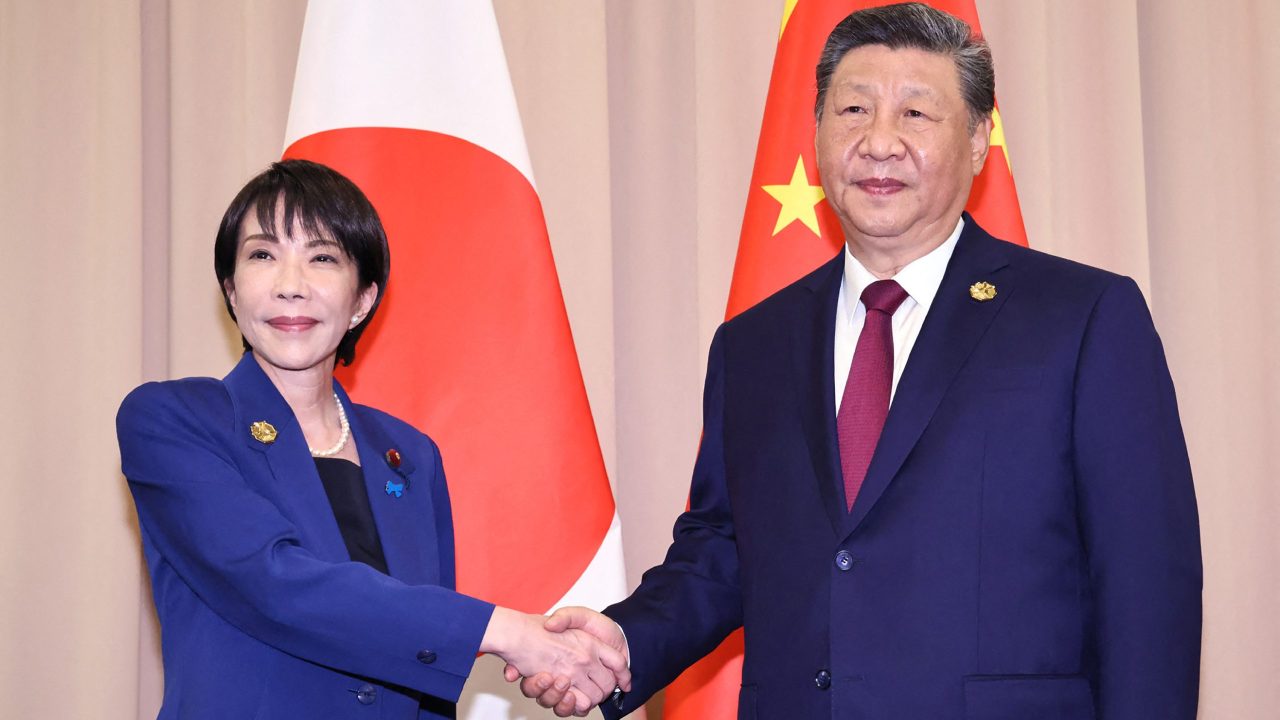
Sino-Japanese ties have nose-dived following Chinese overreactions to remarks made by new Japanese Prime Minister Sanae Takaichi about Taiwan.
Speaking in the Japanese parliament on November 7 in response to a question about a possible Taiwan Strait crisis, Takaichi said, referencing the potential for a Chinese attack on Taiwan: “If warships are used, accompanied by an act of force, I believe this would undoubtedly constitute a case that could become a survival-threatening situation.” The specific wording is highly significant, because under Japan’s restrictive constitution, its military can only be deployed abroad when Japan’s survival is threatened.
China is framing its response as if Japan had threatened to invade Chinese territory, which is what Beijing considers Taiwan to be. This brings the historic memories of World War II and Japanese atrocities and aggression in China into the picture. But this is obviously not what Takaichi meant or said. Her statement was clear that any Japanese action would be a response to Chinese aggression towards Taiwan.
Predictably, China has chosen to react harshly. The first shot was fired when the Chinese Consul General in Osaka, Xue Jian (薛劍), posted on X, “That filthy neck sticking in without permission must be cut off without a moment’s hesitation. Are you prepared for that?” — phrasing that evoked historical wartime rhetoric. That post was subsequently deleted.
What followed was a barrage and counter-barrage of calling in ambassadors for dressings down. Chinese media has been filled with bombastic articles making economic or military threats toward Japan, and Chinese officials and journalists have also been making similar personal posts on social media.
Some of this content has been outright misogynistic: Former Global Times editor Hu Xijin (胡錫進) called Takaichi an “evil witch.” Some of it has been bombastic: People’s Liberation Army Daily, the official newspaper of the Chinese People’s Liberation Army, said (in a translation by Sinocism) that “If Japan does not draw profound lessons from history and dares to take a reckless gamble, China will surely deal it a head-on blow. After all, once you start playing with fire, the way in which the flames spread is no longer something the fire-starter can control.”
Chinese foreign ministry spokesperson Lin Jian (林劍) shared this quote from the Potsdam declaration of 1945: “The terms of the Cairo Declaration shall be carried out and Japanese sovereignty shall be limited to the islands of Honshu, Hokkaido, Kyushu, Shikoku and such minor islands as we determine.” It is difficult to read this and not notice that Okinawa is absent from the text of Lin’s choice. Whether a threat is implicit is for the reader to decide, but this will play on Japanese fears that if Taiwan is annexed by China, the Senkakus, and Okinawa itself, would eventually follow.
Aside from rhetoric, China escalated to discouraging Chinese citizens from traveling to Japan, with the ministry of foreign affairs saying that the country was unsafe. Chinese airlines are now offering full refunds on flight tickets booked to Japan.
China’s Ministry of Education issued an “overseas study alert” specifically targeting Japan — the first such warning since disputes in 2012 over the Senkaku Islands, where Japan, China and Taiwan all contest sovereignty. The ministry urged Chinese students already in Japan or considering enrollment there to “carefully reconsider” their plans due to a “worsening security environment” and potential risks to personal safety.
On Sunday, the Chinese coast guard sailed a flotilla of vessels through the waters of the Senkaku Islands. Starting November 16 and running through to November 25, China is holding live-fire drills in the Yellow Sea, off the coast of northern Jiangsu province.
Takaichi, who met Taiwanese President Lai Ching-te (賴清德) in Taipei this year before becoming prime minister, has shown no indication that she will either apologize or withdraw the remark she made. However, she has also said that in the future she won’t make “explicit statements on specific scenarios.” Former Japanese leaders have implicitly criticized Takaichi, including her predecessor as prime minister, Shigeru Ishiba, who said “Previous governments refrained from narrowing it down to something as absolute as ‘in this particular case, it would be a Japan contingency.’”
The director general of the Japanese Foreign Ministry’s Asian and Oceanian Affairs Bureau, Kanai Masaaki, today met with Liu Jinsong (劉勁松), director general of the Asian Affairs Bureau of the Chinese Ministry of Foreign Affairs. The result of the meeting is unknown at the time of publishing.
The ugly diplomatic spat is unlikely to be over soon. William Yang (楊皓暐), Crisis Group’s senior analyst in North East Asia, said via email that the hardened trend in public opinion will limit both Beijing and Tokyo’s ability to find a path to de-escalate quickly. “On the one hand, Takaichi might feel like her remark has enough public support so there is no need for her to retract the statement, while Beijing has long been using heightening anti-Japanese sentiment as a method to rally public support.”
Takaichi’s remarks a Taiwan Strait crisis were meant to “placate the conservatives, who felt that the Ishiba administration, frankly, sold out Japan to Beijing,” said Stephen Nagy, a professor of politics and international studies at the International Christian University in Tokyo and a visiting fellow with the Japan Institute for International Affairs. He thinks that conservatives within the ruling Liberal Democratic Party were so dissatisfied with Japan-U.S. and Japan-China relations under Ishiba that they wanted to “fundamentally reset the relationship with the United States to be in a much more positive position.”
And does Takaichi wish she hadn’t mentioned Taiwan in the first place? Nagy doubts it: “I actually don’t think she regrets what she said. She’s trying to deal with the weaponization of the information space by Beijing to paint Japan as a militarist power, which it certainly isn’t.”




Leave a Reply