
When a delegation from Taiwan’s main opposition Chinese Nationalist Party (KMT) travels to Beijing this week, they will be received by a relatively unknown cadre of the Chinese Communist Party. Song Tao (宋濤), director of China’s Taiwan Affairs Office, isn’t Xi Jinping (習近平), with whom the KMT has been angling for a summit.
As far as Taiwan policy is concerned, he might as well be.
Prior to becoming Taiwan liaison in 2022, Song served as director of the party’s international department, a post that included high-profile trips to North Korea as Xi’s special envoy. But the most important break of his career came in 1985, when a young Xi was appointed vice mayor of Xiamen, a major coastal city in Fujian province, where Song had also been stationed.
Over the next 17 years, as Xi rose to become governor of Fujian, Song cultivated close ties with the future Chinese leader. Like his “Fujian Clique” peers, many of whom also occupy top roles in the Chinese government, it was the early relationship with Xi that helped fuel Song’s rise.
On Tuesday, Song will host a banquet for the KMT’s vice chairman Hsiao Hsu-tsen (蕭旭岑), who is leading a delegation that also includes the head of a KMT think tank, along with 40 scholars from Taiwanese research institutions. It is the first such summit since 2016, when China suspended direct engagement with Taiwan following the election of Tsai Ing-wen (蔡英文).
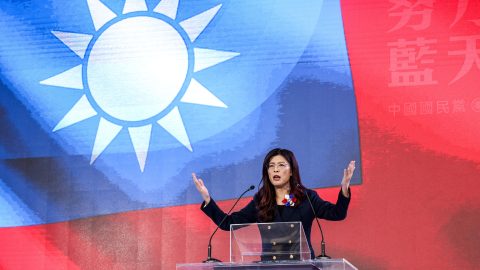
The KMT has described the forum as a technocratic dialogue aimed at strengthening ties in the tourism and green energy industries. But the trip is widely viewed as a potential precursor to a later summit between Xi and the KMT’s chairwoman, Cheng Li-wun (鄭麗文).
“[The CCP] will continue to observe the KMT’s domestic performance in Taiwan to determine whether there is the right timing for Xi to receive Cheng,” said William Yang (楊皓暐), Crisis Group’s Senior Analyst for North East Asia, in an email. “As of now, the Chinese side isn’t convinced by Cheng’s performance as the new KMT leader.”
Xi’s purge of the top ranks of the People’s Liberation Army has hollowed out the command structure that would direct a potential invasion of Taiwan. But Song is part of a diplomatic core that has stayed relatively intact.
China’s foreign minister, Wang Yi (王毅), has held that post, with the exception of a brief hiatus in 2023, since Xi took power in 2013. Wang Huning (王滬寧), the party’s chief ideologue and a longtime Xi confidant, has served on the CCP’s Central Committee since 2002. In 2023, Xi put the latter Wang in charge of the party’s Central Leading Group for Taiwan Affairs, an office that effectively outranks Song’s own.
“Given the grip the ‘big three’ (Xi, Wang Huning, and Wang Yi) will have on Taiwan affairs, we are unlikely to see a major departure from past TAO approaches to Taiwan under Song—who, as the junior partner on the Taiwan file, will merely play the role of executor,” wrote Taipei-based analyst J. Michael Cole shortly after Song was appointed head of the Taiwan Affairs office in 2022.
In addition to the banquet with Song, the KMT delegation will visit Tsinghua, China’s top university. They will tour its AI and carbon neutrality institute, before returning to Taiwan on Wednesday night.
Before leaving Taipei on Monday, Hsiao, the KMT vice chairman, told reporters at the airport that political subjects would not be discussed during the summit. Participants are experts and scholars in their professional fields, Hsiao said, adding that they will engage with Chinese counterparts on “tourism, precision machinery, healthcare, energy and disaster prevention.”
As for meeting with Chinese officials other than Song, Hsiao said he would follow the hosts’ arrangements. He added that KMT Chairwoman Cheng Li-wun (鄭麗文) has said “the mainland is our family,” noting that under the Republic of China Constitution the two sides are not defined as separate countries and, given shared history, culture, blood ties and emotions, “we should not be cutting ourselves off,” even though political differences remain unresolved.
The Republic of China is the name of the state commonly known today as Taiwan which before 1949 encompassed the whole of China.
Fan Shih-ping (范世平), a professor of East Asian studies at National Taiwan Normal University, said during a seminar in November that a summit between Cheng and Xi would mark a major achievement for Xi’s Taiwan policy. Song, he believes, is the most active among all the previous directors when it comes to intervening with Taiwanese domestic politics.
During his New Year’s message last month, Song said, “The mainland will create more favorable conditions for Taiwan enterprises and residents to study, work and live on the mainland.” He added that 2026, would be “a year of overcoming challenges and building momentum toward reunification.”



Leave a Reply