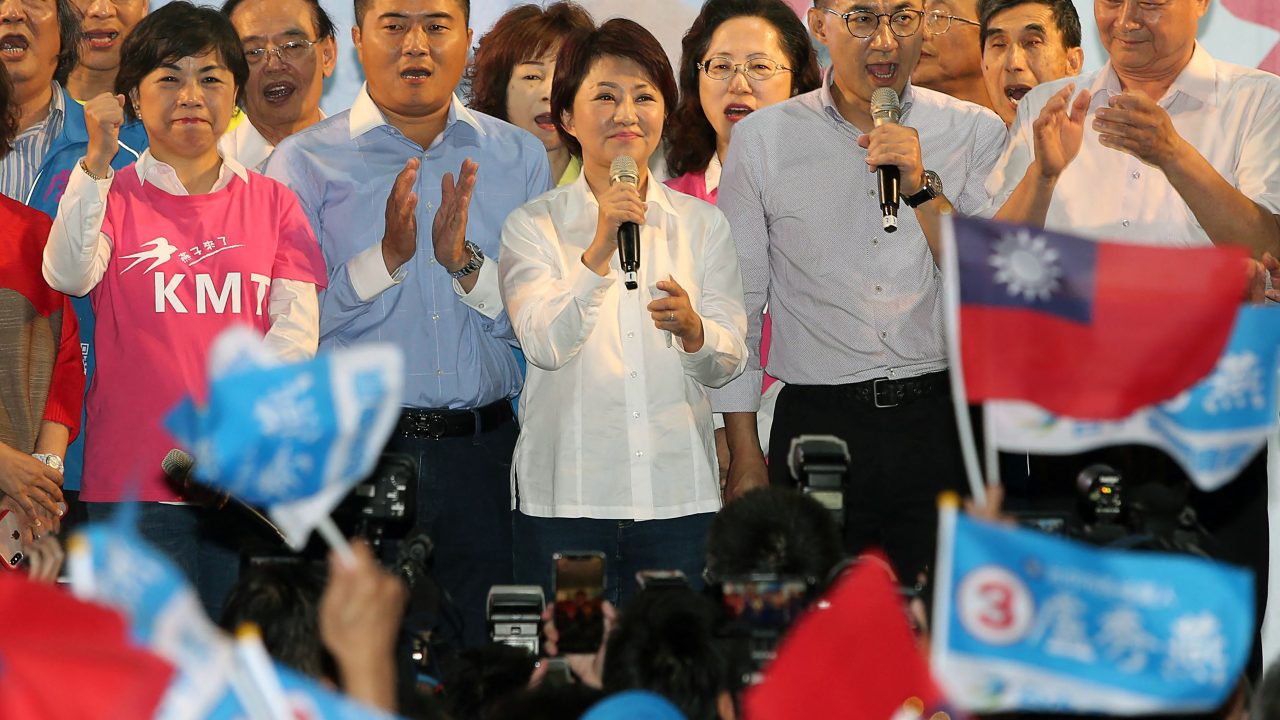
A leading figure in Taiwan’s main opposition party called on President Lai Ching-te (賴清德) to proactively pursue a phone call with Donald Trump, showing that the prospect of direct engagement with the U.S. president enjoys broad support in Taiwan.
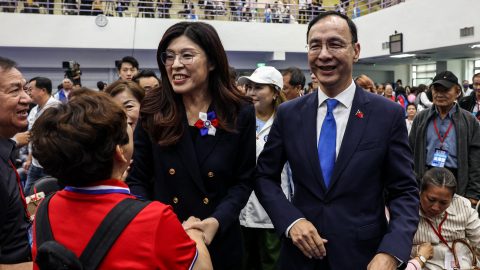
“Taiwan’s relationship with the United States is extremely important, so I would encourage the Lai government to proactively make contact with the American side,” said Taichung Mayor Lu Shiow-yen (盧秀燕) at a press conference on Monday morning. Lu is widely considered to be one of the opposition Chinese Nationalist Party’s (KMT) leading candidates in the 2028 presidential election.
Lu’s remarks came five days after Trump said he would speak with Lai, a move that would represent a break with U.S. diplomatic protocol. The American government is bound by law to provide Taiwan with the arms necessary to defend itself, but severed its formal diplomatic relations with the island nation in 1979. Since then, no sitting U.S. president has ever spoken to a Taiwanese leader.
Trump first floated the idea of speaking with Lai shortly after his summit with China’s president, Xi Jinping (習近平), in Beijing earlier this month. Trump emerged from the summit saying that he was willing to negotiate with Xi over the status of a $14 billion weapons package for Taiwan that has gone unapproved since January, a move that many analysts have called a win for Beijing.
By contrast, a call between Trump and Lai would likely anger the Chinese government, which angrily protests any implication that Taiwan is a sovereign country.
China’s Ministry of Foreign Affairs said Thursday that the United States should “handle the Taiwan issue with extreme caution and stop sending wrong signals to the separatist forces of Taiwan independence,” in a reference to Lai’s government.
Mayor Lu’s KMT, which tends to describe Lai in similar terms as Beijing, has at times recently appeared to drift away from its past emphasis on close relations with the United States and toward a much more friendly stance with Beijing.
In April, the party’s chairwoman, Cheng Li-wun (鄭麗文), became the first opposition leader in Taiwan to meet with Xi in more than a decade. During the recent legislative fight over Taiwan’s special defense budget, which saw the U.S. side increasingly critical of the KMT’s stalling tactics, the tone of Cheng’s deputies sometimes verged on hostile in response to pressure from their American counterparts.
Lu, who has led Taichung — a manufacturing powerhouse in the middle of Taiwan’s western coast — since 2018, has taken a more moderate approach, hoping to maintain a positive relationship with the U.S. even while she shares her party’s broader skepticism of the rapid increases in defense spending backed by the Trump administration.
In April, Lu made an 11-day tour of the U.S., a trip that included stops in Seattle and Boston, as well as meetings with congressional officials and think tank experts in Washington. Following the trip, Lu said that Taichung would continue to expand its global presence.
The Lai administration “needs to go from passive to active in communicating to Washington the situation in Taiwan,” Lu said in her remarks on Monday.
Since Trump’s remarks about speaking with Lai last week, there has been no public indication of plans to make the call a reality, though Taiwan’s government has said that it would welcome the conversation.
The last time Trump spoke to a Taiwanese president came in December 2016, when he had just been elected to the presidency for the first time, and Lai’s predecessor, Tsai Ing-wen (蔡英文), was leading Taiwan. That call, which lasted 10 minutes and focused on economic and security issues in the Asia-Pacific, was reportedly arranged by a cohort of pro-Taiwan advisors who are not a part of Trump’s second administration.
“The President of Taiwan CALLED ME today to wish me congratulations on winning the Presidency. Thank you!” Trump wrote on Twitter at the time.
Trump faced swift backlash for the call, which some saw as the mistake of a political novice. Less than an hour later, he took to Twitter again to explain himself, describing the same logic that may be motivating his current desire to speak with Lai.
“Interesting how the U.S. sells Taiwan billions of dollars of military equipment but I should not accept a congratulatory call,” Trump wrote.
Leave a Reply