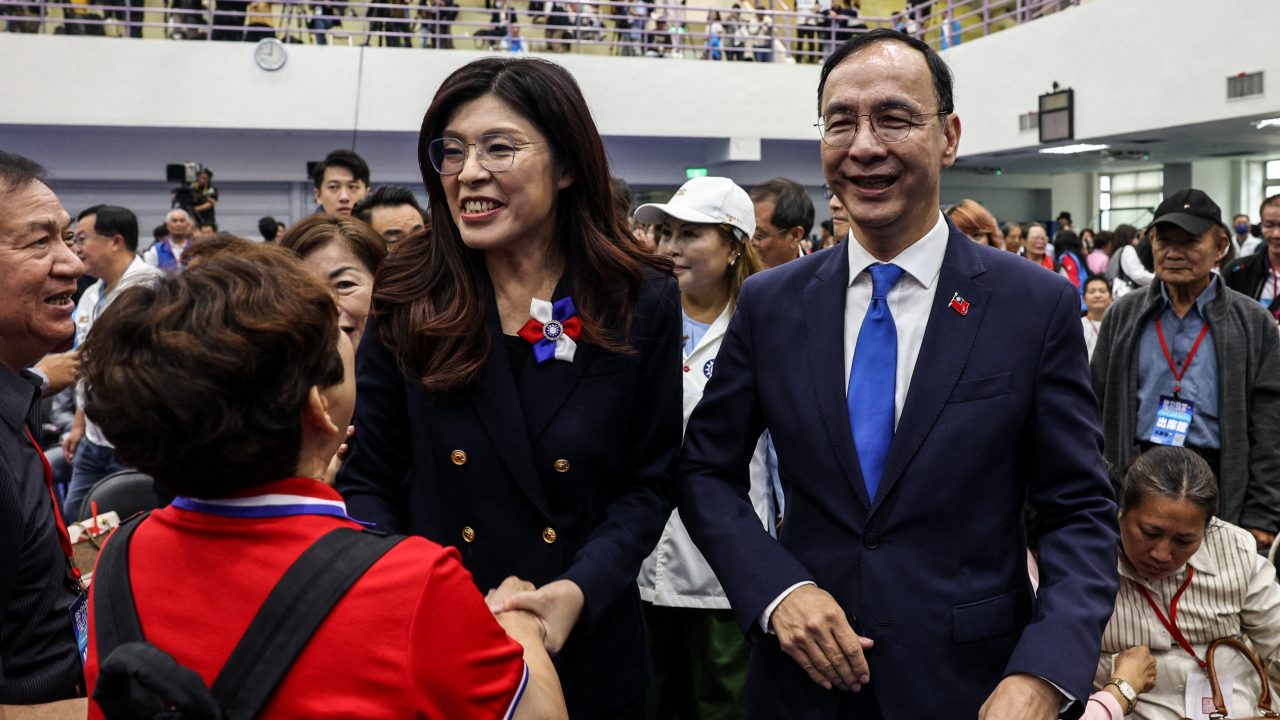
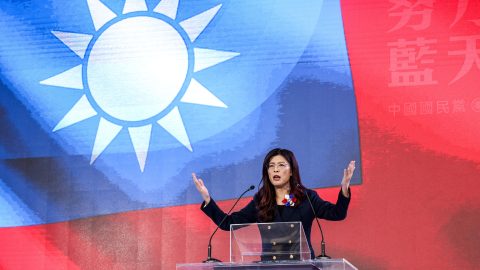
Five months after vowing to turn her political party from a “herd of sheep to a pride of lions” to make it Taiwan’s top political force, Chinese Nationalist Party (KMT) Chairwoman Cheng Li-wun (鄭麗文) faces mounting internal strife that tests her combative leadership.
After the 56-year-old Cheng took up the mantle from her predecessor, Eric Chu (朱立倫), her victory injected immediate optimism into the KMT base, which has been made weary by the ruling Democratic Progressive Party’s (DPP) decade-long dominance.
Cheng’s fiery rhetoric as chairwoman has included statements like “I am Chinese” and that Taiwan is in the “worst of times” under DPP rule. However, her popularity is now being tested in comparison to Chu’s more moderate approach.
For the KMT, much has changed since Chu’s era. In terms of leadership style, Cheng’s edge lies in mobilizing frustrated members, per observers, while Chu stabilized finances, which is vital as KMT eyes the presidency. Cheng’s pro-Beijing approach, often praised in Chinese and by pro-China media, could alienate the moderate support that Chu had worked to gain.
“She is quite charismatic in person. She’s a good speaker. She speaks at length without notes, and she can really kind of rally a crowd,” said Kharis Templeman, a research fellow at Stanford University’s Hoover Institution.
But intra-party competition, Cheng’s pro-China posture and the controversy surrounding her claim that “Putin is not a dictator” have drawn unfavorable comparisons to Chu’s more moderate tenure. Chu started rebuilding the party in 2020, securing the 2022 local elections with landslide victory and a 2024 legislative edge via pacts with the Taiwan People’s Party (TPP).
“I would probably describe her leadership as ‘strong outside, hollow inside’ (外強中乾) … the party on the outside looks very fierce, but I see that internally it is relatively weak,” said Chan Wei-yuan (詹為元), a Taipei City councilor representing the KMT.
“Eric Chu has held elected office for much of his life … he’s pretty good at the insider game, at managing the party’s factions, keeping key people on message and handling disagreements in-house. Cheng Li-wun had no experience doing that, really, until she became party chairwoman,” said Templeman.
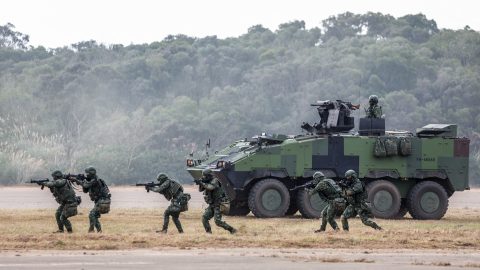
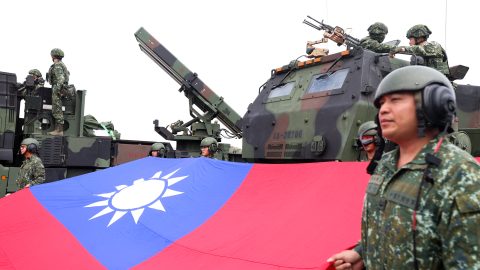
The KMT, holding a legislative majority in Taiwan’s legislature with its small ally, the TPP, repeatedly refused to consider President Lai Ching-te’s (賴清德) 1.25 trillion New Taiwan dollar (roughly $40 billion) special defence budget. When he was party chairman, Chu chose to support a 3.5% GDP defense hike to reassure U.S. allies. Cheng went from opposing any additional defense spending to now supporting her party’s more modest NTD 380 billion proposal.
Internal competition within the KMT is forcing Cheng to balance pro-Beijing rhetoric and coalition-building with the TPP with preparation for the upcoming 2026 local elections.
“With the KMT, there seems to be an internal competition between Cheng and the Taichung mayor [Lu Shiow-yen (盧秀燕)], who’s visiting the U.S. at the moment,” said Niu Tse-hsun (鈕則勳), a marketing professor at Chinese Culture University who frequently offers commentary on Taiwanese political programs. Lu is rumored to be gearing up for the presidential election in 2028.
“The KMT is like a boiling tea pot right now, anything could trigger the anger inside to overflow,” Niu added.
The result is a party that “is going to struggle to coalesce around one candidate in each of the mayor’s races in November … I don’t see much sign that she’s working on that problem,” Templeman observed.
This lack of internal cohesion forms the heart of the “boiling teapot” Niu described, a situation where the party’s energy is being consumed internally rather than focused outward.
Under Cheng’s leadership, China is the KMT’s top priority, while the U.S. is secondary. As Cheng eyes a summit with Chinese leader Xi Jinping (習近平), her party has had a few run-ins with Washington.
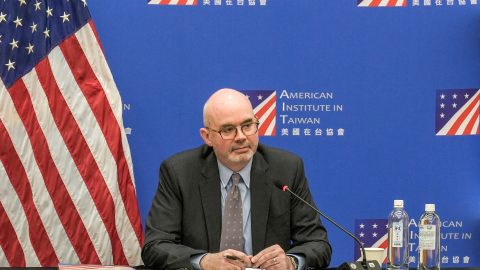
One notable example is the party vice chairman’s comments about the U.S. representative in Taiwan, Raymond Greene, who has publicly urged Taiwan’s political parties to work together to pass Lai’s special defense budget. The vice chairman called Greene’s position “only slightly higher than … a section chief.”
“The KMT right now has a serious Washington problem, and there are a significant number of people in Congress and in the administration who think the KMT is either Beijing’s agent or their puppet or somehow influenced by the PRC and doing their bidding in Taiwan politics,” said Templeman, using the acronym for the People’s Republic of China.
“There’s a contest between pro-China and pro-U.S. mindsets within the party,” Chan, the Taipei city councilor, said.
On the other hand, KMT Legislator Lo Ting-wei (羅廷瑋) said he views this “division of labor” as a deliberate effort to project a more balanced image, emphasizing that the party is focused on “maintaining communication with the entire international community.”
Niu, the political commentator, interpreted the situation as a “competition between Cheng and Lu … But I would also interpret it as ‘pro-China,’ while maintaining a harmonious atmosphere with the U.S.”
Taiwan’s local elections, also known as the nine-in-one election, are held every four years, typically in November, to elect officials such as mayors, magistrates and village heads.
This election is seen as the first and biggest test for Cheng’s leadership style and her party’s strength.
“This ‘storm in a teapot’ situation will explode if Chairwoman Cheng takes one step wrong,” said Chan. “[If] the party suffers a certain defeat [in the local elections], the opposing voice probably will erupt.”


Leave a Reply